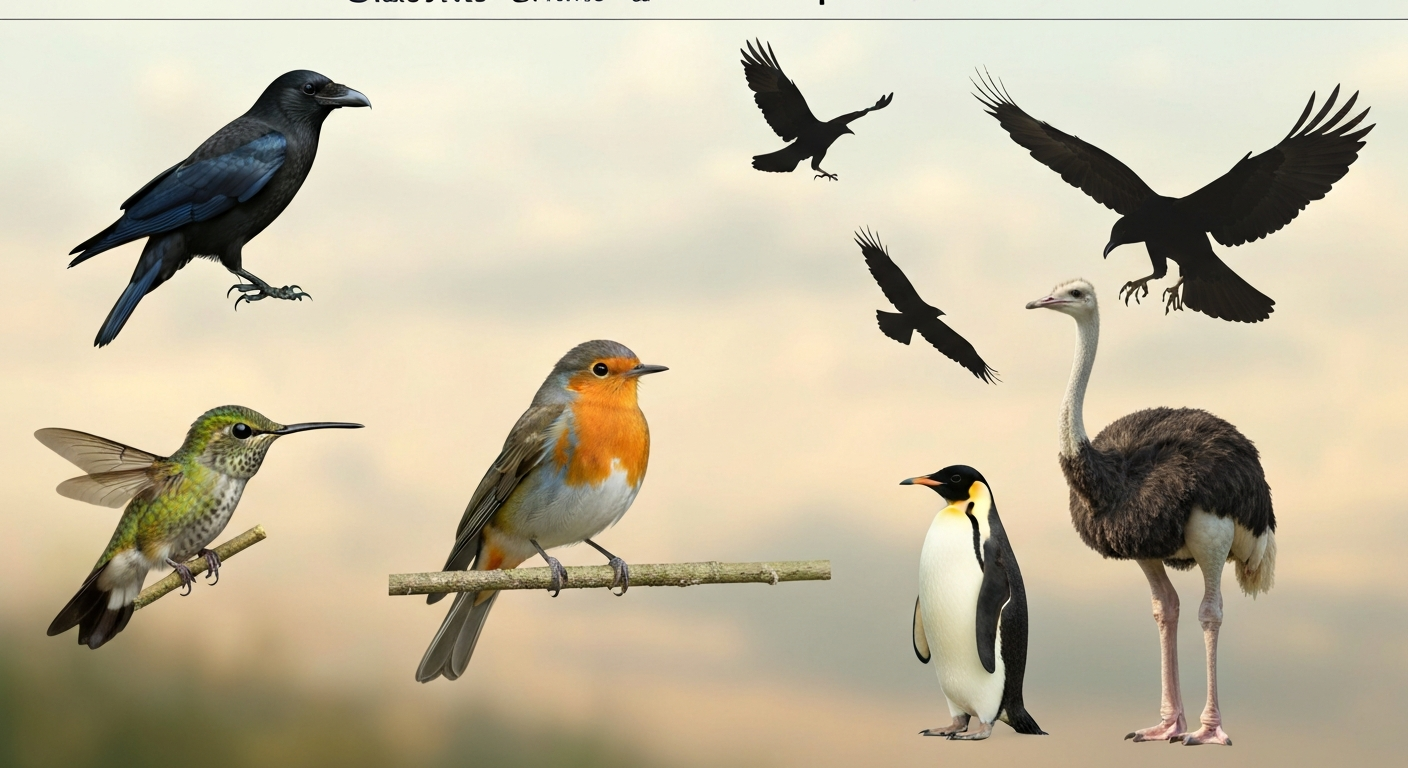
Yes, birds are animals. Every single one of them, from a hummingbird to an ostrich, belongs to Kingdom Animalia and sits inside the class Aves. If you landed here because someone on the internet claimed birds are not animals, or because you are editing a wiki entry and want a citable answer, the science is unambiguous: birds are vertebrate animals in the same broad kingdom as dogs, frogs, sharks, and humans.
Is a Bird an Animal? Wiki Guide to Birds, Taxonomy, ID

Marcus Hendricks
5 Aug 2026
What exactly is a bird? Definition and classification
A bird is a warm-blooded, feathered vertebrate belonging to the class Aves. The Integrated Taxonomic Information System (ITIS) and the NCBI Taxonomy Browser (Taxonomy ID 8782) both list Aves as a valid class within Phylum Chordata under Kingdom Animalia. NCBI Taxonomy Browser, Aves (Taxonomy ID 8782) confirms Aves as a valid class within Kingdom Animalia blank" rel="noopener noreferrer">NCBI Taxonomy Browser — Aves. Authoritative taxonomic databases such as GBIF, Aves (taxon page), the IOC World Bird List, and the eBird/Clements Checklist provide up-to-date species lists and accepted nomenclature for Aves blank" rel="noopener noreferrer">GBIF — Aves (taxon page). That placement has not changed and is not contested. In plain language: being an animal means being a multicellular, eukaryotic organism that cannot make its own food from sunlight and that moves under its own power at some point in its life. Birds tick every one of those boxes.
The full hierarchy looks like this: Domain Eukaryota, Kingdom Animalia, Phylum Chordata, Subphylum Vertebrata, Class Aves. Everything below Class Aves (orders, families, genera, species) is where individual bird groups and species get sorted. There are roughly 10,000 to 11,000 recognized living bird species currently listed on authoritative checklists like the IOC World Bird List and the eBird/Clements Checklist maintained by the Cornell Lab of Ornithology.
Taxonomy made simple: from kingdom down to species
Taxonomy is just a nested filing system for life. Think of it as a set of Russian dolls: the outermost doll is the broadest group, and each smaller doll inside is more specific. The standard ranks used for birds go from broadest to narrowest: Kingdom, Phylum, Class, Order, Family, Genus, Species. 'Bird' maps to the Class level, which is why it is neither a species nor a genus.
| Rank | What it covers | Bird example |
|---|---|---|
| Kingdom | All animals | Animalia |
| Phylum | Animals with a backbone (vertebrates) | Chordata |
| Class | All birds — the word 'bird' lives here | Aves |
| Order | A major group of related birds | Passeriformes (perching birds) |
| Family | A cluster of closely related genera | Corvidae (crows, jays, ravens) |
| Genus | A tighter group sharing a common ancestor | Corvus |
| Species | One specific kind of bird | Corvus corax (common raven) |
This matters because people often ask whether 'bird' is a species or a genus. It is neither. Calling something a 'bird' is like calling something a 'mammal', it tells you the class, not the species. A related question that comes up is whether individual birds count as species or how 'bird' sits in the genus framework, which is worth exploring in more depth if you are editing taxonomy articles.
The defining characteristics of birds, a checklist
Modern ornithology identifies a core set of features that define birds as a group. You do not need all of them present to the same degree in every species (penguins have wings but cannot fly, for instance), but together these traits are what separate Aves from every other class of vertebrate.
- Feathers: the single most diagnostic feature. Feathers are an avian synapomorphy — a trait unique to birds and their closest extinct relatives. No living animal outside Aves has true feathers. They serve insulation, flight, waterproofing, and visual signaling. (Prum & Brush, 2002, Quarterly Review of Biology)
- Toothless keratin beak: modern birds have no teeth. Their jaws are covered with keratin — the same protein in your fingernails — forming a beak or bill whose shape reflects what the bird eats.
- Egg-laying (oviparous reproduction): all birds lay hard-shelled amniote eggs. This is shared with some reptiles but combined with feathers and a beak it is diagnostic.
- Endothermy (warm-blooded): birds generate their own body heat metabolically, maintaining a high, stable internal temperature regardless of their environment.
- Four-chambered heart: birds share the fully divided four-chambered heart with mammals, enabling efficient separation of oxygenated and deoxygenated blood — essential for high-energy flight.
- Modified forelimbs as wings: in most birds, the forelimbs have been evolutionarily reshaped into wings. Even in flightless birds like ostriches, the forelimbs are structurally wing-like.
- Lightweight skeleton with pneumatic bones: many bones in a bird's skeleton are hollow and connected to the respiratory system, reducing weight. The furcula (wishbone) — a fused clavicle — is another uniquely avian skeletal feature.
- Lung-air sac respiratory system: birds breathe with a flow-through system of rigid lungs plus multiple air sacs, producing largely unidirectional airflow. This is more efficient than the tidal breathing of mammals and supports the high oxygen demands of flight.
Myth-busting: 'If an animal has wings, it must be a bird'
Wings are not a bird-exclusive feature. This is one of the most persistent misconceptions in everyday biology, and it trips up a lot of people. Wings evolved independently multiple times across the animal kingdom, that process is called convergent evolution. Having wings tells you an animal can (or could) fly; it tells you nothing definitive about which class that animal belongs to. For a focused discussion on why wings alone do not identify a bird, see the related page if an animal has wings then it is a bird.
| Animal | Has wings? | Is it a bird? | Why not |
|---|---|---|---|
| Bat | Yes (membranous wings) | No | Bats are mammals (Class Mammalia). They have fur, give birth to live young, and nurse with milk. |
| Butterfly / Bee (insect) | Yes (chitinous wings) | No | Insects belong to Phylum Arthropoda, Class Insecta. Six legs, three body segments, exoskeleton. |
| Pterosaur (extinct) | Yes (membranous wings) | No | Pterosaurs were flying reptiles, not birds. They lacked feathers and were a separate lineage of archosaurs. |
| Flying fish | No true wings — enlarged pectoral fins | No | Flying fish are ray-finned fish (Class Actinopterygii). Their 'wings' are fins used for gliding, not powered flight. |
| Flying squirrel | No true wings — skin membrane (patagium) | No | A mammal that glides. No feathers, no beak, warm-blooded but nurses young with milk. |
The reliable way to confirm a bird is not to look for wings but to look for feathers. No other living group has them. A bat found at night might be mistaken for a bird in silhouette, but get close and you will find fur, no beak, and leathery wings made of stretched skin membrane rather than feather-covered forelimbs. The wings question comes up so often it deserves its own careful treatment, the idea that wings automatically equal bird collapses quickly once you line up the counterexamples.
Flightless and unusual birds, what diversity looks like in Aves
People sometimes question whether penguins or ostriches are 'really' birds because they do not fit the mental image of a small, flying creature at a feeder. They are absolutely birds. Class Aves contains enormous variation in size, lifestyle, and ability. What unites them is not flight but the shared set of characteristics listed above.
- Ostrich (Struthio camelus): the world's largest living bird, standing up to 2.8 m tall and weighing up to 156 kg. Flightless, but has feathers, a beak, lays the largest eggs of any living bird, and is warm-blooded.
- Penguin (family Spheniscidae): flightless but supremely adapted for swimming. Their wings evolved into flippers. They still have feathers — densely packed and waterproof — and they lay eggs.
- Kiwi (genus Apteryx): a small, nocturnal, flightless bird from New Zealand with hair-like feathers and vestigial wings so small they are hidden under its plumage. It lays the largest egg relative to body size of any bird.
- Kakapo (Strigops habroptilus): a critically endangered, flightless, nocturnal parrot from New Zealand. Fully a bird, fully unable to fly.
- Cassowary (genus Casuarius): a large, dangerous, flightless bird from Australia and New Guinea with a distinctive bony casque on its head. Despite its dinosaurian appearance, it is unambiguously a bird.
The diversity of birds also connects to their evolutionary origins. Birds descended from theropod (maniraptoran) dinosaurs, a relationship confirmed by decades of fossil evidence, including feathered dinosaur specimens and transitional fossils like Archaeopteryx. So in a very literal sense, birds are living dinosaurs. That is not a metaphor; it is the current scientific consensus in paleontology.
Wild birds, pet birds and what 'wild animal' actually means
Whether a bird lives in a rainforest canopy or in a cage in your living room does not change its biological classification. A budgerigar (Melopsittacus undulatus) is still a bird, still an animal, and still a member of Aves regardless of how domesticated or hand-reared it is. The distinction between wild and domestic matters enormously for how you interact with a bird, but it is a behavioral and legal category, not a taxonomic one. If you’re wondering whether a bird is a wild animal, see is bird a wild animal for a short explanation of wild, feral, and domestic status and how those categories differ from biological classification.
A wild bird is one living free of deliberate human management, finding its own food and raising its own young. A feral bird is a domesticated or captive-bred species that has returned to living wild (feral pigeons in cities are a classic example, they descend from domesticated rock pigeons, Columba livia). A pet or captive bird is one kept by humans under controlled conditions. In terms of biology and taxonomy, all three categories are identical: they are animals, they are birds, and they belong to Class Aves.
Practically speaking, if you find an injured wild bird, most countries require you to contact a licensed wildlife rehabilitator rather than keeping it yourself. Wild birds are protected under legislation like the Migratory Bird Treaty Act in the United States. Pet birds, by contrast, are often subject to trade and welfare regulations specific to captive animals. Understanding that a bird is a wild animal at its biological core helps explain why these legal protections exist.
Birbs, mascots and mythical creatures: when language and biology diverge
Not everything called a bird in culture, slang, or branding is a real animal. It is worth distinguishing internet slang, fictional birds, and brand mascots from the biological category, especially when editing wiki-style reference content.
- 'Birb': internet slang, originating in meme culture around 2010-2016, used affectionately for any small, round, cute-looking bird (especially parrots and sparrows). A birb is still a bird — it is just a bird being described in an endearing, informal way. The word has no taxonomic meaning.
- Mockingjay (The Hunger Games): a fictional hybrid bird from Suzanne Collins's series. Not real. Not a bird in the biological sense. Useful for settling online debates about whether it belongs in a bird taxonomy article (it does not).
- Tweety Bird (Looney Tunes): a cartoon canary. Real canaries (Serinus canaria) are birds; Tweety is an animated character.
- Larry the Bird (Twitter/X logo): a stylized bird image used as a brand icon. Not an animal, not a species. Reportedly inspired by a basketball player, not a specific bird species.
- Phoenix, Thunderbird, Garuda: mythological birds from various cultures. Culturally significant, biologically nonexistent.
- Emu War memes: the emu (Dromaius novaehollandiae) is a very real, very large flightless bird native to Australia. The 'Emu War' of 1932 was a real Australian government culling operation. The emu is definitely an animal and definitely a bird.
Biology does not care about branding or narrative. When a wiki article or reference entry asks whether a bird is an animal, it is asking about Class Aves, not about Angry Birds, the Aflac duck, or a phoenix tattoo. For the internet slang and cultural use of the term 'birb', see the related entry when is a bird a birb. The answer in all biological cases remains the same: if it has feathers, a keratin beak, lays hard-shelled eggs, and is endothermic with a four-chambered heart, it is a bird and therefore an animal.
Practical bird identification guide
If you are looking at an animal and asking whether it is a bird, work through these questions in order. You will usually reach a confident answer within the first two or three steps.
- Does it have feathers? If yes, it is almost certainly a bird. No other living animal has feathers. Stop here for 99% of cases.
- Does it have a toothless keratin beak? Confirm this alongside feathers. A beak without feathers (like a turtle) does not make it a bird.
- Does it lay hard-shelled eggs? This is useful as a secondary check, though some non-birds (reptiles) also lay hard-shelled eggs.
- Are its forelimbs modified as wings (or wing-like structures), even if it cannot fly? Penguins have flippers; ostriches have small vestigial wings. Both are birds.
- Is it warm-blooded with a high metabolic rate? Cold-blooded? Likely a reptile, amphibian, or fish.
- If still unsure: look up the species on GBIF, ITIS, or the IOC World Bird List. If it appears under Class Aves, it is a bird.
Quick decision table for common confusions
| Animal | Feathers? | Beak? | Lays hard-shelled eggs? | Class | Is it a bird? |
|---|---|---|---|---|---|
| Robin | Yes | Yes | Yes | Aves | Yes |
| Bat | No (has fur) | No (has teeth and jaw) | No (live birth) | Mammalia | No |
| Butterfly | No (has scales/chitin) | No (has proboscis) | No (soft eggs) | Insecta | No |
| Crocodile | No (has scales) | No (has toothed jaws) | Yes (soft-shelled) | Reptilia | No |
| Penguin | Yes | Yes | Yes | Aves | Yes |
| Pterosaur (fossil) | Possibly some filaments, not true feathers | Yes (toothed in most) | Likely soft-shelled | Reptilia (extinct) | No |
| Platypus | No (has fur) | Has a soft bill, not keratin beak | Yes (leathery) | Mammalia | No |
| Ostrich | Yes | Yes | Yes | Aves | Yes |
Suggested images and what to show
For a wiki-style article on this topic, images serve a specific purpose: they help readers anchor abstract classification concepts to things they can visually recognize. Here are the most useful image types and what each should illustrate.
- Feather close-up (macro photo): shows the interlocking barb and barbule structure that makes feathers unique. Caption suggestion: 'A contour feather showing the central rachis, barbs, and interlocking barbules — a structure found only in birds.'
- Taxonomic hierarchy diagram: a simple nested graphic showing Domain > Kingdom > Phylum > Class > Order > Family > Genus > Species, with a common bird (e.g., a robin or sparrow) as the example. Caption: 'Where birds sit in the tree of life: Class Aves under Kingdom Animalia.'
- Flightless bird comparison: side-by-side of an ostrich, penguin, and kiwi. Caption: 'Three flightless birds — all members of Class Aves — showing how diverse birds can be in size and lifestyle.'
- Bat vs. bird wing comparison: anatomical diagram showing a bird wing (feathers, fused digits) next to a bat wing (membrane stretched between elongated fingers). Caption: 'Bird wing (left) vs. bat wing (right): both enable flight, but the structures are entirely different.'
- Archaeopteryx fossil photo: the famous Berlin specimen or cast. Caption: 'Archaeopteryx lithographica, a Jurassic transitional fossil showing both dinosaurian teeth and avian feathers.'
- Keratin beak close-up (e.g., a toucan or puffin): to illustrate the toothless beak trait. Caption: 'A bird's beak is covered in keratin and contains no teeth — one of the defining features of modern Aves.'
For wiki editors: internal links and sources to cite
If you are building or improving a wiki entry based on this content, here are the internal link topics that naturally branch from this article, along with the strongest authoritative sources to use as citations. See the internal page Is bird a species for a focused explanation of why 'bird' names a class rather than a species.
Related pages worth linking within the same classification topic cluster include articles on whether bird is a species (since 'bird' is a class, not a species), how bird fits into genus-level classification, what the defining characteristics of a bird are and why those traits matter, and whether all winged animals count as birds. Coverage of wild bird status versus captive or domestic birds is also a natural extension that adds practical value for readers.
- ITIS Report: Aves — authoritative North American taxonomic listing confirming Class Aves under Kingdom Animalia.
- NCBI Taxonomy Browser, Aves (Taxonomy ID: 8782) — genomic/molecular taxonomy database confirming classification.
- GBIF Taxon Page: Aves — global biodiversity database listing all accepted bird species.
- IOC World Bird List — the most widely used checklist for current bird species names and counts.
- Encyclopaedia Britannica, 'Bird' entry — accessible, peer-reviewed summary of avian characteristics.
- Cornell Lab of Ornithology, Handbook of Bird Biology — comprehensive reference for endothermy, circulatory system, and behavior.
- Cornell Lab of Ornithology, 'All About Feathers' (Bird Academy) — plain-language reference for feather structure and function.
- Prum & Brush (2002), 'The evolutionary origin and diversification of feathers,' Quarterly Review of Biology — primary literature on feathers as a synapomorphy.
- Norell & Xu (2005), 'Feathered dinosaurs,' Annual Review of Earth and Planetary Sciences — bird evolutionary origins.
- Natural History Museum London, Archaeopteryx (Dino Directory) — accessible fossil reference.
- Maina (2006), 'Development, structure, and function of the lung-air sac system of birds,' Biological Reviews — respiratory system reference.
- Gutherz & O'Connor (2022), 'Postcranial skeletal pneumaticity in neoavians,' Journal of Anatomy — skeletal pneumaticity detail.
The bottom line: birds are animals, full stop
Birds are animals. They belong to Kingdom Animalia and Class Aves. That is the answer for your wiki edit, your online debate, your homework, and your pub quiz. For a deeper explanation, see the article why is a bird a bird. The word 'bird' describes a class of vertebrates, not a species or a genus, which means roughly 10,000 to 11,000 individual species, from the bee hummingbird at 5 cm long to the ostrich at nearly 3 m tall, all qualify. The defining evidence is feathers: no other living animal has them, which makes spotting a bird considerably easier than most classification questions in biology.
Wings do not make a bird, flight does not make a bird, and cute internet slang does not make a bird. What makes a bird is the full biological package: feathers, a toothless keratin beak, hard-shelled eggs, endothermy, a four-chambered heart, modified forelimbs, and a unique lung-air sac respiratory system. If you remember only one fact from this article, make it this: feathers are the single trait exclusive to birds among all living animals, and they have been a defining feature of the lineage since at least the Jurassic period.
FAQ
Is a bird an animal?
Yes. Birds are animals: they belong to Kingdom Animalia and are classified as Class Aves (commonly called 'birds'). Authoritative taxonomies list Aves under Animalia (e.g., ITIS, NCBI Taxonomy).
What is a bird (plain-language definition)?
A bird is a warm‑blooded vertebrate in Class Aves characterized by feathers, a toothless keratin beak, laying hard‑shelled amniote eggs, a high metabolic rate, forelimbs typically modified as wings, and distinctive respiratory and skeletal adaptations. (See Encyclopaedia Britannica; Cornell Lab of Ornithology.)
How does bird classification fit into taxonomic ranks?
Taxonomy is hierarchical. A typical bird hierarchy: Domain Eukaryota → Kingdom Animalia → Phylum Chordata → Subphylum Vertebrata → Class Aves → Order → Family → Genus → Species. 'Bird' = class Aves, not a single species or genus. (See ITIS/NCBI.)
What checklist of traits reliably identifies a bird?
Key avian traits (useful checklist): feathers (unique synapomorphy), toothless keratin beak, hard‑shelled eggs, endothermy (warm‑blooded) and four‑chambered heart, forelimbs adapted as wings (in most), lightweight/pneumatic bones and furcula (wishbone), and a lung–air‑sac respiratory system. Not every trait appears in every species (e.g., flightlessness), but feathers are diagnostic. (See Prum & Brush; Handbook of Bird Biology.)
If an animal has wings, is it a bird?
No. Wings occur in other lineages. Counterexamples: bats (mammals, powered by skin membranes), insects (arthropods, chitinous exoskeleton), pterosaurs (extinct flying reptiles), and 'flying' fish (glide using enlarged fins). Distinguishing traits: presence of feathers and other avian anatomy (beak, eggs, air‑sac lungs) indicate a bird, not merely wings.
What about flightless birds like penguins or ostriches — are they still birds?
Yes. Flightlessness does not remove a species from Class Aves. Penguins, ostriches, emus, kiwis, and others are birds because they have avian features (feathers, beaks, eggs, skeletal/respiratory traits). Flight ability is variable across Aves.