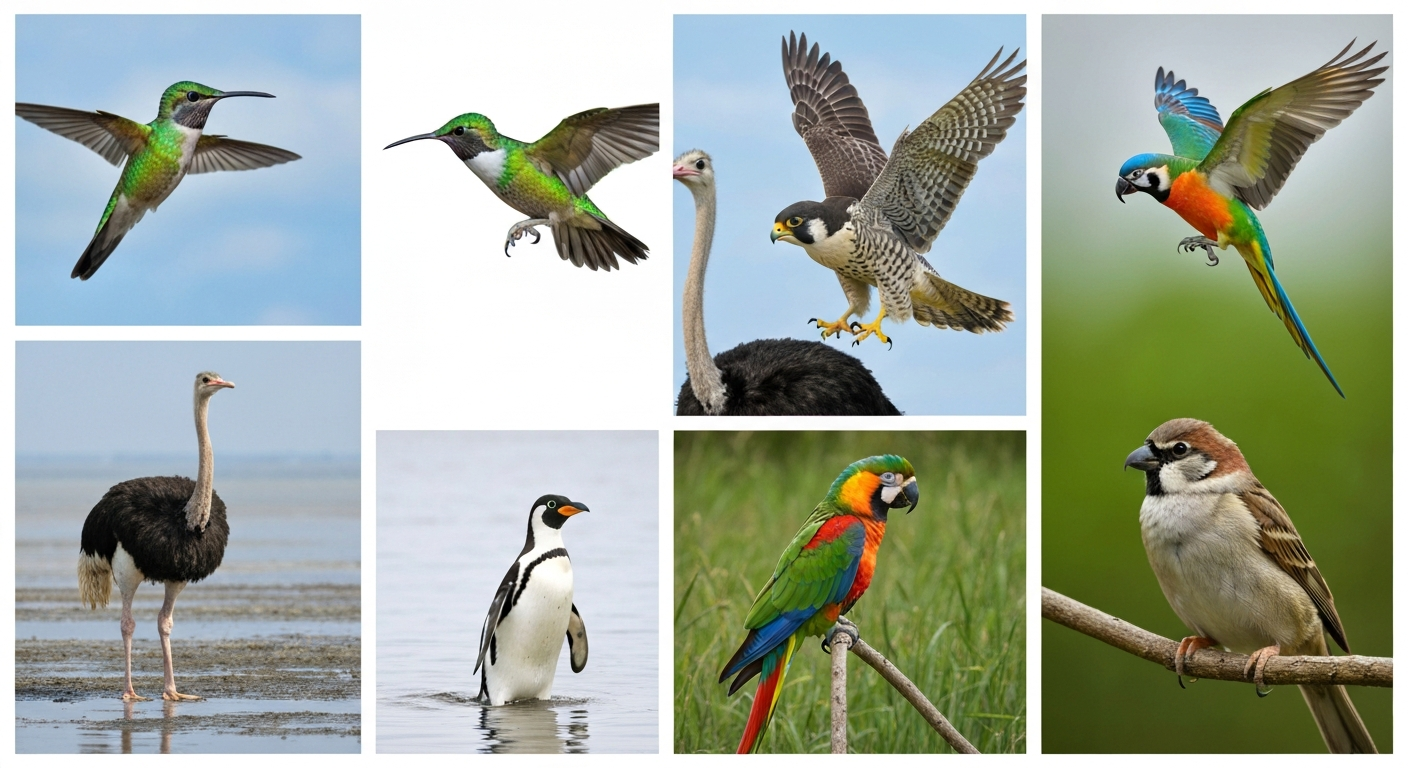
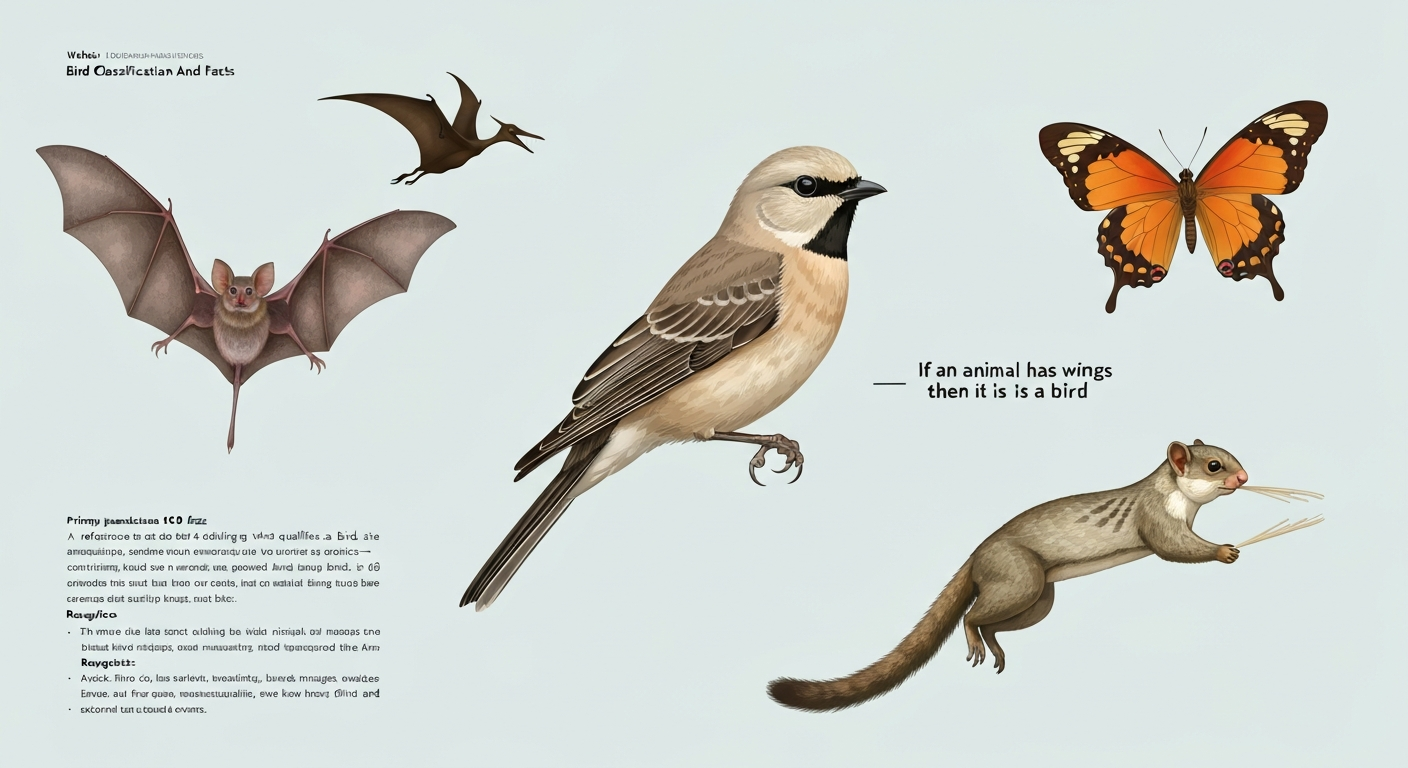
Having wings does not make an animal a bird. Bats have wings. Butterflies have wings. Pterosaurs had wings. None of them are birds. The statement 'if an animal has wings, then it is a bird' is a classic logical error called affirming the consequent, and biology makes short work of it: wings evolved independently at least four separate times across the animal kingdom, so the presence of a wing tells you an animal can (or could) fly, not which class it belongs to.
If an Animal Has Wings Then It Is a Bird? Quick Guide

Marcus Hendricks
25 Jul 2026
What actually makes something a bird?
Birds belong to Class Aves, a group of feathered, warm-blooded vertebrates that descended from theropod dinosaurs. See the wiki entry 'Is a bird an animal? See the wiki entry 'Is a bird classed as an animal' for more. See the article 'Is bird a wild animal' for discussion of whether birds are classified as wild animals. ' for a concise, plain-language overview of how birds fit into the animal kingdom Is a bird an animal? (wiki). No single trait defines them, but there is one that comes close: feathers. Every living bird has feathers, and no other living animal does. Beyond feathers, ornithologists and comparative anatomists look at a whole suite of traits to place an animal in Aves. For a concise explainer on the question 'why is a bird a bird', see the article why is a bird a bird.
- Feathers: complex, branched integumentary structures covering the body, unique among living animals to birds
- Forelimbs modified as wings: even in flightless species like ostriches and penguins, the arm bones are modified into a wing structure
- Toothless beak: all living birds lack teeth (some extinct avian ancestors had teeth, but no modern bird does)
- Hard-shelled, amniotic eggs laid externally
- Endothermy: birds are warm-blooded and maintain a constant body temperature
- Four-chambered heart: fully separating oxygenated and deoxygenated blood
- Lightweight, often pneumatic (air-filled) skeleton, including a fused wishbone (furcula) and fused tail vertebrae (pygostyle)
- A distinctive respiratory system: rigid lungs ventilated by multiple air sacs in a largely unidirectional airflow, making avian breathing highly efficient
Taxonomists diagnose birds using combinations of these traits, not any single one in isolation. Many skeletal characters appear independently in unrelated lineages (a phenomenon called homoplasy), so reliable classification requires looking at multiple anatomical features together, ideally combined with molecular and fossil evidence. The carpometacarpus (fused hand bones), keeled sternum in most fliers, and pneumatized bones connected to air sacs are among the most useful structural markers. Ornithologists routinely score combinations of characters, such as furcula, pygostyle, carpometacarpus, a keeled sternum, pneumatized bones, and specialized pectoral and forelimb morphology, in anatomical matrices used to diagnose and analyze crown birds (Toward a Comprehensive Anatomical Matrix for Crown Birds: Phylogenetic Insights from the Pectoral Girdle and Forelimb Skeleton, PMC (peer‑reviewed)) Toward a Comprehensive Anatomical Matrix for Crown Birds: Phylogenetic Insights from the Pectoral Girdle and Forelimb Skeleton — PMC (peer‑reviewed).
Taxonomy basics: class, species, genus, and where 'bird' fits
One common source of confusion is the word 'bird' itself. It is not a species name or a genus name. It is a common-English label for a class: Class Aves sits above order, family, genus, and species in the Linnaean hierarchy. Within Aves there are roughly 10,000 to 11,000 living species (the exact number shifts slightly as taxonomists split and lump lineages), organized into around 40 orders and over 200 families. The International Ornithologists' Union (IOC World Bird List) and the Cornell Lab's eBird/Clements Checklist are the primary authorities that field guides, researchers, and databases like eBird use for standardized rank names and species-level taxonomy. Major modern bird taxonomic checklists include the IOC World Bird List, International Ornithologists' Union (working group / checklist), widely used for standardized species names, order, and classification by ornithologists and field biologists blank" rel="noopener noreferrer">IOC World Bird List — International Ornithologists' Union (working group / checklist). The NCBI Taxonomy Browser lists Aves under taxon ID 8782 but notes it defers to professional checklists for definitive bird lists.
The International Code of Zoological Nomenclature (ICZN) governs species and genus names but does not strictly regulate how higher ranks like 'class' are applied, which is why modern taxonomy increasingly uses clade-based (phylogenetic) definitions alongside traditional Linnaean ranks. In practical terms, when someone asks 'is bird a species? See the wiki entry 'Is bird a species' for a short explanation See the wiki entry 'Is bird a species' for a short explanation.. ', the answer is no: 'bird' is a vernacular name for an entire vertebrate class, just as 'mammal' covers Class Mammalia and 'reptile' loosely covers several related classes.
How wings work: four very different designs
Part of what makes the 'wings equal birds' mistake so understandable is that we use the same word for structures that are anatomically worlds apart. Here is what is actually going on inside each type of wing.
Feathered wings (birds)
A bird wing is a modified forelimb. The bones (humerus, radius, ulna, and a fused carpometacarpus) support an array of flight feathers anchored to the bone and skin. The feathers themselves are the aerodynamic surface. The entire structure is controlled by a highly specialized pectoral muscle system, typically attached to a keeled sternum.
Membranous wings (bats and pterosaurs)
Bat wings are a skin membrane called a patagium, stretched across dramatically elongated finger bones. The plagiopatagium runs from the side of the body to the hindlimb; the uropatagium connects the hindlimbs and tail. Elastin bundles and intramembranous muscles allow bats to control wing shape mid-flight in ways that differ entirely from feather manipulation. Pterosaurs (extinct flying reptiles) used a similar membrane strategy, but their membrane was supported mainly by a single hugely elongated fourth finger, making their wing architecture distinct from both birds and bats.
Gliding patagia (flying squirrels, colugos, and relatives)
Gliding mammals like flying squirrels and colugos have a patagium too, but it is a passive skin flap stretched between the limbs and body rather than a powered wing. These animals do not flap and generate lift the way birds or bats do. They lose altitude gradually as they glide, using the membrane as a parachute more than a wing. The colugo's patagium is anatomically and developmentally distinct from any vertebrate powered-flight structure.
Exoskeletal wings (insects)
Insect wings are outgrowths of the thoracic exoskeleton. They have no bones at all. The aerodynamic surface is formed by a chitinous membrane reinforced by a network of hollow veins, and the whole structure attaches to the thorax via jointed sclerites. The musculature and mechanics are completely different from any vertebrate wing. Insect flight evolved independently from all vertebrate flight, full stop.
Winged animals that are definitely not birds
Wings have appeared across the animal tree through convergent evolution, the process by which unrelated lineages independently evolve similar structures to solve similar problems (in this case, aerial locomotion). Here is a systematic breakdown of winged non-birds and why they do not qualify as Aves.
Insects
Insects are invertebrates. They lack a vertebral column entirely, and their wings are exoskeletal structures with no homology to vertebrate forelimbs whatsoever. Butterflies, dragonflies, beetles, and bees all fly, none are birds. Insects are not even vertebrates, placing them in a completely different kingdom branch from birds.
Bats (Order Chiroptera)
Bats are mammals. They are warm-blooded and have a four-chambered heart, which they share with birds, but the similarities stop there. Bats nurse their young with milk, are covered in fur not feathers, give birth to live young (most species), and have membranous wings built from elongated digits. They are not birds by any biological definition.
Pterosaurs (extinct)
Pterosaurs were flying reptiles that lived alongside dinosaurs and are now entirely extinct. Their wings were membranous, supported by an elongated fourth finger, and they lacked feathers (though some had hair-like filaments called pycnofibers). Pterosaurs were archosaurs closely related to dinosaurs and crocodilians, but they were not birds and did not give rise to birds. Birds descend from a separate branch of theropod dinosaurs.
Gliding reptiles
Draco lizards in Southeast Asia extend elongated ribs covered in skin to form gliding surfaces and sail between trees. They are reptiles, not birds, and their 'wings' are not homologous to bird wings.
Gliding mammals
Flying squirrels, sugar gliders, and colugos all glide on patagia. They are mammals with fur, mammary glands, and live births. No feathers, no furcula, no avian respiratory system.
Mythological and fictional winged creatures
Pegasus, dragons, angels, griffins, and similar figures from mythology and fiction are not real animals at all, so classification is moot. If you are settling an online debate about whether Dumbledore's phoenix or the Mockingjay from The Hunger Games is 'a real bird species,' the answer is that they are fictional constructs, though they are depicted as birds within their fictional universes.
Brand mascots and cartoon characters
The Twitter/X bird logo, Toucan Sam, the Aflac duck, and Woodstock from Peanuts are not animals at all. Some are stylized representations of real bird species (toucans and ducks are absolutely birds), while others like abstract logo birds have no biological classification. Actual toucans (family Ramphastidae) and actual ducks (family Anatidae) are genuine members of Class Aves.
Birds vs. common winged lookalikes: a side-by-side comparison
| Animal group | Wing type | Has feathers? | Skeleton type | Eggs / reproduction | Respiration | Class/group |
|---|---|---|---|---|---|---|
| Birds (Aves) | Feathered forelimb | Yes (diagnostic) | Lightweight, pneumatic, with furcula and pygostyle | Hard-shelled external eggs | Air sac system, rigid lungs, largely unidirectional flow | Class Aves |
| Bats (Chiroptera) | Membranous patagium (digits) | No (fur) | Standard mammal skeleton, elongated finger bones | Live birth (most species) | Standard mammalian lungs, bidirectional airflow | Class Mammalia |
| Insects | Exoskeletal chitinous membrane | No (exoskeleton/scales) | None (exoskeleton only) | Eggs (varied) | Tracheal system (no lungs) | Class Insecta |
| Pterosaurs (extinct) | Membranous (4th finger) | No (pycnofibers in some) | Reptilian, with some pneumatic bones | Eggs (leathery) | Likely similar to archosaurs | Extinct Reptilia (Archosauria) |
| Gliding mammals (squirrels, colugos) | Skin patagium (passive glide) | No (fur) | Standard mammal skeleton | Live birth | Standard mammalian lungs | Class Mammalia |
| Draco lizards | Extended rib patagium (passive glide) | No (scales) | Standard reptile skeleton | Eggs (leathery) | Standard reptilian lungs | Class Reptilia |
Edge cases worth knowing about
Before you confidently apply the 'has feathers, must be a bird' rule in every situation, a few genuine edge cases are worth understanding.
Flightless birds
Ostriches, emus, penguins, kiwis, and rheas cannot fly, but they are unambiguously birds. They have feathers, a furcula (ostriches have a modified version), lay hard-shelled eggs, and share the full diagnostic package of Class Aves. Penguins have wings so modified for swimming that they look almost flipper-like, but the underlying bone structure is still that of a bird forelimb. Flightlessness is not a disqualifier for bird status: it simply tells you the species evolved away from powered flight under particular environmental pressures.
Featherless or downy juvenile stages
Many newly hatched birds (altricial species like robins and sparrows) emerge naked or covered in sparse down, with no visible feathers at all. They are still birds. The species' classification is determined by its biology and lineage, not the developmental stage you happen to be looking at. If you find a pink, featherless hatchling on the ground, it is almost certainly a baby bird, not a strange featherless non-bird.
Moulting birds
Birds shed and replace feathers through a process called moulting, and during heavy moult some species can look patchy, ragged, or temporarily less feathery than usual. Some ducks and geese go through a simultaneous wing moult that leaves them briefly flightless. They are still birds throughout the process.
Feathered fossil theropods
Paleontology has revealed that feathers are not exclusive to living birds. Multiple non-avian theropod dinosaurs, including species from the Jehol Biota in China, had pennaceous (quill-like) or filamentous feathers. This means that 'has feathers' alone does not guarantee an animal is a living bird: it indicates membership in the broader avian lineage (Avialae) or close theropod relatives. For classifying living animals, feathers combined with the full suite of Aves traits are the reliable indicator.
Domesticated birds vs. wild birds
Chickens, turkeys, domestic ducks, and pigeons are all fully birds regardless of domestication. Domestication changes behavior, morphology, and genetics over generations, but it does not change class membership. A broiler chicken with clipped wings and heavily modified proportions is still a member of Class Aves just as surely as a wild peregrine falcon. The distinction between domesticated and wild is ecologically and practically important, but it has no bearing on whether an animal is a bird.
The 'birb' question
If you have spent time on the internet, you have seen the word 'birb' applied to round, fluffy, or particularly endearing birds in meme culture. 'Birb' is an affectionate internet slang term, not a taxonomic category. A birb is always a bird in the biological sense (typically a small passerine, parrot, or other species photographed looking particularly round or derpy). The distinction between a bird and a birb is purely one of cultural context, not biology. For a short cultural explanation of the term, see when is a bird a birb.
A practical checklist for identifying a bird in the field
If you are looking at an animal and trying to decide whether it is a bird, run through this checklist. You do not need all traits to be visible, but the more you can confirm, the more confident you can be.
- Look for feathers: any visible feathers (not fur, not scales, not membrane) immediately place the animal in Class Aves if it is a living species
- Check the forelimbs: are they structured as wings, even if the animal is not flying? Even flightless bird forelimbs retain the modified wing structure
- Look at the beak: a hard, toothless bill (rather than toothed jaws, a snout, or mandibles) is a strong indicator
- Check the hind limbs: birds walk on two legs with scaled feet and typically clawed toes; four-legged animals with wings are not birds
- Consider reproduction if observable: hard-shelled eggs in a nest context strongly suggest a bird; live births or soft-shelled eggs suggest otherwise
- Listen: avian vocalizations (songs, calls, alarm notes) are produced by a unique structure called the syrinx, distinct from the mammalian larynx
- Rule out the obvious non-birds: if the wings are membranous with no feathers, you are looking at a bat, pterosaur, or gliding mammal/reptile; if the animal has six legs and an exoskeleton, it is an insect
Why this misconception is so persistent
The idea that wings equal birds is intuitive because, in everyday life, most of the winged animals people encounter are in fact birds. You look up and see a seagull, a sparrow, a pigeon: all birds, all winged. Bats are mostly nocturnal and often misidentified. Insects are categorically different enough that most people instinctively do not conflate them with birds. The real confusion tends to cluster around bats and around abstract or fictional winged figures. The fix is simple once you internalize that wings are a functional adaptation that evolved multiple times in very different lineages, not a defining characteristic of any single group. Feathers, not wings, are the biological signature of a bird.
FAQ
Quick answer: If an animal has wings, is it necessarily a bird?
Short answer: No. Having wings does not automatically make an animal a bird. Wings (structures that enable powered flight or gliding) evolved independently in multiple animal groups — insects, pterosaurs (extinct), birds (Class Aves), and bats (mammals) — and gliding adaptations evolved repeatedly in other reptiles and mammals. To identify a bird you must look for the suite of anatomical, developmental and phylogenetic traits that define Class Aves rather than just the presence of wings. (See sources: Integrative & Comparative Biology review; Animal Diversity Web.)
What is the scientific definition of a bird (Class Aves) and which diagnostic traits matter?
Definition and diagnostic traits: Birds (class Aves) are a clade of feathered vertebrates diagnosed by a combination of characters rather than any single trait. Key, widely cited features of living birds include: - Feathers: complex branched integuments present on all living birds and unique to the avian lineage (and some close dinosaur relatives). - Forelimbs modified as wings (morphology variable; may be flight-capable or reduced) with a characteristic avian forelimb skeleton (e.g., carpometacarpus in many taxa). - Toothless beak (keratinous bill) in all living birds (toothed beaks occur only in fossils). - Hard-shelled (calcified) eggs and parental care patterns common to the group. - High metabolic rate and endothermy, four-chambered heart. - Pectoral musculature and skeletal specializations: furcula (wishbone), pygostyle (fused tail vertebrae), often a keeled sternum in flying species, and pneumatic (air-filled) bones connected to an air-sac respiratory system that produces largely unidirectional airflow. Ornithologists and comparative anatomists use suites of these characters plus phylogenetic (cladistic and molecular) placement to define Aves; many characters are homoplastic and must be used together (sources: Animal Diversity Web; Prum Lab; J. Ornithol review).
Is "bird" a class, species, genus—or what taxonomic rank is Aves? How should I use these terms correctly?
Taxonomy explained: 'Bird' corresponds to the Linnaean rank Aves, commonly treated as a class of vertebrates. Within Aves, taxonomic ranks used in practice are order, family, genus and species (plus subspecies when relevant). Scientific naming of species and genera follows the International Code of Zoological Nomenclature (ICZN), but higher ranks (like class) are not strictly governed by that code and are increasingly informed by clade‑based (phylogenetic) definitions. For field and research use, standardized checklists maintained by professional bodies (IOC World Bird List, eBird/Clements, HBW/BirdLife) provide the working taxonomy and names for living birds. Use 'bird' or 'avian' to refer to members of Class Aves; use genus and species (binomial) for specific taxa (sources: IOC, Clements, ICZN discussion).
Which winged animals are not birds? Systematic list and how their wings differ anatomically
Major winged non‑bird groups and wing anatomy: - Insects (Class Insecta): Wings are outgrowths of the thoracic exoskeleton with venation, hinged at sclerites and moved by direct or indirect flight muscles; fundamentally different development and structure from vertebrate wings. - Bats (Order Chiroptera, Mammalia): Powered wings are membranous patagia stretched mainly between elongated digits (finger bones) and the body; muscle and skeletal support are mammalian in origin. - Pterosaurs (extinct order Pterosauria): Membranous wings supported chiefly by an extremely elongated fourth finger; extinct flying reptiles, anatomically distinct from birds. - Gliding mammals (e.g., flying squirrels, colugos) and gliding reptiles: Use patagia (skin membranes) or extended ribs for passive gliding, not powered flapping flight like most birds. - Flying fish and gliding frogs: Some fish and amphibians use enlarged fins or webbing to glide above water or between trees — not avian wings. - Winged insects (e.g., butterflies, dragonflies) and winged arthropods: functionally wings but developmentally exoskeletal. - Mythological/fictional winged creatures and logos/mascots (e.g., dragons, pegasi, corporate birds): cultural uses of wings do not map onto biological taxonomy. Anatomical basis of wings summarized: - Feathered wings: feathers anchored to forelimb and body integument (birds, some fossil theropods). - Membranous wings supported by digits or skeletal elements: bats and pterosaurs. - Skin membranes for gliding: flying squirrels, colugos. - Exoskeletal wings with venation: insects. (Sources: comparative flight reviews; bat wing development paper; insect wing references.)
Comparison table: key anatomical differences between bird wings and common lookalikes
Simple comparison table (columns: Group | Wing type | Key structural support | Developmental origin): Group | Wing type | Key structural support | Developmental origin Birds (Aves) | Feathered wing | Forelimb bones (humerus, radius/ulna, carpometacarpus), feathers | Skin/integument with specialized feather follicles (epidermal/dermal interaction) Bats (Chiroptera) | Membranous wing (patagium) | Extremely elongated digits (finger bones), limb skeleton | Skin membrane supported by modified limb skeleton (mammalian) Pterosaurs (extinct) | Membranous wing | Elongated fourth finger + limb bones | Reptilian limb modifications (extinct clade) Insects | Chitinous wing with veins | Thoracic exoskeleton and sclerites | Exoskeletal outgrowths of thoracic segments Gliding mammals/reptiles | Patagium or extended ribs | Skin membranes between limbs or elongated ribs | Skin/dermal extensions or modified ribs Interpretation: external winged appearance can be convergent; only morphological, developmental and phylogenetic characters reliably indicate avian identity. (Sources: Journal of Evolutionary Biology; CombesLab; comparative reviews.)
What are important edge cases and exceptions I should know about (flightless birds, featherless stages, domestication)?
Edge cases and how to interpret them: - Flightless birds: Ostriches, emus, kiwis, cassowaries, rheas, and penguins are all birds even though they cannot fly. They retain key avian traits (feathers, beak, skeletal characters, eggs), so lack of flight is not exclusionary. - Featherless stages: Chicks and embryos may lack fully formed feathers (altricial species hatch naked or downy) but they remain birds by developmental lineage. - Vestigial or reduced wings: Some birds (e.g., kakapo, some rails) have reduced wings yet are avian. - Fossil feathered theropods: Many non‑avian theropod dinosaurs had feather‑like integuments; feathers indicate evolutionary relationships but not membership among living bird species. - Domesticated forms: Chickens, ducks, turkeys are still birds; domestication alters morphology and behavior but not taxonomic assignment. Rule of thumb: use phylogenetic position and the avian character suite rather than flight ability or presence/absence of obvious feathers at a glance. (Sources: Nature Communications; paleontological literature.)
Next Article
Is Bird a Wild Animal? Clear Guide for Bird ID & Law
Is a bird a wild animal? Clear yes/no answer, traits, taxonomic scope, wild vs domestic, ID checklist & resources