A rooster is a bird. More specifically, it is both a bird and an animal, because every bird is an animal. The confusion usually comes from treating 'bird' and 'animal' as opposites, but they are not. 'Animal' is a vast kingdom that includes everything from sponges to elephants. 'Bird' is a class within that kingdom, called Aves. A rooster sits squarely inside class Aves and therefore inside Kingdom Animalia at the same time. If you have ever watched a rooster strut across a yard, crow at sunrise, and flap up onto a fence post, you have watched a fully qualified bird doing exactly what birds do.
Rooster Is Bird or Animal? Taxonomy & ID Guide for Students

Marcus Hendricks
20 Jul 2026
What exactly is a rooster? Names and formal taxonomy
The word 'rooster' is the standard American English term for an adult male domestic chicken. In British English the same bird is usually called a 'cock,' and an immature male under about one year old is a 'cockerel' on both sides of the Atlantic. The female is a 'hen,' a young female before first lay is a 'pullet,' and a juvenile of either sex is simply a 'chick.' All of these birds belong to the same species: the domestic chicken, formally known as Gallus gallus domesticus, a domesticated subspecies of the red junglefowl, Gallus gallus. GBIF, Gallus gallus f. domesticus (Global Biodiversity Information Facility) lists the domestic chicken under Gallus gallus, noting domestic synonyms such as Gallus domesticus and Gallus gallus f. domesticus GBIF — Gallus gallus f. domesticus (Global Biodiversity Information Facility).
That scientific name tells you a great deal in a compact form. 'Gallus gallus' is the red junglefowl of South and Southeast Asia, the wild ancestor of every chicken breed on earth. 'Domesticus' flags the domesticated lineage that humans have been selectively breeding for at least 8,000 years. The full taxonomic ladder from broadest category to most specific looks like this:
| Taxonomic Rank | Name |
|---|---|
| Kingdom | Animalia |
| Phylum | Chordata |
| Class | Aves |
| Order | Galliformes |
| Family | Phasianidae |
| Genus | Gallus |
| Species | Gallus gallus (red junglefowl) |
| Domestic form | Gallus gallus domesticus |
Notice that Class Aves appears right there in the chain. There is no ambiguity in formal biology: a rooster is classified as a bird at the level of its class, the same class that contains eagles, penguins, hummingbirds, and robins. The order Galliformes is the 'landfowl' group, which also includes turkeys, pheasants, quail, and peacocks, so roosters are in reasonably famous company.
The avian features that make a rooster a bird
Biologists do not classify animals by gut feeling. They use a checklist of shared, derived traits called synapomorphies. For birds, feathers are the single unique defining feature, the one trait that no other living animal group has. But feathers are not the only box a rooster ticks. Work through the full list and you will see why there is no debate here.
Feathers
A rooster's body is covered in feathers from its hackle (the neck plumage) to its tail sickles (those long, curved tail feathers that arch dramatically over its back). Feathers are chemically distinct structures made of beta-keratin, and they serve insulation, waterproofing, communication, and, to a limited degree, flight. No reptile, mammal, or amphibian grows feathers. If it has feathers, it is a bird.
Beak
A rooster has a hard, keratinous beak with no teeth. The beak is used for pecking grain, tearing food, and preening. This is a universal avian feature, contrasted with the toothed jaws of the group's reptilian ancestors.
Wings
A rooster's forelimbs are wings, even if those wings do not carry it very far. The underlying bone structure, a modified tetrapod limb with fused wrist bones and reduced digits, is the same basic architecture seen in a hawk or a swan. The wings are feathered, and the rooster uses them for brief flapping flights to reach a roost and for dramatic courtship and threat displays.
Egg-laying (oviparity)
Domestic chickens reproduce by laying hard-shelled, amniotic eggs. It is the hens that actually lay the eggs, but the rooster's species is egg-laying by nature. Oviparity in birds involves a mineralized shell, a feature tied directly to avian biology. (Mammals, with the exception of monotremes like the platypus, do not lay eggs.)
Specialized skeleton
Chickens have a keeled sternum (a breastbone with a central ridge called the carina) that anchors the pectoral flight muscles. They also have a furcula, the wishbone formed by the fused clavicles, which is a structural feature unique to birds among living animals. Many of the bones in a chicken's skeleton are pneumatized, meaning they contain air spaces connected to the respiratory system, which reduces body weight. These are textbook avian skeletal features.
Avian respiratory system
Birds breathe through a system of rigid lungs connected to a series of air sacs that extend through much of the body cavity and into some bones. Air flows in one direction through the lungs rather than tidal back-and-forth as in mammals, making the avian system exceptionally efficient at oxygen extraction. Chickens have this complete air-sac system. It is one reason chickens can sustain activity at high metabolic rates.
Evolutionary link to theropod dinosaurs
Modern paleontology and comparative anatomy have firmly established that birds are living dinosaurs, specifically the surviving lineage of maniraptoran theropods. Discoveries of feathered theropods and transitional forms like Archaeopteryx placed the bird lineage inside the dinosaur family tree. The domestic chicken, as a member of class Aves, is part of that same lineage. When you look at a rooster, you are technically looking at a small, feathered, crowing dinosaur. That is not a metaphor; it is the scientific consensus.
Why a rooster is both a bird and an animal (and not one or the other)
The question 'is a rooster a bird or an animal' implies these are mutually exclusive options, but they sit at completely different levels of the biological hierarchy. Think of it like asking whether a terrier is a dog or a mammal. It is both, because 'mammal' is the broader category that contains 'dog.' The same logic applies here. Kingdom Animalia contains every multicellular organism that gets energy by consuming other organisms, including all insects, fish, reptiles, mammals, and birds. Class Aves is one specific subdivision within Animalia. A rooster is an animal because it belongs to Kingdom Animalia. It is a bird because it belongs to Class Aves within that kingdom. Saying it is 'just an animal' or 'just a bird' both miss the full picture.
Behavior and appearance: how these traits relate to classification
Classification is based on anatomy and evolutionary relationships, not behavior. But a rooster's behavior and appearance do reflect its avian biology in interesting ways, and they are part of what makes it recognizable as a bird and, more specifically, as a male chicken.
Crowing
Crowing is a testosterone-driven vocalization produced by the rooster's syrinx, the uniquely avian vocal organ found at the base of the trachea where it splits into the two bronchi. Mammals do not have a syrinx; it is a bird-specific structure. Research has shown that the dominant rooster in a flock has priority to crow at dawn, and that crowing is regulated by both circadian rhythms and social hierarchy. It is one of the clearest behavioral markers that you are looking at an adult male bird.
Sexual dimorphism: combs, wattles, plumage, and spurs
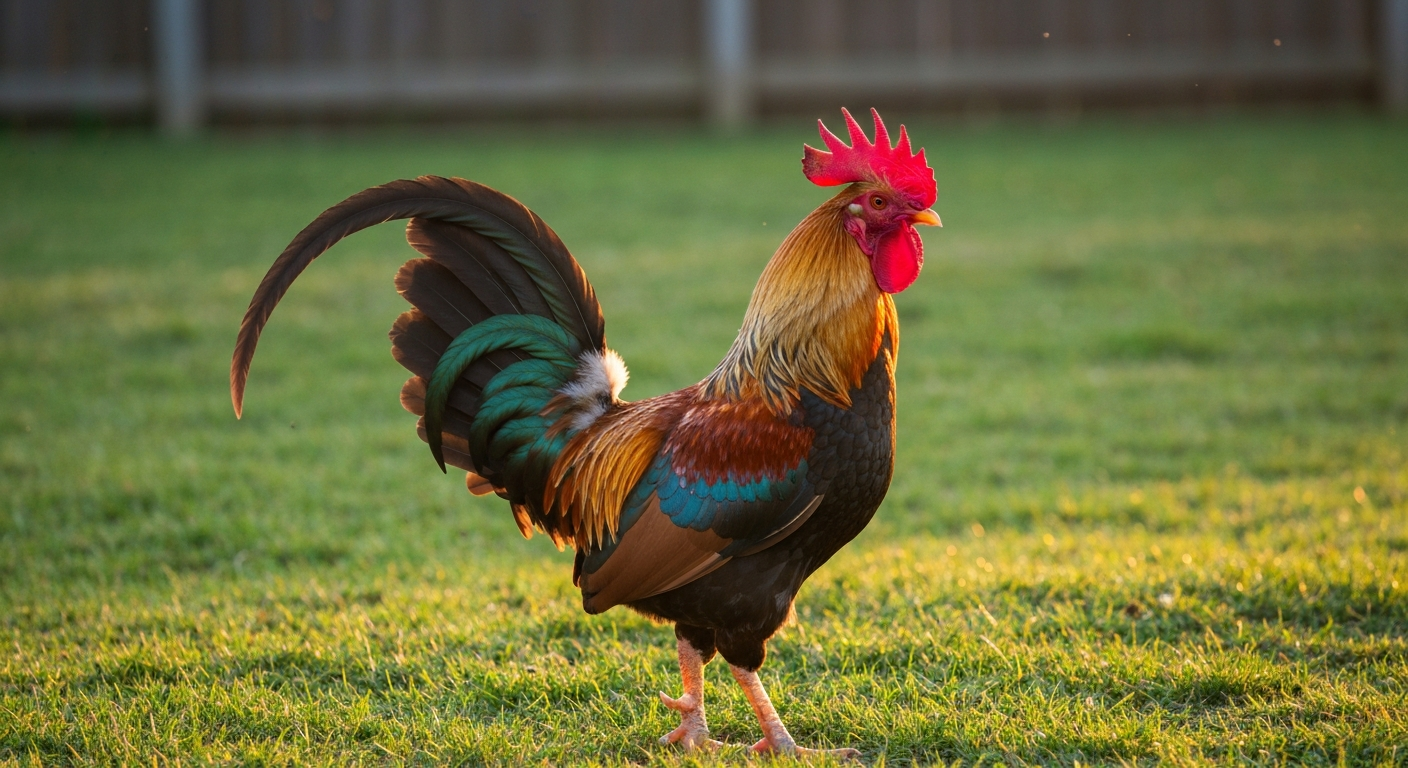
Roosters are visually very different from hens, a phenomenon called sexual dimorphism. The rooster has a larger, more prominent comb (the fleshy red crest on top of the head) and larger wattles (the fleshy lobes hanging below the beak). His hackle feathers (neck), saddle feathers (lower back), and tail feathers are pointed and often iridescent, rather than rounded as in hens. He also grows spurs, bony projections on the lower legs used for defense and competition with other males. None of these traits change what he is biologically, but they are the field marks that let you identify a rooster instantly.
Limited flight ability
Domestic chickens can fly in short, low bursts and routinely fly up to reach roosting perches. For more on whether hens are technically 'perching birds' or simply perch in everyday terms, see is hen a perching bird. The factsheet 'Sickness behaviour and normal behaviour in chickens (University of Maryland Extension factsheet)' states domestic chickens are capable of brief, low, flapping flights to reach roosts and are motivated to perch, and it recommends perch access in welfare guidance. They do not sustain powered flight the way a pigeon or a starling does, largely because selective breeding for meat and egg production has increased body mass relative to wing area. But the anatomical machinery for flight is still present: the keeled sternum, the flight muscles, the feathered wings. Whether a bird chooses or is able to fly long distances does not determine whether it is a bird. Penguins do not fly at all, and they are unambiguously birds.
How to recognize a rooster: practical field ID
Whether you are visiting a farm, a backyard flock, or spotting a free-ranging bird, these are the features that reliably mark an adult male chicken as a rooster.
- Comb and wattles: Roosters have noticeably larger, more upright combs and longer, thicker wattles than hens of the same breed. The comb is often bright red and may be single, rose, pea, or another breed-specific shape.
- Hackle feathers: The neck feathers on a rooster are pointed and typically have a shiny, iridescent sheen. On a hen the same feathers are rounded.
- Saddle and tail feathers: A rooster has long, pointed saddle feathers covering the lower back and dramatically arching sickle feathers in the tail. This gives him a larger, more theatrical silhouette than a hen.
- Leg spurs: Most adult roosters develop hard, curved spurs on the lower leg, just above the foot. Hens rarely grow them, and when they do the spurs are vestigial and small.
- Posture and size: Roosters typically stand more upright and alert than hens, and in most breeds are noticeably larger.
- Call: If it crows, it is a rooster. Hens cluck and occasionally produce a short crow-like sound, but the loud, sustained crow is functionally a rooster-only vocalization in healthy flocks.
Quick answers to closely related questions
Is a cockerel a bird?
Yes. A cockerel is simply a young male chicken under about one year of age, before he has fully matured into what we call a rooster. For a quick direct answer, see is a cockerel a bird. He is the same species, Gallus gallus domesticus, with the same taxonomic placement in class Aves. The age label does not change the classification. A cockerel is a bird by every measure.
Is a hen a flying bird?
A hen is technically capable of flight in short bursts, and she will fly up to a roost bar without hesitation. However, domestic hens are not strong or sustained fliers in the way that migratory or aerial birds are. They are better described as weak fliers rather than flightless birds. Their wings are fully functional avian wings; selective breeding for heavier body mass is what limits their range, not any fundamental difference in anatomy. The question of whether a hen counts as a 'flying bird' is really a question of degree, not category.
Is a hen a perching bird?
In everyday language, yes: hens perch readily and naturally, and welfare guidelines for laying hens specifically require perch access because it is a strong, innate behavioral drive. In strict taxonomic terms, 'perching birds' refers to order Passeriformes (songbirds and their relatives), and hens belong to order Galliformes, not Passeriformes. So a hen is not a 'perching bird' in the technical taxonomic sense, but she absolutely perches. It is one of those cases where common language and scientific terminology mean slightly different things.
How do robins fit into bird classification?
Robins (whether the American Robin, Turdus migratorius, or the European Robin, Erithacus rubecula) are birds classified in order Passeriformes, class Aves. They are among the most studied and most recognizable songbirds. Questions about whether a robin is a 'happy' bird touch on animal behavior and cognition rather than taxonomy; observations of robins singing vigorously, defending territories, and actively foraging are sometimes interpreted as indicators of a thriving, behaviorally healthy bird, though assigning emotional states to animals is a question scientists approach carefully. For a focused discussion of whether a robin can be considered 'happy,' see the question titled: do you think that robin is a happy bird why. Questions about whether robins are kosher sit at the intersection of biology and religious dietary law.
A brief note on kosher bird questions
The question of whether a specific bird species is kosher is a matter of Jewish dietary law (halakha), not biological classification. Jewish law uses both a list of non-kosher birds (primarily birds of prey and scavengers listed in Leviticus and Deuteronomy) and a tradition of community acceptance for kosher birds. For any specific species, including robins or other wild birds, the authoritative answer comes from a qualified rabbinic authority, not a biology reference. Biology can tell you what family and order a bird belongs to; it cannot tell you whether it meets religious dietary requirements.
Cultural roles and dietary notes
Roosters carry enormous cultural weight worldwide, and it is worth separating that cultural identity from their biological one. In many Asian cultures the rooster is one of the twelve zodiac animals, symbolizing confidence and punctuality. In French national iconography the Gallic Rooster (le coq gaulois) is a longstanding national symbol representing vigilance and pride. In West African, Caribbean, and Latin American traditions roosters appear in religious ceremony, folklore, and art. In the context of cockfighting, which is now illegal in many countries, roosters were historically bred for aggression and endurance, a practice that led to several distinct heritage breeds.
On the dietary side, chicken meat and eggs are among the most widely consumed animal products on earth, and the domestic chicken is arguably the most economically important bird in human history. In Jewish dietary law, domestic chicken is generally considered kosher when slaughtered and prepared according to halakhic requirements, a status that rests on long-established tradition and rabbinic authority rather than on any taxonomic feature. For other bird species, particularly wild birds, kosher status requires specific rabbinic determination. None of these cultural or religious designations change what a rooster is biologically: an adult male bird of the species Gallus gallus domesticus, classified in class Aves within Kingdom Animalia.
Cultural labels and biological classification operate on completely separate tracks. A rooster can be a national symbol, a zodiac sign, a religious dietary subject, and a farmyard alarm clock all at once, and in every one of those contexts it remains, biologically, a bird.
FAQ
Short definitive answer: Is a rooster a bird or an animal?
Both—biologically a rooster is an animal (Kingdom Animalia) and, more specifically, a bird (Class Aves). In everyday terms, a rooster is the adult male of the domestic chicken (Gallus gallus domesticus).
What is the rooster’s formal scientific name and common synonyms?
The domestic chicken is commonly listed as Gallus gallus domesticus (a domesticated form/subspecies of the red junglefowl, Gallus gallus). Common English synonyms/terms: chicken (species/common name), rooster or cock (adult male; U.S. 'rooster'), cockerel (young/immature male), hen (adult female), pullet (young female).
What taxonomic hierarchy places the rooster among birds?
Standard taxonomy: Kingdom Animalia → Phylum Chordata → Class Aves (birds) → Order Galliformes → Family Phasianidae → Genus Gallus → Species Gallus gallus (domestic form often cited as G. g. domesticus). This classification places roosters within Aves, the bird class (sources: ITIS, NCBI, GBIF).
What avian characteristics qualify roosters as birds?
Roosters have the key bird traits: feathers (the unique synapomorphy of Aves), a beak without teeth, a furcula (wishbone) and a keeled sternum for strong flight muscles, pneumatic (light) bones and an air‑sac respiratory system, endothermy (warm‑bloodedness), and they reproduce by laying shelled eggs (hens lay the eggs). These anatomical and physiological features are why chickens are classified as birds (OpenStax, avian anatomy reviews).
How does the term 'bird' differ from 'animal'?
'Animal' refers to the broad biological kingdom Animalia, which includes insects, mammals, fish, reptiles, amphibians and birds. 'Bird' is a narrower category—Class Aves—inside Animalia. So every bird (including a rooster) is an animal, but not every animal is a bird. This explains the confusion: 'animal' is the umbrella term; 'bird' is the accurate class-level description for a rooster. (Cornell All About Birds / general taxonomy sources).
What behavioral and appearance traits do roosters show that relate to classification?
Roosters display sexually dimorphic traits—larger combs and wattles, pointed hackle/saddle/tail feathers, long sickle tail feathers, spurs on the legs, and often a larger body—used by breeders to sex chickens. Behaviorally they crow (a male‑typical vocalization linked to hormones and social status) and perform courtship and dominance displays. These features are sex/age characteristics within the species and do not change the bird’s taxonomic placement. (Poultry science and behavioral studies).
Next Articles
Is a Dragonfly a Bird? How to Tell the Difference
Dragonflies are insects, not birds. Learn key bird traits vs dragonfly anatomy to tell them apart fast.
Is a Flyer a Bird? How to Tell Flyers From Real Birds
No. Flyers aren’t automatically birds; true birds have feathers, beaks, bird anatomy, and breeding traits, not just flig
Is a Dragon a Bird? Clear Science Verdict and Criteria
No: dragons are not birds. Learn bird criteria like feathers and reproduction and why real birds are theropod dinosaurs.