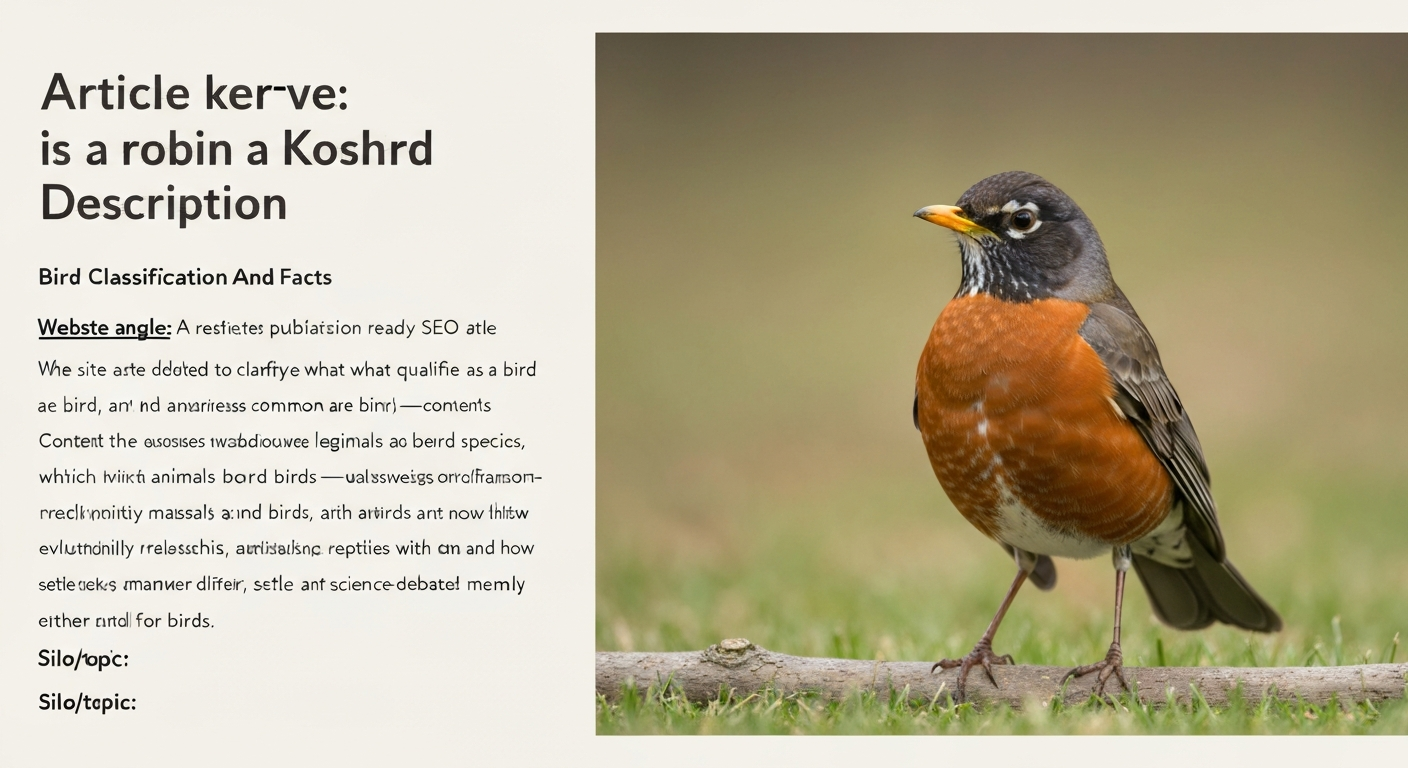
Robins are not considered kosher in mainstream Jewish practice. Neither the American robin (Turdus migratorius) nor the European robin (Erithacus rubecula) has a recognized continuous tradition, a mesorah, identifying it as a permitted food, and without that tradition, virtually all modern rabbinic authorities and kashrut agencies treat the species as off the table, regardless of the bird's physical traits.
Is a Robin a Kosher Bird? Clear Answer & Halacha Guide

Marcus Hendricks
21 Jul 2026
Can you eat a robin?
The short practical answer is: no, not under kosher dietary law as it is commonly observed today. You will not find robins certified or sold by any major kashrut agency, and if you asked your local Orthodox rabbi whether you could eat one you caught, the almost-certain answer would be that it is not permitted. The reason is not that robins are obviously predatory or scavenging birds, they are not, but rather that no established community has a documented, unbroken tradition of eating them. In Jewish law, that absence alone is sufficient to exclude a species from kosher status in practice. Beyond kashrut, it is worth noting that in the United States, the American robin is a migratory bird protected under the Migratory Bird Treaty Act, making it illegal to hunt, kill, or possess outside narrow exceptions, so the question is largely theoretical for most readers anyway.
What 'kosher bird' means in Jewish law
The Torah (Leviticus 11 and Deuteronomy 14) does not give a universal rule for permitted birds the way it does for mammals (split hooves, chewing cud) or fish (fins and scales). Instead, it lists roughly 24 species of forbidden birds by name. Every bird not on that list is theoretically permitted, but the identification problem is enormous. Bird names in ancient Hebrew and Aramaic do not map cleanly onto modern taxonomy, and the Talmudic sages themselves acknowledged that correct identification of forbidden species was uncertain. The practical result is that kosher status for birds ends up being defined less by a simple checklist and more by trust: you need a credible, continuous communal tradition saying 'yes, we have always eaten this species.'
This is why chicken, duck, goose, and turkey are universally accepted across major Jewish communities, while hundreds of other bird species, including many that pose no obvious problem on paper, simply never made it onto anyone's menu in a documented, traceable way.
How halacha identifies kosher birds: mesorah versus physical signs
The Mishnah in Tractate Chullin (61–64) records four physical signs (simanim) that can help identify a kosher bird: the presence of a crop, a peelable gizzard lining, a projecting extra toe (the hallux), and non-predatory behavior. The Rambam codifies these in the Mishneh Torah (Ma'achalot Assurot), and the Shulchan Aruch (Yoreh De'ah 82:1–2) preserves them in the standard halachic code.
Here is the catch: even meeting all four signs does not automatically make a bird kosher in common practice. The Rishonim, Rashi in particular, interpret the Talmud to mean that a positive mesorah is decisive, and that physical signs alone are not enough to permit an unfamiliar species. Later Achronim and modern kashrut agencies have broadly followed that stricter position, partly because the definitions of the signs themselves are debated. What exactly counts as 'predatory behavior' (dores)? Exactly how must the extra toe be positioned? Different major commentators answer those questions differently, which means that trying to certify a new species purely on the basis of anatomy invites argument. Relying on an established communal tradition sidesteps the argument entirely.
Classical sources and the limits of applying them today
The Talmudic discussion in Chullin 63b–64a is the foundational text, and it is genuinely fascinating, the Gemara records debates about specific bird names that scholars still argue over. The Rambam's list, the Shulchan Aruch's treatment, and the commentaries of figures like the Shach and Pri Megadim all deal with birds known in the Mediterranean and Middle Eastern world. Robins, whether the red-breasted European garden bird or the larger American thrush, were simply not part of that world. Neither species appears in any prominent classical responsum as a bird to eat.
The limits of classical sources for modern identification are well illustrated by the turkey debate. When Ashkenazi Jews encountered turkeys in the New World (or when turkeys arrived in Europe), there was no mesorah for them at all. Eventually, most major communities and poskim accepted turkey based on historical investigation, widespread communal adoption, and the argument that certain physical markers were satisfied, but the debate went on for centuries and a minority of very strict opinions never fully accepted turkey. That story shows both how the system can accommodate new species and how high the bar is. Robins have never been through that process.
Robins defined: American robin and European robin
The name 'robin' actually refers to two completely unrelated birds that happen to share a common name and a famously orange-red breast. They are worth distinguishing clearly.
| Feature | American Robin | European Robin |
|---|---|---|
| Scientific name | Turdus migratorius | Erithacus rubecula |
| Family | Turdidae (thrushes) | Muscicapidae (Old World flycatchers/chats) |
| Order | Passeriformes | Passeriformes |
| Size | ~25 cm, ~77 g | ~14 cm, ~16–22 g |
| Breast colour | Brick-orange | Vivid orange-red |
| Range | North America (migratory) | Europe, W. Asia (partially migratory) |
| Primary diet | Earthworms, invertebrates, fruit | Insects, worms, berries |
| Foot type | Anisodactyl (perching) | Anisodactyl (perching) |
The American robin is a true thrush, a large, sturdy passerine related to the European blackbird and song thrush. The European robin is significantly smaller and belongs to a different family entirely, sitting closer to Old World flycatchers and chats in modern taxonomy. Both are passerines (order Passeriformes), meaning they are perching birds with anisodactyl feet: three toes pointing forward and one pointing backward, the classic arrangement for gripping a branch. If you are curious about the broader category of perching birds versus other bird types, the distinction between perching and non-perching species comes up in related questions about domestic birds like hens as well. For related classification details, see rooster is bird or animal. For more detail on whether hens are considered perching birds, see Is hen a perching bird.
Robins' diet and ecology, does any of this affect kosher status?
Robins are insectivores and frugivores. The American robin is famous for its earthworm-hunting behavior, tilting its head to the side on a lawn, then pulling a worm out of the ground. It also eats a wide range of invertebrates and, especially in late summer and autumn, heavily supplements its diet with berries and fruit. The European robin has broadly similar habits: insects, worms, spiders, and seasonal fruit. Neither species is a raptor, neither hunts vertebrate prey, and neither scavenges carrion.
From a halachic standpoint, this behavioral profile is relevant because 'dores', predatory or tearing behavior, is one of the disqualifying traits in the classical simanim discussion. Robins do not 'tear' prey with their feet or talons the way a hawk or eagle would. On paper, that removes one potential objection. But as discussed above, the absence of a disqualifying sign is not the same as having a positive mesorah. You can clear every hurdle in the physical checklist and still have no standing as a kosher species if no community has a documented tradition of eating you.
Why robins are excluded: no mesorah, small songbird, no culinary tradition
There are three converging reasons robins are not accepted as kosher in practice, and they reinforce each other.
- No positive mesorah: There is no documented, continuous Jewish communal tradition of eating robins anywhere. Without this, most rabbinic authorities decline to permit the species regardless of its physical profile.
- Classification as a wild songbird: Robins are passerines — small, wild, non-domesticated songbirds. The kosher birds that have established mesorot are overwhelmingly domesticated or semi-domesticated species (chicken, turkey, duck, goose, pigeon/dove). Wild songbirds simply were not part of the standard food culture that generated these traditions.
- Lack of any prominent rabbinical investigation: Unlike turkey — which generated a rich body of responsa because communities actually wanted to eat it — robins have not been the subject of serious sustained halachic investigation by major poskim. There is no equivalent responsum permitting robins the way there eventually was for turkey.
Community Q&A sources, including accessible online responsa, consistently reflect this. The answer to 'Is a robin kosher?' is not nuanced speculation, it is a clear 'no' based on the absence of tradition, and that position is uniform across major kashrut agencies including the Orthodox Union, the Chicago Rabbinical Council (cRc), and Star-K. The Chicago Rabbinical Council (cRc) explains it accepts only bird species with a reliable mesorah, noting that chicken and turkey are commonly accepted while many wild species are not (Poultry, cRc Consumer Kosher) blank" rel="noopener noreferrer">Poultry — cRc Consumer Kosher. Interestingly, Star-K does address the American robin in the context of the mitzvah of shiluach haken (sending away a mother bird before taking eggs from a nest), which means rabbinic authorities do engage with the species in a ritual context, they just are not recommending anyone eat it. blank" rel="noopener noreferrer">Star‑K’s article 'Shiluach Hakan' discusses the American robin among local birds in connection with the mitzvah, illustrating that some agencies address specific species for ritual purposes while not endorsing them as food.
What modern rabbinic authorities say, and what varies
There is no single authoritative responsum saying 'the robin is forbidden,' in the same way that there is no single proclamation banning starlings or sparrows. The exclusion is effectively by default: robins have not been permitted, rather than being explicitly prohibited. That distinction matters because it means the theoretical question remains open, if a community somehow developed and documented a mesorah for robins, the analysis would be different. In practice, this will not happen.
Modern rabbinic practice on robins can be summarized straightforwardly: no major kashrut certification body certifies robins, no prominent posek has issued a ruling permitting them as food, and community-level responses to the question consistently direct people away from eating them. The closest variation you will find is that some authorities might treat the question as 'not prohibited with certainty' versus 'actively forbidden', but even those who take the more permissive theoretical framing agree that absent a mesorah, eating a robin in practice is not acceptable. For anyone keeping kosher, the safe and universally accepted guidance is simply: do not eat robins.
What you should eat instead, and what the robin question tells us about bird classification
If you are keeping kosher and want poultry, stick to species with well-established mesorot: chicken, turkey, domesticated duck, domesticated goose, and Cornish hen (which is a chicken variety). Squab (young pigeon) is also accepted in many communities. These are the birds with documented traditions behind them, and they are what every major kashrut agency certifies.
The robin question is also a nice illustration of why bird classification matters beyond just biology. Whether a bird is a passerine or a galliform, whether it is wild or domesticated, whether it is native to the Old World or the New, these are not just taxonomic footnotes. They shape the social and culinary history that determines whether a tradition of eating that bird ever formed in the first place. Chickens and their relatives (cockerels, hens, roosters) have a rich documented history as food birds across virtually every human culture that encountered them, which is exactly why their kosher status is uncomplicated. Robins, charming as they are, never had that role.
One last note: if you arrived here partly wondering about robins as animals, whether they are 'happy' birds or what kind of birds they are ecologically, those questions have their own interesting answers rooted in robin behavior and biology. Separately, if you have been curious about whether roosters and cockerels qualify as birds in the zoological sense, or whether hens can fly or are classified as perching birds, those classification questions come up regularly on this site and are worth exploring in their own right.
FAQ
Can you eat a robin (American robin Turdus migratorius or European robin Erithacus rubecula)?
Short answer: No—robins are not generally considered kosher in contemporary practice. Although robins have biological features that match some of the classical physical signs (simanim) for kosher birds, they lack a continuous positive mesorah (oral tradition) identifying them as fit to eat. For that reason most rabbinic authorities and kashrut agencies do not permit eating robins.
What does “kosher bird” mean in Jewish law (halacha)?
A kosher bird is a species that Jewish law permits to be eaten. The Talmud lists forbidden bird-names and describes physical signs (simanim) used to identify kosher birds, but in practice halacha places central weight on mesorah—a continuous community tradition that a species is edible. Many poskim require either a reliable mesorah or clear, agreed-upon simanim before permitting a species.
What are the classical halachic signs (simanim) for kosher birds and how are they used?
Classical sources (Mishnah, Talmud, Rambam, Shulchan Aruch) describe several signs: presence of a crop, a gizzard whose inner lining can be peeled, non‑predatory feeding habits (not a bird of prey), and a particular foot/toe arrangement referenced in earlier texts. Commentators disagree about exact definitions and application, so many authorities prefer a mesorah rather than relying only on simanim.
Do robins have the physical signs (simanim) that matter for kosher status?
Biologically, both the American and European robins are passerine birds with a crop, a gizzard, and anisodactyl (three forward, one back) perching feet. Those features correspond to some classical simanim. However, having those physical traits alone is not sufficient in practice because halacha typically requires either a reliable mesorah or uncontested simanim as defined by halachic authorities.
How does halacha treat bird identification—mesorah versus physical signs?
Halacha recognizes physical signs but historically gives decisive weight to mesorah. The Talmud and later Rishonim explain that a positive mesorah identifying a bird as edible is binding; absent a mesorah, many poskim prohibit eating unfamiliar or wild species even when some simanim appear present. This is why new-world birds (e.g., turkey) required extended rabbinic discussion and communal practice before widespread acceptance.
Is there any classical or modern rabbinic responsum that permits eating robins?
There are no prominent classical responsa that identify robins as permitted food. Modern searches of responsa and kashrut literature show that robins are not treated as kosher because they lack an unbroken mesorah. Some community Q&A pages and kashrut agencies explicitly note robins as non‑accepted for eating.
Next Articles
Rooster Is Bird or Animal? Taxonomy & ID Guide for Students
Is a rooster a bird or an animal? Clear answer with taxonomy (Gallus gallus domesticus), bird traits, ID tips.
Is a Dragonfly a Bird? How to Tell the Difference
Dragonflies are insects, not birds. Learn key bird traits vs dragonfly anatomy to tell them apart fast.
Is a Flyer a Bird? How to Tell Flyers From Real Birds
No. Flyers aren’t automatically birds; true birds have feathers, beaks, bird anatomy, and breeding traits, not just flig