Yes, a robin can reasonably be described as a happy bird, but with one important qualifier: what you are actually observing is positive welfare, not human-style happiness. When a robin is singing at dawn, preening its feathers at leisure, foraging efficiently, and successfully raising a brood, that bird is showing every measurable sign that its physical and psychological needs are being met. That is the closest science gets to "happy," and honestly, it is a pretty meaningful version of the word.
Do You Think That Robin Is a Happy Bird? Why, Explained

Marcus Hendricks
8 Aug 2026
Can a Robin Actually Be "Happy"? A Qualified Yes
The question sounds simple, but it is doing a lot of work. When people ask whether a robin is a happy bird, they usually mean: does the robin seem content, healthy, and thriving? That is a fair and answerable question. What is harder to answer with certainty is whether the robin experiences subjective emotional joy the way you or I do. Welfare science splits these two things apart, and that distinction matters if you want a genuinely useful answer rather than a comforting guess.
The short version: robins living in suitable habitat, with adequate food, low parasite loads, and the freedom to sing, forage, and breed, display a consistent set of behaviours that welfare researchers classify as positive welfare indicators. A wild robin bouncing across a garden lawn, tail cocked, letting loose its famously melodious song, is ticking most of those boxes. That is the evidence-based case for calling it a happy bird.
What "Happy" Actually Means for a Bird
Animal welfare science uses a framework called the Five Domains Model, which looks at four physical areas (nutrition, environment, health, and behavioural opportunities) and then evaluates the animal's resulting mental or affective state. Crucially, the model explicitly includes positive experiences, not just the absence of suffering. So welfare researchers are not just asking "is this bird in pain?" They are asking "is this bird in a state that supports positive affect?" That is as close to operationalizing happiness as science currently gets.
The key distinction to keep in mind is that "happy" as humans experience it involves conscious self-reflection about one's emotional state. Birds almost certainly do not do that. What they do have are motivational and affective states that drive behaviour, influence physiological markers, and can be measured objectively. When a robin's corticosterone levels are low, its feather condition is excellent, and it is singing regularly, that is measurable positive welfare, even if we cannot ask the robin how it feels.
Wait, Which Robin Are We Talking About?
There are actually two birds most people mean when they say "robin," and they are not closely related despite sharing a name and a reddish-orange chest. Getting this straight matters for taxonomy and for any welfare discussion, because their behaviours differ in important ways.
| Feature | European Robin (Erithacus rubecula) | American Robin (Turdus migratorius) |
|---|---|---|
| Family | Muscicapidae (Old World flycatchers) | Turdidae (thrushes) |
| Order | Passeriformes | Passeriformes |
| Size | Small, 14 cm, ~16–22 g | Larger, 25 cm, ~77 g |
| Diet | Insects, worms, berries | Earthworms, insects, fruit |
| Song style | Melancholic, complex warble | Melodious, flute-like phrases |
| Social behaviour | Highly territorial year-round | Territorial when breeding, flocks in winter |
| Foraging style | Ground and low vegetation | Ground forager, run-stop-look method |
| Distribution | Europe, western Asia, North Africa | North America, Central America |
Both species are in the order Passeriformes, the perching birds, which is by far the largest order of birds. Beyond that shared classification, however, they sit in different families. The European robin belongs to Muscicapidae, making it a distant relative of Old World flycatchers and chats. The American robin belongs to Turdidae, placing it firmly with the thrushes alongside species like the blackbird. They earned the same common name because early European settlers in North America saw that reddish chest and thought of home, but taxonomically they are quite different birds.
Why a Robin Is Definitely a Bird
Both robin species are unambiguously birds. They have feathers, beaks, hollow bones, endothermic (warm-blooded) metabolism, and they lay hard-shelled eggs. They both belong to Passeriformes, the perching birds, which means they have an anisodactyl foot arrangement (three toes forward, one back) that allows them to grip a branch and lock in place passively. This is the same order that includes sparrows, finches, warblers, and starlings.
Compared to domestic fowl like chickens, both robins are considerably smaller, more aerial, and occupy entirely different ecological niches. Chickens (Gallus gallus domesticus) belong to the order Galliformes, not Passeriformes, which is why their feet, flight capability, and social structures differ so much from a robin's. The robin is a perching bird by both anatomy and classification; the chicken is a ground-dwelling gamebird. Both are birds, just quite different kinds.
Signs That a Robin Is Doing Well
If you want to assess whether a robin in your garden or local park is thriving, these are the observable indicators welfare researchers point to. You do not need a laboratory to do a basic check.
- Song: A robin singing regularly, especially at dawn and dusk, is demonstrating motivational health. Song rate in passerines tracks current condition and motivational state, and research on related songbirds shows singing can be associated with reward and positive affect. A silent robin outside the moult period is worth a second look.
- Preening and grooming: Longer, unhurried preening bouts are a recognised comfort behaviour and positive welfare indicator in birds. If a robin is taking its time to work through its feathers methodically, that is a good sign. Stressed birds either over-preen (barbering feathers) or neglect preening altogether.
- Feather condition: Clean, intact, well-structured feathers signal both good health and low chronic stress. Ragged, faded, or broken feathers (outside the annual moult) can indicate nutritional deficits or elevated corticosterone over time.
- Foraging behaviour: An active, purposeful forager, making the classic American robin run-stop-look sequence or the European robin's quick ground peck, is a bird in positive energy balance. Listless or erratic foraging can signal illness or nutritional stress.
- Activity level: A healthy robin is alert, responsive to its environment, and moves with purpose. Fluffed-up posture, closed eyes during the day, or unusually tame behaviour (letting you walk right up to it) are common signs something is wrong.
- Breeding success: For wild robins, successfully raising chicks to fledging is one of the strongest whole-season welfare indicators available. It requires adequate nutrition, low parasite load, a safe territory, and enough energy reserves to sustain incubation and provisioning.
How Scientists Actually Measure Robin Welfare
Observable behaviour gives you a useful first read, but welfare scientists go further when they need precise data. The main tools used in avian welfare research apply directly to robins.
Corticosterone: the stress hormone in feathers and blood
Corticosterone is the primary stress hormone in birds. Plasma corticosterone sampled within three minutes of capture gives researchers a baseline reading of the bird's unstressed state, since levels rise rapidly after handling. Feather corticosterone (fCORT) is a different tool: as feathers grow, corticosterone from the bloodstream is deposited in the feather structure, creating a time-averaged record of stress over the entire growth period. This means a robin's feathers are essentially a biological diary of its recent HPA-axis (stress response) activity. High fCORT can indicate sustained nutritional stress, predator pressure, or a disrupted habitat. Research on American robins has directly validated corticosterone assays in this species and shown that CORT levels influence specific behaviours including egg rejection responses.
The heterophil:lymphocyte ratio
A blood smear can reveal the ratio of heterophils to lymphocytes (H:L ratio) in a bird's white blood cells. Under chronic stress, heterophils increase and lymphocytes decrease, so a high H:L ratio flags prolonged physiological stress even when behaviour looks normal on the surface. It is a complementary measure, most useful when corticosterone data is also available.
Body condition indices
Body condition indices (standardised mass relative to structural size) quantify a bird's fat and muscle reserves. A well-conditioned robin has the energetic buffer to sing, defend a territory, and invest in eggs. Body condition correlates with reproductive success and survival, making it a practical welfare proxy. For robins caught in the hand for ringing, a quick measurement of wing length and mass gives researchers a scaled condition index immediately.
Cognitive bias tests
One of the more fascinating tools in welfare science is the judgment bias or cognitive bias test. Birds in positive affective states tend to respond to ambiguous stimuli more "optimistically," while stressed birds respond more pessimistically. The classic paradigm (first demonstrated in European starlings) trains a bird to associate one cue with a reward and another with a negative outcome, then presents an ambiguous intermediate cue. A bird in good welfare leans toward the reward interpretation. This has become an accepted experimental tool for inferring affective valence in birds, though it requires controlled conditions and cannot be done in the back garden.
What You See vs What the Science Says
Here is where it gets philosophically interesting. Humans are strongly predisposed to attribute emotions to animals, particularly animals with appealing faces and complex behaviours. Anthropomorphism and observer biases are well documented; methodological best practices include operationalizing observable behaviours, using blinded and validated measures, and triangulating behavioural observations with physiological and cognitive tests (Who Sees Human? The Stability and Importance of Individual Differences in Anthropomorphism, Perspect Psychol Sci) Anthropomorphism and observer biases are well documented; methodological best practices include operationalizing observable behaviours, using blinded and validated measures, and triangulating behavioural observations with physiological and cognitive tests (Who Sees Human? The Stability and Importance of Individual Differences in Anthropomorphism, Perspect Psychol Sci).. The European robin, with its upright posture, bright chest, and habit of following gardeners closely, has been described as "cheerful," "friendly," and "bold" for centuries. Some of those descriptions map reasonably onto measurable behaviours. Others do not.
The European robin follows gardeners not out of friendliness but because digging exposes worms and invertebrates, which are exactly what it wants. The American robin's dawn song is not an expression of joy; it is a territorial signal and a mate-attraction display that happens to coincide with low predator activity. Interpreting these as expressions of happiness is not wrong exactly, but it conflates motivation with emotion in a way that can lead you to miss actual welfare problems. A bird can appear cheerful and lively while carrying a heavy parasite load or facing nutritional stress that will catch up with it later.
The practical takeaway is this: your observer impressions are a useful first screen, but they work best when you know what the normal baseline for that species looks like. If you know what a healthy, well-fed robin behaves like, deviations from that baseline become meaningful signals. That is why Cornell Lab's species accounts for both the European and American robin matter: they give you the behavioural reference points against which to compare what you are actually seeing.
Robins vs Chickens: Very Different Birds, Same Basic Rules
A common thread running through questions about bird welfare is comparing wild songbirds like robins to familiar domestic species like chickens, hens, and roosters (cockerels). All of these animals are birds, which sometimes surprises people who think of "bird" as meaning small and wild. The core biology is the same: feathers, beaked mouths, two wings, warm blood, egg-laying. But the practical differences in behaviour, care needs, and welfare assessment are significant.
| Characteristic | Robin (Passeriformes) | Chicken/Hen/Rooster (Galliformes) |
|---|---|---|
| Order | Passeriformes | Galliformes |
| Perching ability | Yes, anisodactyl feet lock onto perches | Yes, but primarily ground-dwelling |
| Flight | Strong flier, migratory (American robin) | Limited; hens and cockerels rarely fly far |
| Diet in the wild | Insects, worms, berries | Seeds, insects, plant material |
| Territorial song | Central to welfare and breeding | Crowing is territorial; hens cluck socially |
| Social structure | Largely solitary or pair-bonded | Flock hierarchy (pecking order) |
| Welfare indicators | Song, feather condition, foraging, fCORT | Feather condition, H:L ratio, preening, social interaction |
| Primary welfare concern in captivity | Flight space, insect access, stress from confinement | Space, social density, perch access, dust bathing |
The question of whether a hen is a flying bird or a perching bird comes up regularly, and the honest answer is: both, partially. Hens have an anisodactyl foot and will perch on roosting bars, but their pectoral muscles and wing-to-body-mass ratio make sustained flight impractical. If you wonder whether "is a hen a perching bird", the short answer is that hens can perch but are not perching birds in the aerial sense of many passerines. They can flutter and make short bursts to escape predators or reach a low roost, but they are not aerial birds in the way a robin is. The European robin makes sustained territorial flights; the American robin is genuinely migratory. A hen is better understood as a perching ground bird with limited flight capability. Similarly, a cockerel (rooster) is entirely a bird, just a domesticated gamebird rather than a perching songbird.
A Side Note: Is a Robin a Kosher Bird?
If you have come across the question of whether robins are kosher, that is a different kind of question entirely, one that falls outside bird biology and into Jewish dietary law (kashrut). The Torah lists non-kosher birds by name but does not give a definitive anatomical rule for permitted birds. Determining whether a specific species like the European or American robin qualifies as kosher requires consulting a qualified rabbinic authority, not an ornithology reference. What biology can confirm is that robins are not birds of prey and are not among the species listed as forbidden, but the full legal determination is a matter for rabbinic guidance, not taxonomic classification.
How to Actually Support a Robin's Welfare
If you want to help robins in your garden or local area, the science is pretty direct about what works.
- Provide access to insect-rich soil: both robin species are ground foragers targeting earthworms and invertebrates. Lawns treated heavily with pesticides cut off their primary food source and elevate nutritional stress.
- Keep water available: a shallow birdbath for drinking and bathing supports feather condition and thermoregulation, both important positive welfare contributors.
- Plant native shrubs and trees: berry-producing native plants provide autumn and winter food for American robins especially, helping them maintain body condition through energetically costly cold periods.
- Minimise window collisions: window strikes are one of the leading causes of songbird mortality. Bird-safe window treatments or repositioning feeders more than a metre from glass reduces strike risk significantly.
- Reduce free-roaming cat exposure: both robin species nest relatively low and forage on the ground, making them vulnerable. Keeping cats indoors or using a breakaway bell collar reduces predation pressure.
- If a robin appears unwell (fluffed, grounded, unresponsive), contact a licensed wildlife rehabilitator rather than attempting home care. Handling stress can worsen the bird's condition rapidly.
The Bottom Line on Robin Happiness
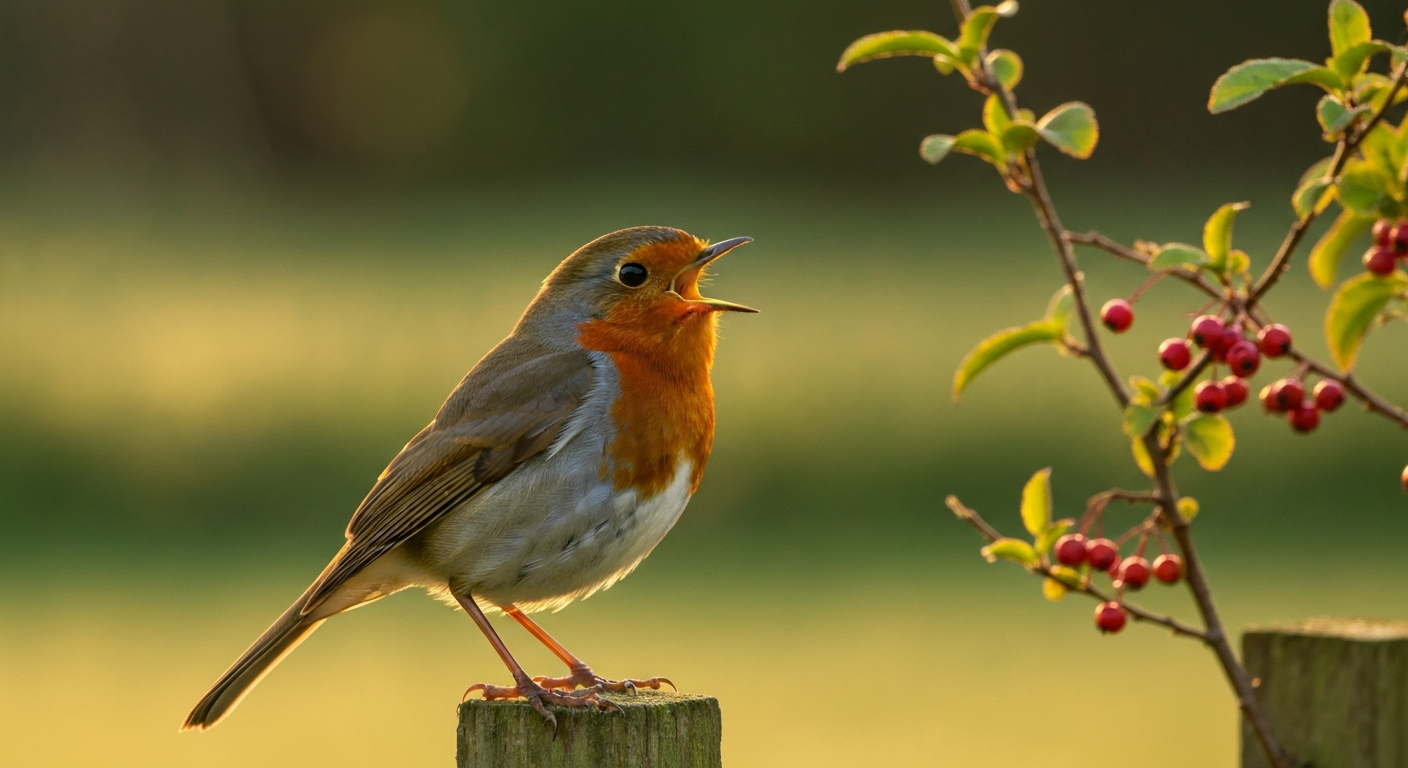
A robin singing from a fence post on a May morning, feathers gleaming, heading out to forage before returning to a nest full of eggs, is about as close to a happy bird as science can currently confirm. What you are seeing is positive welfare: nutritional needs met, behavioural drives expressed, stress hormones low, and the whole system running as it evolved to run. Whether that involves subjective joy the way humans experience it remains genuinely unknown, and it is honest to say so. But the measurable evidence that a well-resourced robin is thriving is real, consistent, and worth paying attention to. The robin that follows you across the garden while you dig is not being your friend. It is being a very effective, very well-adapted bird, and that, practically speaking, is a good thing to be.
FAQ
Short answer: can a robin legitimately be described as “happy,” and why?
Qualified yes: biologists avoid assuming human emotions, but robins (European Erithacus rubecula and American Turdus migratorius) can show behavioral and physiological signs consistent with positive welfare (what welfare scientists mean by “positive affect”). Observable relaxed, motivated, and successful functioning—e.g., frequent song in appropriate contexts, normal foraging, regular preening, good body condition, and successful breeding—are evidence that the bird’s needs are met and that it is likely experiencing positive states. This conclusion is grounded in operational welfare frameworks (e.g., the Five Domains) that distinguish measurable welfare indicators from informal anthropomorphic claims.
What does “happy” mean for birds in scientific/welfare terms?
In science, “happy” is not used as a direct equivalent of human emotion. Instead, researchers assess positive welfare or positive affective states: the presence of valued resources (food, shelter, behavioural opportunities) and measurable positive outcomes such as relaxed comfort behaviours, motivated goal‑directed behaviour, optimistic cognitive biases, low chronic stress markers, good body condition, and successful reproduction. These are integrated under models like the Five Domains.
Which behaviors are reliable, observable positive‑welfare indicators in robins? (Checklist)
Checklist of observable positive‑welfare signs: - Regular, context‑appropriate song (territorial or mate attraction during breeding) - Frequent, uninterrupted preening and smooth feather maintenance - Normal, efficient foraging and food‑handling - Active, responsive movement and normal activity budgets (not listless) - Successful breeding: nest building, egg laying, parental provisioning and fledging - Good feather condition (no major wear, bald patches, or heavy ectoparasite signs) - Stable body condition (no extreme weight loss or emaciation) Use several indicators together rather than a single sign.
Which physiological and experimental measures do scientists use to assess positive or negative states in birds?
Common scientific measures: - Feather corticosterone (fCORT): integrated, long‑term index of HPA activation during feather growth (needs standardisation) - Baseline plasma corticosterone: sampled within ~3 minutes of capture to infer acute physiological stress - Heterophil:lymphocyte (H:L) ratio from blood smears: indicator of chronic physiological stress - Body condition indices (scaled mass index, residuals): reflect energetic reserves - Cognitive/bias tests (judgement bias, anticipatory behaviour): infer positive vs negative affective valence - Behavioural tests and validated ethograms triangulate physiological and behavioural data. Each method has caveats; best practice is to combine measures.
How should observers avoid anthropomorphism when judging a robin’s welfare?
Operationalize observations: record concrete, species‑normal behaviours and measurable condition metrics (song frequency, preening time, foraging success, feather condition, body mass), avoid interpreting those as human feelings, and triangulate behaviour with physiological measures or multiple behavioural indicators. Use blinded or standardized observation protocols where possible, and remember human biases can over‑interpret cute or familiar behaviours.
Are there important differences between European robin and American robin relevant to welfare assessment?
Yes. They differ in taxonomy, typical behaviour and ecology that set baselines for welfare interpretation: - European robin (Erithacus rubecula): family Muscicapidae (Old World flycatcher family in current treatments), strongly territorial year‑round in many areas, small insectivore/ground gleaner with distinct behavioural repertoire. - American robin (Turdus migratorius): family Turdidae (thrushes), larger, seasonally social outside breeding, ground forager, melodious song. Because normal activity budgets, song timing and sociality differ, welfare indicators must be interpreted against species‑specific baselines (All About Birds and field guides provide normative behaviour patterns).
Next Article
Is hen a flying bird? Clear answer, flight limits & care
Is hen a flying bird? Clear answer with simple taxonomy, flight limits, and practical care & containment tips.