
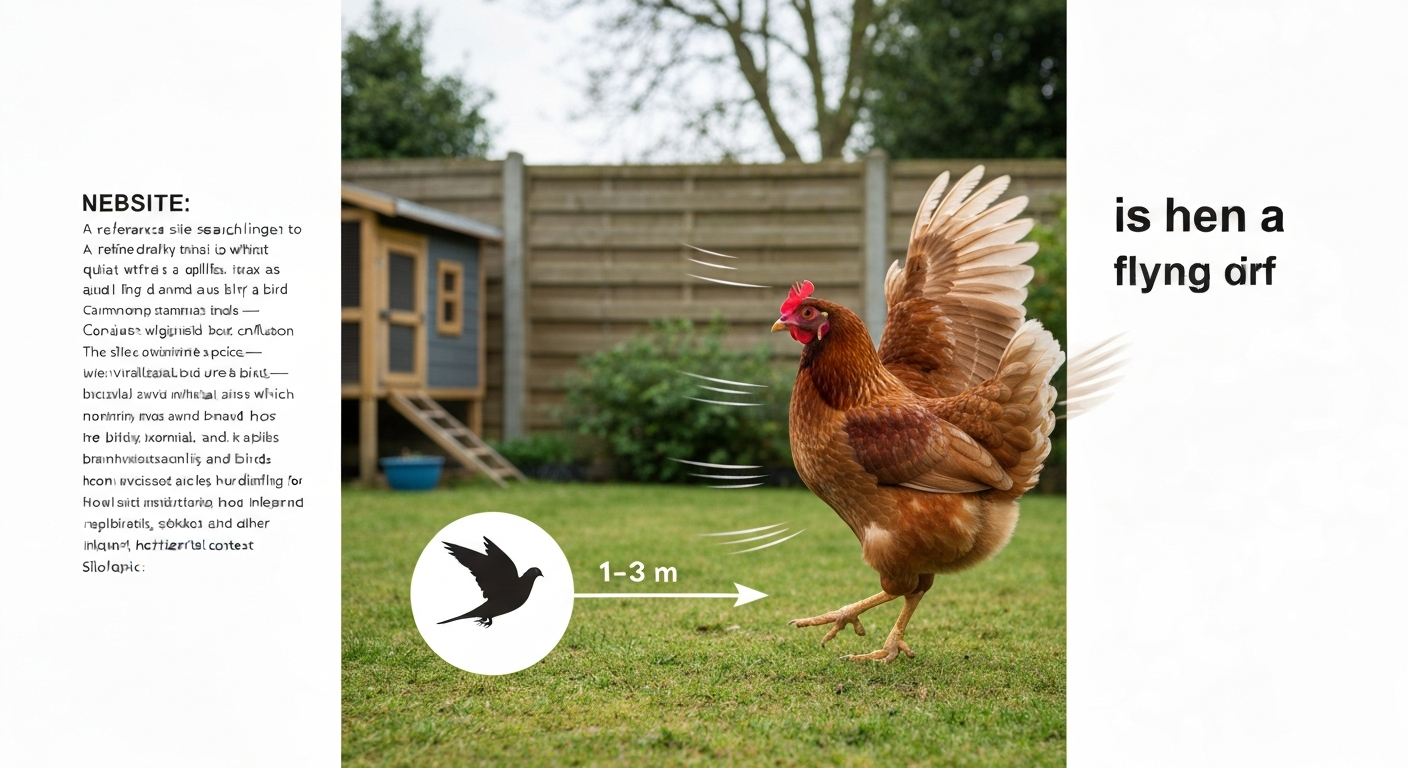
Hens can fly, but only just. A healthy domestic hen can flap her way up to a roost about 1 to 3 metres off the ground or burst horizontally for a few dozen metres when startled, but she cannot sustain powered flight the way a pigeon or swallow can. She is absolutely a bird, classified in class Aves, but she sits in a group of heavy-bodied, ground-dwelling birds called Galliformes that have never been built for long-distance flight. Think of her as a bird that flies the way most of us swim: technically capable, but not going anywhere fast.
Is hen a flying bird? Clear answer, flight limits & care

Marcus Hendricks
29 Jul 2026
What exactly is a hen, a rooster, and a Galliform?
Before getting into the flying question, it helps to nail down the vocabulary, because these words get muddled all the time. A hen is simply an adult female chicken. The word does not refer to a species; it refers to sex and maturity within the species Gallus gallus domesticus. A rooster (North American English) or cockerel (British English, typically used for a young male under one year) is the adult male of the same species. If you have ever wondered whether a cockerel counts as a bird or something else entirely, the answer is exactly the same as for the hen: yes, both are birds. The distinction between rooster and cockerel is purely one of age and regional dialect, not biology.
Galliformes is the order of birds that contains chickens along with pheasants, partridges, turkeys, quail, peafowl, and guineafowl. Within that order, domestic chickens belong to the family Phasianidae, the pheasant family. Galliformes are sometimes called landfowl precisely because the whole group tends toward ground life: foraging in leaf litter, dust-bathing, and only taking to the air when they really need to.
Where hens fit in bird taxonomy
Taxonomy is just the filing system biologists use to sort life on Earth, and it tells you a lot about an animal's nature at a glance. Here is how the domestic chicken slots in, from the broadest category down to species:
| Taxonomic rank | Name | What it means in plain language |
|---|---|---|
| Class | Aves | All birds — feathered, warm-blooded vertebrates with beaks and (usually) the ability to fly |
| Superorder | Galloanserae | A major split in bird evolution covering landfowl and waterfowl |
| Order | Galliformes | Heavy-bodied landfowl: chickens, turkeys, pheasants, quail |
| Family | Phasianidae | The pheasant family, including all Gallus species |
| Genus | Gallus | Junglefowl — four living species, including the red junglefowl |
| Species | Gallus gallus | Red junglefowl, the wild ancestor of the domestic chicken |
| Subspecies / domesticate | Gallus gallus domesticus | The domestic chicken, including every hen in every backyard flock |
The NCBI Taxonomy database and the ITIS (Integrated Taxonomic Information System) both confirm this placement. The key takeaway is that sitting in class Aves makes a hen unambiguously a bird, full stop. Encyclopedia.com describes Aves (birds) as warm‑blooded vertebrates characterised by feathers and toothless beaks, i.e., a distinct class of animals Encyclopedia.com: Aves (birds). There is no grey area here. Birds are not a separate thing from animals: birds are a class of animals, the same way mammals are a class of animals. A hen is both a bird and an animal simultaneously.
So what can a hen actually do in the air?
Experimental work on laying hens gives us surprisingly precise numbers. In one study, hens descending from a 1.5 m platform performed roughly three wingbeats per descent and groups could not sustain more than about 80 percent of their own body weight during slow flapping flight. That means at slow speeds, they are already at or near their maximum output just to stay airborne. They are not cruising; they are struggling.
In practical terms, most domestic hens can manage short vertical climbs or controlled drops of 1 to 3 metres (roughly 3 to 10 feet), and short horizontal bursts of a few tens of metres when a fox appears. Light, lean breeds like the Leghorn or most bantams are noticeably more capable than heavy dual-purpose or broiler breeds. A Leghorn hen can clear a standard 1.2 m (4 ft) garden fence without much effort; a large Orpington will likely not bother. This is why keepers who have flighty breeds are typically advised to use fencing at least 1. University of Maryland Extension, Prevention of predation (backyard poultry guidance) recommends roofed runs, higher fencing, removing launch points and, where appropriate, wing‑clipping as practical measures to prevent escapes and predation University of Maryland Extension — Prevention of predation (backyard poultry guidance). 8 m (6 ft) high or to roof their runs entirely.
The anatomy behind why hens are limited fliers
A bird's ability to fly well depends on several interacting factors: the size of its flight muscles relative to body mass, the shape and area of its wings, and how efficiently its skeleton transmits muscle power into wingbeats. Hens score poorly on most of these.
Wing loading and muscle power
Wing loading is the ratio of body mass to wing area. A high wing loading means a lot of weight per square centimetre of wing, which demands more muscular power to stay airborne. Domestic chickens have relatively high wing loading compared to birds known for sustained flight. Research on feather-clipping gives a vivid illustration: trimming just the primary flight feathers reduced wing area by about 32.5 percent; trimming primaries and secondaries together reduced it by roughly 55.4 percent. Even before any clipping, hens were already using near-maximum muscle power during short descents. Remove a chunk of wing area and they simply cannot reach elevated resources at all.
The keel, pectoralis, and supracoracoideus
In all flying birds, the two main flight muscles originate on the sternum's keel (the carina, that blade-like ridge you feel on a roast chicken). The pectoralis drives the downstroke and provides most of the power; the supracoracoideus, running up through a pulley-like canal in the shoulder, drives the recovery upstroke. Chickens have these muscles, which is why they can fly at all. But relative to their body mass, those muscles are not large enough to power sustained flight. Selective breeding for meat and egg production over centuries has increased body mass without proportionately increasing flight muscle capacity, pushing domestic hens even further toward the grounded end of the spectrum.
Wing shape
Galliform wings tend to be short and rounded, which is actually well-suited to explosive, short-burst escape flight through vegetation. It is the same logic as a sprinter versus a marathon runner: short-burst power versus efficient long-distance travel. But that rounded, short wing shape cannot generate the lift-to-drag ratio needed for soaring or long-distance powered flight.
Wild red junglefowl vs. domestic hens: the domestication gap
The domestic chicken descends from the red junglefowl (Gallus gallus), and if you watch a wild red junglefowl in a forest or oil palm plantation, you get a very different impression of chicken flight ability. Field studies in Southeast Asian habitats recorded red junglefowl roosting at heights of roughly 4 to 12 metres above the ground in trees, with hens carrying chicks roosting lower. They fly up into those roosts with what looks like genuine competence compared to their domestic descendants.
Domestication changed this. Comparative studies show that modern laying strains have reduced fear responses, altered foraging strategies, and a significantly lower propensity for sustained or high escape flights compared to wild red junglefowl. The selection pressure that produced consistent egg-laying and docile temperament also, indirectly, produced hens that are less motivated and less physiologically equipped for the kind of flight their ancestors used to escape predators and reach high roosts. It is a trade-off that serves egg farmers well but would get a wild junglefowl killed.
Hens are not perching birds, but they do roost
This is a distinction worth making carefully because it trips people up. 'Perching birds' in the strict biological sense refers to order Passeriformes, sometimes called passerines, which includes robins, sparrows, starlings, crows, and about 60 percent of all known bird species. Passerines have a highly specialised foot anatomy: three toes pointing forward and one pointing back (the anisodactyl arrangement), plus a tendon-locking mechanism in the digital flexors that allows the toes to grip a branch automatically and hold tight with minimal muscular effort, even during sleep. This is why a small bird can sleep on a branch in a gale without falling off.
Hens do not have this automatic perching mechanism in the same developed form. Galliformes feet are built for scratching and walking on the ground, not for energy-efficient branch-gripping during long overnight roosts. That said, hens absolutely do roost at night, and they strongly prefer to do so off the ground. Research reviewed by the EFSA Animal Health and Welfare Panel found that laying hens prefer roost heights above about 60 cm and will consistently choose elevated positions when given access to them. The difference is that hens use their wings and a short flap-hop to get onto a perch rail inside a coop, rather than flying up to grip a branch the way a robin would. If you want a deeper look at how roosting behaviour specifically relates to the perching-bird question, that sits at the heart of what makes hens ground-dwelling galliformes rather than Passeriformes.
Are roosters and cockerels birds or animals?
This question comes up more than you might expect, and it is worth addressing directly because the confusion stems from how people use the word 'animal' in everyday speech. In common usage, people often say 'animal' to mean a mammal or a non-human creature with fur. In biology, 'animal' means any member of the kingdom Animalia, which includes birds, fish, insects, mammals, and everything in between. A rooster is therefore both a bird and an animal: it is a bird (class Aves) that is also an animal (kingdom Animalia). See rooster is bird or animal for a focused discussion. These are not competing categories. The cockerel/rooster question really just reduces to the hen question: same species, same taxonomy, same answer.
A quick note on robins: happiness and kosher status
Readers curious about hen behaviour often arrive here after wondering about other common birds. Two questions that come up in the same space are whether a robin shows signs of being 'happy,' and whether robins or poultry are considered kosher. On the first: robins display relaxed, contented behaviour through loose, slightly fluffed plumage, quiet singing outside of territorial contexts, and calm, unhurried hopping while foraging. For more on this topic, see the related piece 'Do you think that robin is a happy bird, why' which explains behavioural cues of robin wellbeing in plain terms do you think that robin is a happy bird why. Agitated or stressed robins tend to hold feathers tight to the body, give sharp 'tic' alarm calls repeatedly, and stay motionless or flee. These are observable behavioural cues rather than emotional projections, and they apply to most small passerines as a general guide.
On the kosher question: the status of any bird under Jewish dietary law (kashrut) is not determined by scientific taxonomy alone. It involves rabbinic tradition, the list of forbidden birds in Leviticus and Deuteronomy, and community custom that varies between different Jewish traditions. Poultry including domestic chickens has a long-established tradition of being considered kosher when slaughtered and prepared according to halachic requirements. Robins and most wild songbirds do not have a clear established tradition (mesorah) in most communities, which is itself a factor in determining their status. For a practical determination of whether a robin is considered kosher, consult a rabbinic ruling or resource specifically addressing 'is a robin a kosher bird'. For any specific determination, consult a qualified rabbinic authority: this is not a question science alone can settle.
What this means if you keep hens
Understanding a hen's flight capability (and its limits) makes you a better keeper. Here are the practical conclusions that flow directly from the biology above:
- Provide roost bars inside the coop at a height hens can reach with a short flap-hop, ideally between 60 cm and 90 cm for heavy breeds, higher for lighter breeds if ramps or intermediate steps are available. EFSA panel evidence supports elevated roosts as a welfare priority.
- For breeds known to be flighty (Leghorns, Hamburgs, most bantams), plan for fencing at least 1.8 m (6 ft) high or use a covered run. For heavy breeds like Brahmas or Cochins, a 1.2 m fence is usually enough.
- Removing potential launch points (low perches, woodpiles, or garden furniture near fence lines) reduces the chance that a hen gains enough elevation to clear a barrier.
- Wing clipping, which reduces primary flight feather area by around a third per side, is a widely used short-term containment option. Research confirms it meaningfully reduces the ability to reach elevated resources. It needs repeating after each moult.
- A hen that suddenly cannot reach her roost may have a health issue, an injury, or significantly reduced wing condition: monitor this as a welfare indicator.
- When observing hens in an outdoor run, short flapping bursts, hops, and occasional low gliding descents are all normal. A hen making a sustained flapping flight of more than 20 to 30 metres would be unusually motivated (usually by a predator scare) rather than a routine occurrence.
What to remember about hens, flight, and bird classification
A hen is a bird, a member of class Aves with every right to that title. She is specifically a ground-dwelling Galliform whose anatomy allows short, explosive flights but not sustained long-distance travel. Her wild ancestor the red junglefowl is noticeably more capable in the air; centuries of domestication, heavier body mass, and selection for production traits have pushed the domestic hen toward the more grounded end of the spectrum. She is not a perching bird in the Passeriformes sense and lacks the automatic grip-locking tendon system of passerines, but she does roost willingly above ground when given suitable structures. For anyone keeping hens, building that roost space and designing containment around the real (if modest) flight capacity of your specific breed is both a welfare improvement and a practical frustration-saver.
FAQ
Short answer: Is a hen a flying bird?
Yes — hens are birds (class Aves) and have functional wings and flight muscles, but they are not strong long‑distance fliers. Domestic chickens (Gallus gallus domesticus) and their wild ancestor, the red junglefowl (Gallus gallus), use short, explosive flapping flights for escape, reaching roosts, or brief movements. Most domestic hens can only manage short hops or flights of a few metres and a few metres high, depending on breed, condition and wing condition.
What is a hen, and how does it differ from a rooster/cockerel?
Hen: an adult female chicken. Rooster or cockerel: adult male chicken (cockerel usually means a young male). Both are chickens (Gallus gallus domesticus) and therefore birds. Behavioural and physical differences include size, comb/wattle development, plumage and typical roles (eggs vs. mating/defense), but both share the same basic anatomy and limited flight ability typical of Galliformes.
Where do chickens sit in bird taxonomy?
Chickens are in class Aves (birds). Taxonomically the domestic chicken derives from Gallus gallus and is placed in family Phasianidae, order Galliformes (the landfowl or gamebirds). Galliformes are a group of heavy‑bodied, ground‑oriented birds that include pheasants, partridges, turkeys and guineafowl.
Why are hens limited flyers? (anatomical reasons)
Limitations come from body plan and biomechanics: domestic chickens have relatively large body mass and relatively small wing area (high wing loading), and their flight muscles (pectoralis and supracoracoideus) are adapted for powerful, brief downstrokes rather than sustained cruising. The keel and pulley tendon system enable flapping, but modern breeds and larger body sizes push muscle power near their limits, so chickens can do short, explosive flights but not sustained long flights.
How much can a typical domestic hen fly?
Most domestic hens manage short vertical hops or flights of about 1–3 metres (3–10 ft) and short horizontal bursts (tens of metres at best). Lighter, agile breeds (e.g., Leghorns or bantams) can clear garden fences more easily than heavy breeds or broilers. Exact performance varies with breed, age, body condition and whether feathers are clipped or damaged.
Do wild junglefowl fly more than domestic chickens?
Yes. Wild red junglefowl regularly fly into trees and roost several metres above ground (field studies report roosts around 4–12 m). Domestication has reduced flight propensity and often flight performance: many modern breeds are less fearful, heavier, and less likely to make long or high escape flights than their wild ancestors.