SEO Title: Is Kelenken a Terror Bird? Fossil Evidence, Taxonomy, and Classification Meta Description: Yes, Kelenken guillermoi is a terror bird. Learn what that means, how scientists classify it, and how it differs from dinosaurs and other giant birds.
Is Kelenken a Terror Bird? Fossils, Taxonomy & Evidence

Marcus Hendricks
6 Aug 2026
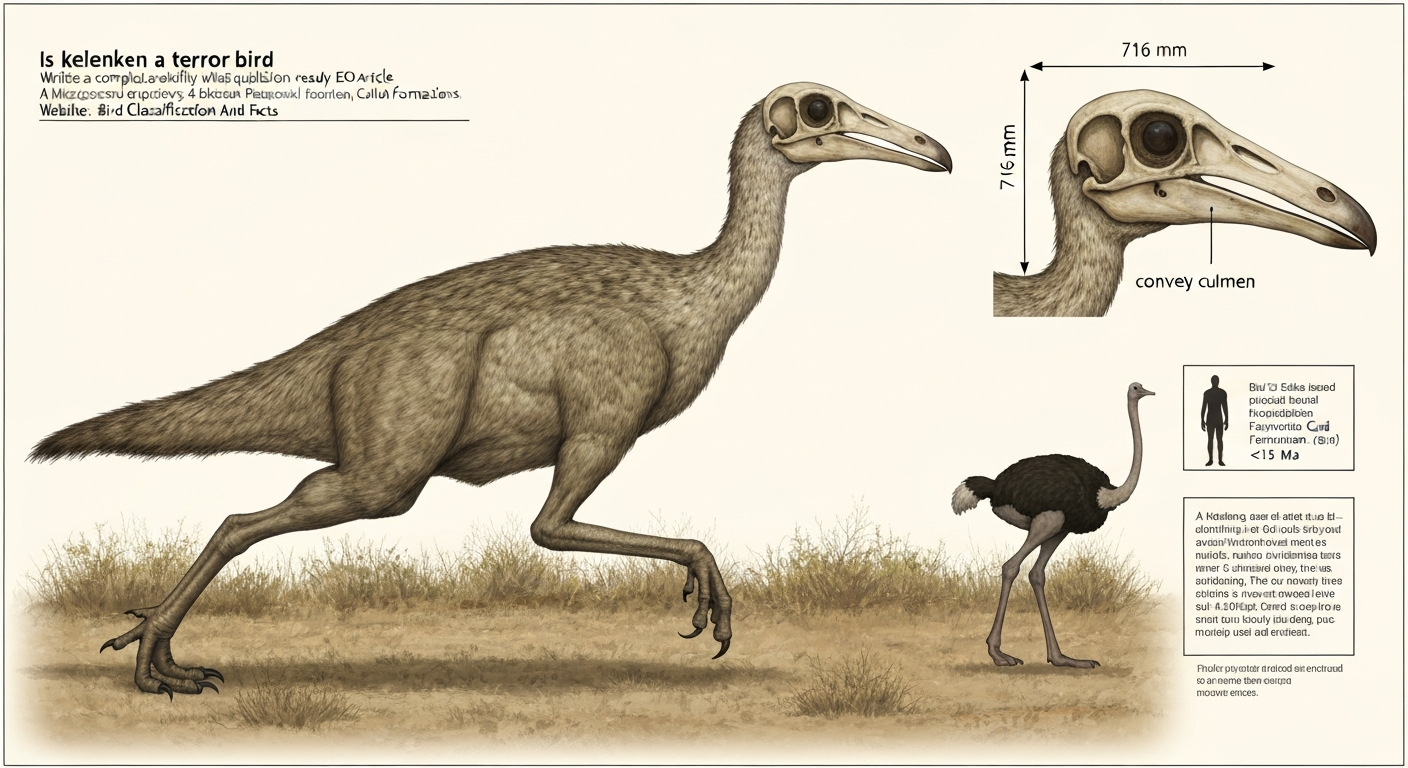
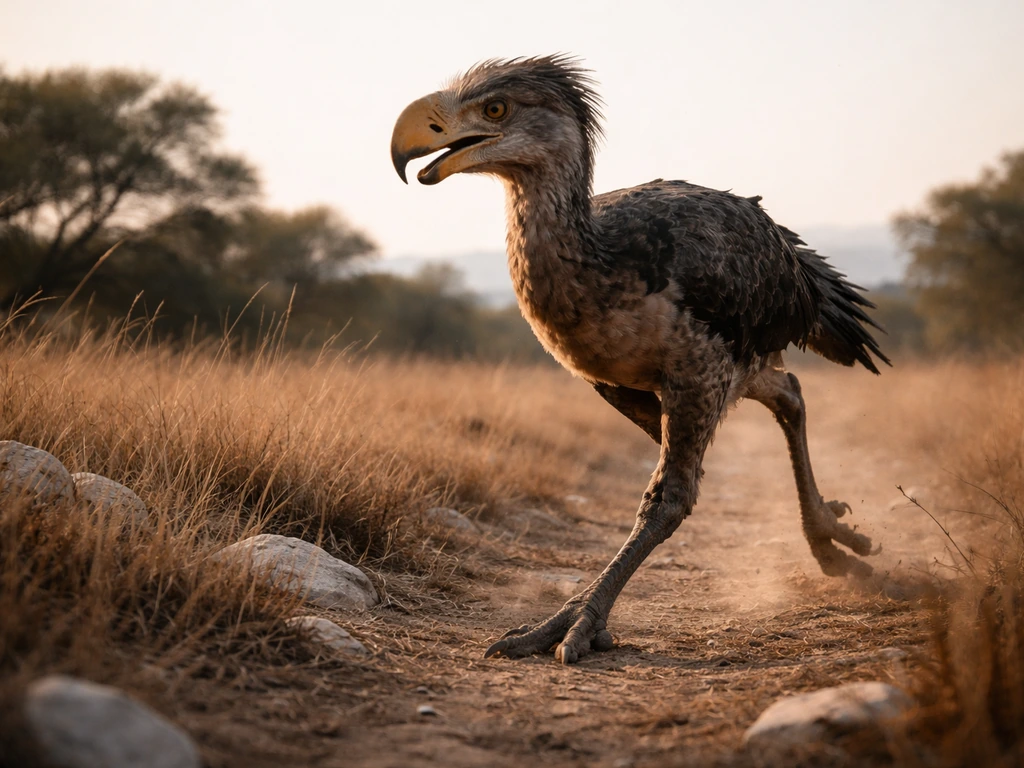
Yes, Kelenken guillermoi is a terror bird, full stop. It belongs to the family Phorusrhacidae, the group scientists formally call terror birds, and it is one of the largest members ever discovered. Its skull, measuring roughly 716 mm from tip to nuchal crest, is the biggest known skull of any bird, living or extinct. If you have seen claims online suggesting it is a dinosaur, a reptile, or something other than a bird, those claims are wrong. Kelenken is a genuine bird in every biological sense of the word.
What Kelenken Is and Where It Was Found
Kelenken guillermoi was formally named and described in 2007 by paleontologists Sara Bertelli, Luis Chiappe, and Claudia Tambussi in the Journal of Vertebrate Paleontology. The holotype specimen (catalog number BAR 3877-11, housed at the Museo Asociación Paleontológica Bariloche in Río Negro, Argentina) consists of a nearly complete skull, a left tarsometatarsus, and a partial pedal phalanx. That might sound like a modest haul, but a near-complete skull is genuinely rare and enormously informative for classifying an extinct bird.
The fossil came from Comallo, Río Negro Province, in Patagonia, Argentina, pulled from outcrops assigned to the Collón Curá Formation. Radiometric dating places those rock layers in the Middle Miocene, roughly 15 to 14. Vera B., Reguero M., et al. (2017) discuss Bilmes et al. (2013)'s 40Ar/39Ar date of 14.86 ± 0.13 Ma for the middle Collón Curá Formation (Gastre Basin), which places many Collón Curá fossil horizons in the Langhian (middle Miocene) Vera B., Reguero M., et al. (2017) (discussion citing Bilmes et al. 2013 40Ar/39Ar date 14.86 ± 0.13 Ma for middle Collón Curá; regional stratigraphic synthesis).. 86 million years ago. So Kelenken was wandering Patagonia long before humans existed, during a time when South America was an island continent with its own extraordinary fauna. That isolation is part of why terror birds grew so large and dominated as top predators.
The tarsometatarsus (the fused foot bone running from ankle to toe joints) measures approximately 437 mm. To put that in perspective, an ostrich tarsometatarsus is typically around 350 to 390 mm. Kelenken was not just big for a terror bird; it was enormous even by the standards of the largest living birds today.
What Exactly Is a Terror Bird? Defining Phorusrhacidae
The informal name 'terror bird' refers specifically to members of the family Phorusrhacidae. These were large to gigantic flightless predatory birds that lived primarily in South America from the Eocene through the end of the Pleistocene, spanning roughly 60 to 2.5 million years ago. One genus, Titanis, even made it into North America after the Great American Biotic Interchange. The colloquial name is used in both popular and scientific literature, including an authoritative 2011 book chapter titled 'Phorusrhacids: the Terror Birds' by Alvarenga, Chiappe, and Bertelli.
Not every big flightless bird qualifies. The diagnostic traits that put an animal in Phorusrhacidae are specific and anatomical. The standard taxonomic reference, Alvarenga and Höfling's 2003 systematic revision, lists a suite of cranial and appendicular features that define the family. In plain terms, a phorusrhacid has a skull that is deep, laterally compressed, and tipped with a strongly hooked, raptorial beak. The culmen (the ridge along the top of the bill) is distinctly convex. The overall skull architecture is built for delivering powerful downward strikes, more like a hatchet than a filter-feeding bill. The legs are long and robust, built for speed rather than swimming or digging.
- Large to gigantic body size, with many species exceeding 1 meter in height and some reaching 2.5 meters or more
- Skull that is deep and laterally compressed, not broad and flat
- Strongly hooked rostrum (upper beak tip) with a convex culmen
- Reduced, vestigial wings incapable of flight
- Long, powerful hindlimbs suited for rapid terrestrial locomotion
- Fused tarsometatarsus with robust architecture typical of active cursorial predators
- Restricted to the Americas, with the fossil record concentrated in South America
- Temporal range spanning Eocene to late Pleistocene (roughly 60 to 2.5 million years ago)
Where Kelenken Sits in the Bird Family Tree
Phorusrhacidae sits within the order Cariamiformes, which in turn belongs to Neognathae, one of the two major divisions of modern (crown-group) birds. The other division is Palaeognathae, which includes ostriches, emus, and their relatives. So Kelenken is not some evolutionary dead-end oddity; it is a neognath bird, more closely related to living seriemas (family Cariamidae, still alive today in South America) than to ostriches or any dinosaur that isn't a bird.
Bertelli et al. (2007) originally placed Kelenken in the subfamily Phorusrhacinae alongside giants like Phorusrhacos and Titanis. Later phylogenetic work has complicated that picture. A 2015 study by Degrange and colleagues and a 2024 time-calibrated Bayesian phylogeny by LaBarge and colleagues both found that 'Phorusrhacinae' as traditionally defined is probably not a natural group (technically, it is paraphyletic). In some analyses, Kelenken clusters with taxa previously placed in other subfamilies. What none of this changes is the family-level assignment: Kelenken is unambiguously a phorusrhacid, a terror bird, placed within Phorusrhacidae in every published phylogenetic analysis.
The Evidence Checklist: Why Kelenken Is a Terror Bird
Here is the specific evidence that puts Kelenken squarely inside Phorusrhacidae, drawn from the original description and subsequent phylogenetic studies.
- Skull morphology: the 716 mm skull shows the deep, laterally compressed profile and strongly hooked rostrum diagnostic of phorusrhacids, as described in the holotype diagnosis in Bertelli et al. (2007)
- Convex culmen: the upper bill ridge curves convexly, a feature listed in the family diagnosis by Alvarenga and Höfling (2003) and confirmed in the holotype
- Tarsometatarsus form: the approximately 437 mm left tarsometatarsus matches the robust, cursorial proportions seen across Phorusrhacidae
- Cranial architecture consistent with strike-feeding: cranial morphology revisions (Degrange 2012/2021) place Kelenken's skull in the large predatory phorusrhacid morphotype, not the smaller psilopterine type
- Geographic and stratigraphic fit: South American Middle Miocene Patagonia is core phorusrhacid territory; the Collón Curá Formation has yielded other South American crown birds in the same fauna
- Phylogenetic placement: both the 2015 Degrange et al. matrix and the 2024 LaBarge et al. time-calibrated phylogeny consistently recover Kelenken within Phorusrhacidae
- No non-avian features: there is nothing in the skeleton of Kelenken suggesting a non-avian theropod, a mammal, or any other non-bird animal class
Kelenken vs. Dromornis vs. T. rex: Clearing Up Common Confusion
A few other animals get swept into online discussions of terror birds, and the mix-up is understandable because they are all big, extinct, and sometimes described with dramatic language. Here is a direct comparison so you can see exactly why Kelenken belongs to one category while the others do not.
| Feature | Kelenken guillermoi | Dromornis stirtoni | T. rex |
|---|---|---|---|
| Animal type | Bird (Aves, crown group) | Bird (Aves, crown group) | Non-avian theropod dinosaur |
| Family | Phorusrhacidae (terror birds) | Dromornithidae (mihirungs) | Tyrannosauridae |
| Time period | Middle Miocene (~15 Ma) | Miocene–Pleistocene | Late Cretaceous (~68–66 Ma) |
| Location | South America (Patagonia) | Australia | North America |
| Diet | Carnivore/predator | Likely herbivore or omnivore | Carnivore/apex predator |
| Flight | Flightless | Flightless | Never flew (non-avian) |
| Skull length | ~716 mm (largest known bird skull) | Large but differently shaped | ~1,500 mm (very different morphology) |
| 'Terror bird'? | Yes | No | No |
Dromornis stirtoni, sometimes called the 'mihirung' or demon duck of doom in popular writing, is a bird but not a terror bird. It belongs to Dromornithidae, an Australian family that is probably related to waterfowl and landfowl (Galloanserae) rather than to Cariamiformes. It was gigantic and likely not a dedicated predator. The name 'terror bird' sometimes gets applied to it loosely in pop-science articles, but formally it does not belong to Phorusrhacidae. For a focused discussion, see Is Dromornis a terror bird Is Dromornis a terror bird?. T. rex, meanwhile, is a non-avian theropod dinosaur from the Mesozoic. It is related to birds in the broad evolutionary sense (birds descended from avian theropods), but T. rex itself is not a bird. Whether T. rex counts as a 'bird' depends entirely on which definition you use, and that question comes up often enough that it is worth addressing directly.
How Scientists Draw the Line Between Birds and Non-Avian Dinosaurs
This is where things get genuinely interesting, and where a lot of internet confusion originates. Scientists who study bird origins, including key researchers like Kevin Padian and Luis Chiappe (whose 1998 review in Biological Reviews remains a foundational reference), define birds as the avian lineage of theropod dinosaurs. Authoritative treatments, notably Padian & Chiappe (1998) and Mayr (2016/2017), summarize how systematists define birds as the avian (crown‑group) theropod lineage and distinguish crown birds from non‑avian Mesozoic theropods blank" rel="noopener noreferrer">Padian K. & Chiappe L.M. 1998. The origin and early evolution of birds. Biological Reviews 73:1–42 (authoritative review on bird origins, definitions of avian vs. non‑avian theropods); Mayr G. 2016/2017. Avian Evolution: The Fossil Record of Birds and its Paleobiological Significance (textbook synthesis) also summarizes crown‑group definitions.. In phylogenetic terms, birds (Aves) are typically defined as the crown group containing all living birds and their common ancestor. Under this definition, T. rex is NOT a bird. For a deeper look at whether T. rex should be called a bird, see the article 'Was the T. rex a bird' was the trex a bird. See the separate discussion titled "T. rex is a bird" for a focused explanation of the definitions and evidence behind claims that T. rex should or should not be called a bird. It is a non-avian theropod. It sits on the dinosaur family tree closer to birds than, say, a sauropod does, but it branched off before the avian lineage and never developed the features that define crown-group birds.
The features that distinguish crown birds from their closest non-avian relatives include a fully fused wishbone (furcula), a keeled sternum (in flying species), feathers with complex microstructure, a highly modified hand and wrist suited to wing function (or secondarily reduced in flightless birds), and a suite of skull characters including a fully kinetic beak. T. rex had some of these features in partial or precursor form, but it was not a bird any more than your thumb is a hand. Kelenken, by contrast, has all the features of a crown-group bird. It is nested within Neognathae. T. rex is nested outside Aves entirely.
Birds Are Avian Dinosaurs, and Why That Doesn't Mean What You Think It Means
Here is the cladistics note that trips people up. In modern phylogenetic classification, birds ARE dinosaurs. For a concise explanation of this cladistic point, see our explainer titled "are bird dinosaurs," which clarifies what scientists mean when they say birds are living dinosaurs. Specifically, they are avian dinosaurs, the one lineage of the dinosaur family tree that survived the end-Cretaceous extinction. When a biologist says 'birds are living dinosaurs,' that is a precise, defensible statement about evolutionary descent, not a poetic metaphor. Dinosauria is the clade that includes Triceratops, Brachiosaurus, T. rex, and every living sparrow, eagle, and penguin. For a clear explanation of whether terror birds count as dinosaurs in cladistic versus colloquial use, see Is the terror bird a dinosaur.
What this does NOT mean is that T. rex was a bird, or that Kelenken is a dinosaur in the colloquial sense. The word 'dinosaur' in everyday conversation usually means the non-avian Mesozoic animals: the big scary ones that died out 66 million years ago. In cladistic terms, those are 'non-avian dinosaurs.' Kelenken is a bird, and because birds are avian dinosaurs, Kelenken is technically a dinosaur in the same technical sense that you are a tetrapod. The label is accurate but not very illuminating for everyday purposes. What matters practically is that Kelenken is a bird, a real feathered, beak-having, egg-laying crown-group bird, and it is the largest-skulled one we have ever found.
This same logic applies when people ask whether T. rex was a bird or a reptile, or whether birds should be classified as reptiles. The answer depends on which classification system you use: traditional Linnaean taxonomy or phylogenetic cladistics. Under cladistics, birds are avian dinosaurs and technically within the reptile lineage (Reptilia in its broadest sense includes birds). Under traditional classification, birds are separated from reptiles. For practical purposes, when someone asks 'is Kelenken a bird,' the answer is yes by any reasonable definition. For a focused discussion of that issue, see Is T. rex a reptile or bird.
A Note on the Name 'Terror Bird' and Why It Only Belongs to Phorusrhacidae
The term 'terror bird' is informal but it has a consistent scientific referent: Phorusrhacidae. You will occasionally see it applied loosely to Dromornis, to large raptors, or even to fictional animals, but when paleontologists use it, they mean phorusrhacids. Kelenken meets every criterion. It is South American, Cenozoic, large, flightless, predatory in build, and sits inside Phorusrhacidae in every published phylogenetic analysis. If there is a poster child for the 'terror bird' label, Kelenken's 716 mm skull is a strong candidate.
The Practical Takeaway: How to Tell a Real Bird From a Dinosaur
If you want a quick mental checklist for evaluating whether a fossil animal is a bird, these are the criteria paleontologists lean on most heavily.
- Does it have a toothless beak covered in keratin, or a beak-like structure derived from one? (Modern birds lack teeth; some early birds had teeth, but the beak structure distinguishes them from non-avian theropods)
- Does the skeleton show a fused clavicle (wishbone/furcula)?
- Are the forelimbs modified as wings, even if secondarily reduced for flightlessness?
- Does the tarsometatarsus show the fused, bird-specific form rather than the unfused condition of non-avian dinosaurs?
- Does phylogenetic analysis consistently place the animal within Aves (crown group) rather than outside it?
- Is the temporal range Cenozoic or Late Cretaceous (consistent with crown-group birds or their immediate stem relatives)?
Kelenken checks every one of those boxes. T. rex checks none of them in the full sense. Dromornis checks most of them but fails the family-level test for Phorusrhacidae specifically. The classification system is not arbitrary; it reflects real anatomical and evolutionary differences that you can trace through the fossil record, one bone at a time.
FAQ
SEO title and meta description
SEO title: Is Kelenken a Terror Bird? Evidence, Classification, and Quick Answer Meta description (≤160 characters): Yes — Kelenken is a phorusrhacid 'terror bird'. Learn the fossil evidence, taxonomy, and how it differs from look‑alikes and non‑avian dinosaurs.
Quick answer
Yes. Kelenken guillermoi is identified by paleontologists as a member of Phorusrhacidae (the 'terror birds') based on its giant hooked skull and diagnostic cranial and tarsometatarsal characters from a Middle Miocene Argentine fossil (holotype BAR 3877-11).
What is Kelenken and where/when was it discovered?
Kelenken guillermoi is a large, flightless predatory bird described in 2007 from the Collón Curá Formation near Comallo, Río Negro Province, Argentina. The holotype (BAR 3877-11) includes an almost complete skull, a left tarsometatarsus and partial toe bone. The horizon is Middle Miocene (roughly ~15–14.8 million years ago). (Bertelli et al. 2007; regional radiometric work cited in subsequent studies).
What are 'terror birds' (Phorusrhacidae)?
Phorusrhacidae, commonly called 'terror birds', are an extinct family of large, mostly flightless predatory neornithine birds known from the Cenozoic of South America and other regions. Diagnostic traits include an enlarged laterally compressed hooked rostrum (strongly curved beak), tall fused tarsometatarsi adapted for terrestrial locomotion, and cranial features shared across the family. The common name 'terror birds' is used in both scientific and popular literature to describe this family.
Why do scientists place Kelenken in Phorusrhacidae?
Kelenken was assigned to Phorusrhacidae in its original description because its enormous, laterally compressed hooked beak, distinctive culmen curvature, and several cranial and tarsometatarsal characters match the family diagnosis. Subsequent phylogenetic studies that include Kelenken recover it within the phorusrhacid radiation, though exact subfamily relationships have been revised (some traditional subfamilies are paraphyletic). Key references: Bertelli et al. 2007; Alvarenga & Höfling 2003; Degrange et al. 2015; LaBarge et al. 2024.
Evidence checklist: anatomical and geological reasons Kelenken is classed as a terror bird
Evidence checklist: - Holotype locality: Collón Curá Formation (Middle Miocene), Argentina (~15–14.8 Ma). - Holotype specimen: BAR 3877-11 includes nearly complete skull, left tarsometatarsus, partial pedal phalanx. - Skull morphology: very large skull (~716 mm skull length reported), laterally compressed rostrum, strongly hooked beak (convex culmen) — matches phorusrhacid cranial pattern. - Appendicular elements: tarsometatarsus morphology consistent with large, cursorial phorusrhacids. - Comparative diagnosis: cranial and tarsometatarsal character suite matches Phorusrhacidae as defined in systematic revisions (Alvarenga & Höfling 2003) and described in the Kelenken diagnosis (Bertelli et al. 2007). - Phylogenetic context: included and recovered within phorusrhacid matrices in later studies (Degrange et al. 2015; LaBarge et al. 2024).
Next Article
Is the Terror Bird a Dinosaur? The Science-Backed Answer
Clear answer to is the terror bird a dinosaur, with evolution, traits, and how it differs from non-avian dinosaurs.