Quick verdict: is T. rex a bird?
No, T. rex is not a bird under the standard biological definition most scientists use today. Under the most widely accepted taxonomy, "birds" refers to the crown-group clade Aves, which means the most recent common ancestor of all living birds and every species descended from it. Tyrannosaurus rex sits outside that crown group. It is a non-avian theropod dinosaur, which means it is closely related to birds but did not make the cut taxonomically. That said, the full picture is genuinely more interesting than a flat no, and if you have stumbled into one of those internet debates where someone insists "T. rex is literally a bird," this article gives you the tools to untangle what is actually being claimed and why.
What actually counts as a bird?
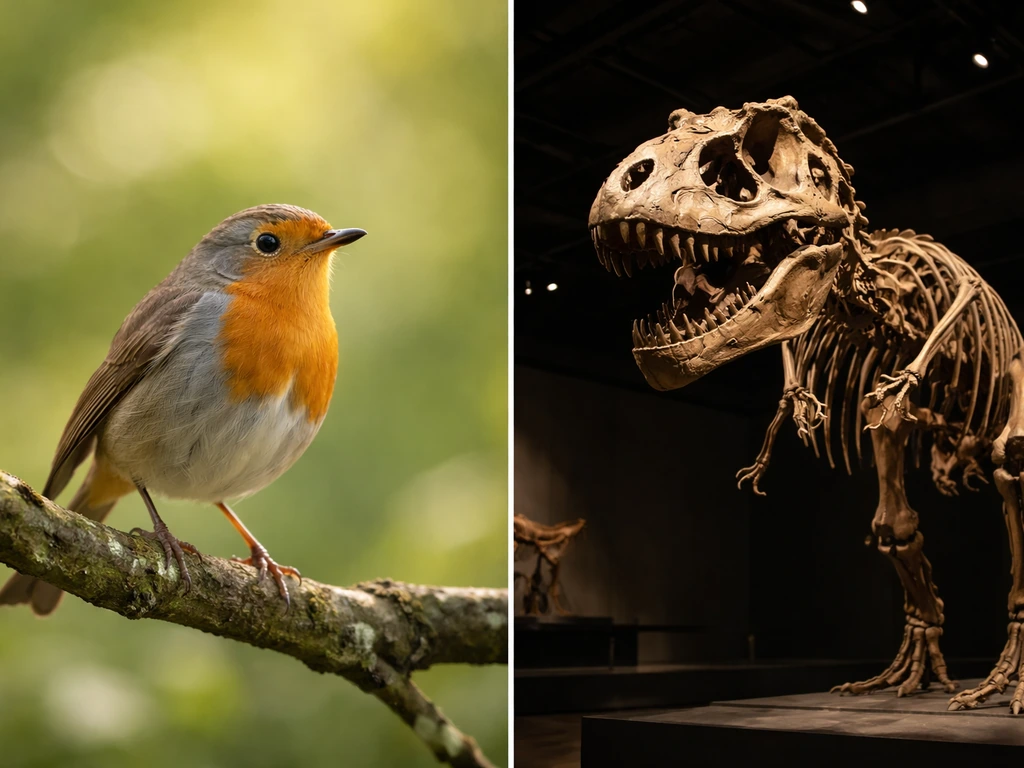
Most people think of birds as feathered, flying, egg-laying animals with beaks. That description works fine in a backyard, but biologists need something more rigorous. Modern taxonomy leans heavily on phylogenetic (clade-based) definitions, where a group is defined by ancestry rather than by a checklist of physical features. Under this system, "Aves" or "birds" is defined as the crown group containing the most recent common ancestor of all living bird species and all descendants of that ancestor. This is called a crown-group definition, and it is the dominant framework in professional systematics today.
Why does that matter? Because it means taxonomy is about where an animal sits on the family tree, not whether it happens to have feathers or a beak. Whether something counts as a dinosaur, reptile, or bird depends entirely on which branch of the evolutionary tree it belongs to. A furcula (wishbone), pygostyle, and semilunate carpal block are among the osteological features that mark the transition toward birds, but a species has to be on the right branch of the tree to qualify as Aves, not just sporting a few similar bones. Character-based evidence helps us place species on the tree; it does not define the group by itself.
How theropod dinosaurs connect to modern birds
Here is where things get genuinely fascinating. Birds did not appear from nowhere. They evolved from a group of dinosaurs called theropods, the same broad group that includes T. rex. Shared skeletal features across both groups, including hollow bones, wishbones, and hip and ankle structures, point to a common theropod ancestor. Fossil evidence shows that feathers and bird-like reproductive behaviors were already evolving in theropod dinosaurs before the first crown birds ever existed. So when you hear someone say "birds are dinosaurs," they are making a precise evolutionary claim: modern birds are the living descendants of theropod dinosaurs, which makes birds a subset of Dinosauria rather than something separate from it.
Think of it like this. Humans are mammals, but not all mammals are humans. Birds are dinosaurs, but not all dinosaurs are birds. T. rex is in the dinosaur family, and it shares a distant common ancestor with modern birds, but it branched off from the lineage leading to crown birds long before that crown group formed. Whether T. rex was a bird in any meaningful sense comes down to exactly this branching point, and the consensus answer is that it branched off too early to be counted as Aves.
T. rex traits vs. bird traits: feathers, bones, and behavior
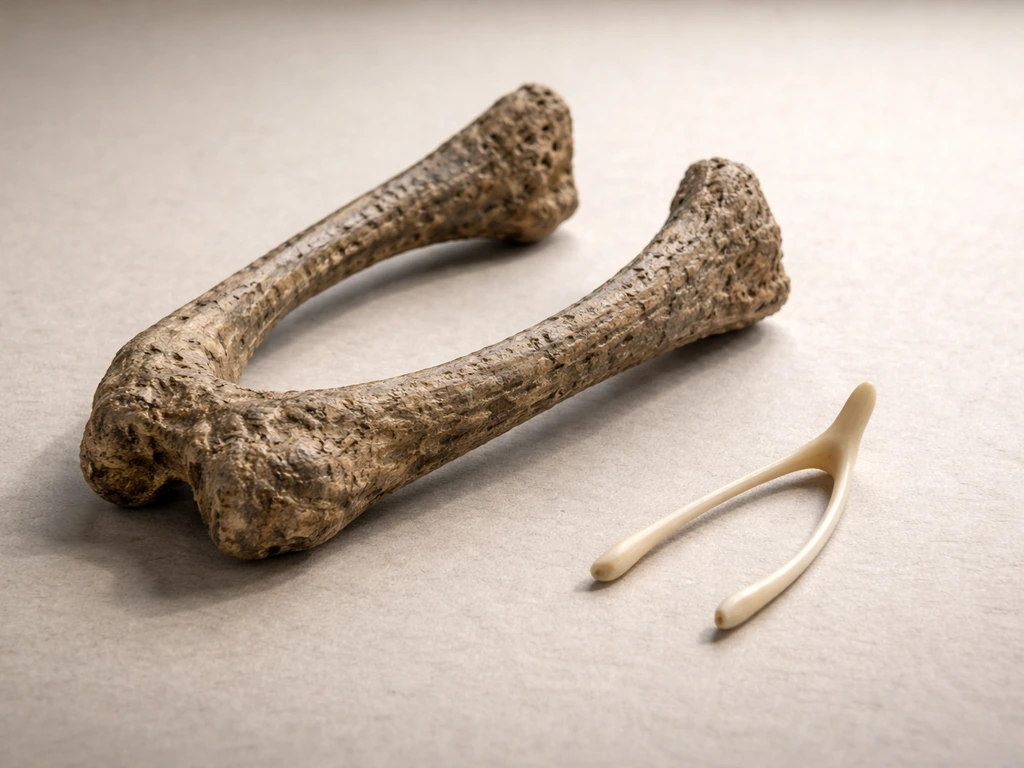
Let's go through the evidence side by side. T. rex does share some genuinely bird-like features. A furcula (wishbone) has been confirmed in Tyrannosaurus rex fossils, a bone long considered a hallmark of avian anatomy. There is also biochemical evidence of medullary bone tissue in T. A peer-reviewed PNAS paper reports endosteally derived medullary bone-like reproductive tissue in Tyrannosaurus rex (MOR 1125), interpreting it as homologous to specialized avian medullary bone biochemical evidence of medullary bone tissue in T. rex. rex, a type of calcium-rich reproductive tissue that modern female birds produce when forming eggshells. These are real, peer-reviewed findings, and they are remarkable.
On feathers, the picture is murkier. Skin impressions from large tyrannosauroids, including regions of the T. rex body, have generally been interpreted as showing scales rather than feathers or protofeathers. Importantly, those patchy impressions do not cover the whole body, so scientists cannot rule out feather-like coverings in unpreserved areas. The honest scientific position is that T. rex probably was not covered in the fluffy feathers you might imagine, but the question is not fully closed either. What is clear is that feather evidence (or the lack of it) is not the deciding factor in taxonomy anyway.
| Trait | Modern Birds | Tyrannosaurus rex |
|---|
| Furcula (wishbone) | Present | Present (confirmed) |
| Pygostyle (fused tail vertebrae) | Present | Absent |
| Feathers | Present (defining integument) | Uncertain; scale impressions found in sampled regions |
| Medullary bone (reproductive tissue) | Present in egg-laying females | Evidence found in one specimen |
| Forelimbs modified as wings | Yes | No; small forelimbs, not wing-like |
| Toothless beak | Yes (in crown birds) | No; large toothed jaws |
| Air-sac respiratory system | Present | Probable in theropods broadly |
| Crown-group Aves membership | Yes | No |
The table makes the pattern clear. T. rex shares some deep structural features with birds, features inherited from a common theropod ancestor. But it lacks the defining derived traits of crown birds, most obviously the pygostyle, the toothless beak, and wings. Being "birdlike" and being a bird are two very different things in taxonomy.
Does "was T. rex a bird" change the answer?
Not really, but the question is worth addressing because it comes up constantly. Some people phrase it as "was T. rex a bird" thinking the past tense might change the classification, as if maybe T. rex got reclassified into birds at some point in history. It did not. T. rex has always been a non-avian theropod under modern taxonomy. The debate over whether T. rex is a reptile or a bird is partly a terminology problem: older classification systems grouped reptiles and birds separately, but modern cladistics treats birds as a branch within what used to be called reptiles. Either way, T. rex sits outside the bird crown group in every historical and modern framework.
The one legitimate sense in which someone might say "T. rex was a bird" is under a broader, more inclusive definition of Aves that some researchers have used historically, one that extends the bird clade further back down the theropod tree to include more primitive forms. Under those alternative definitions, T. rex could in theory fall inside a very broadly defined "Aves." But this is not the mainstream usage, and most working biologists and paleontologists use the crown-group definition. If you encounter the claim in an internet argument, the person is almost always either using a non-standard definition or conflating "birds are dinosaurs" with "all dinosaurs are birds," which is a logical reversal.
Common confusion points, sorted out
"Birds are dinosaurs, so T. rex is a bird"

This is the most common source of confusion and it flips the logic backward. Yes, birds are dinosaurs in the sense that Aves is a clade nested inside Dinosauria. But that does not mean all dinosaurs are birds, any more than all mammals being animals means all animals are mammals. T. rex is a dinosaur, birds are dinosaurs, but T. rex is not a bird. The relationship runs one way.
This one goes the other way. Some people use the scale impressions found on T. rex skin to argue it has nothing to do with birds. That is also wrong. Evolutionary relationships are determined by ancestry and shared derived skeletal features, not by feathers alone. The scale impressions are real and informative, but they do not erase the furcula, the medullary bone evidence, or the deep theropod anatomy T. rex shares with birds. Feathers and scales can actually coexist or alternate within the same evolutionary lineage, and some dinosaur groups appear to have secondarily lost feathery coverings as they grew larger.
"T. rex doesn't look anything like a bird"
Fair point visually, but looks are not the basis of modern classification. The terror birds, for instance, were giant flightless predatory birds that looked more like a dinosaur than a sparrow. Whether the terror bird was itself a dinosaur is a separate question, but the point stands: bird body plans are wildly variable. The giant flightless Kelenken, for example, shows just how different a confirmed bird can look from what most people picture. Kelenken's place among the terror birds is actually a useful reminder that "looks like a bird" and "is a bird" are not the same standard.
This one relies on an outdated model that treats birds and reptiles as completely separate groups. Under modern cladistics, birds are nested within what used to be called reptiles. T. rex being scaly does not make it "just a reptile" that is unrelated to birds. It makes it a non-avian dinosaur with reptilian integument that is still more closely related to living birds than it is to living crocodilians, even though crocodilians are also archosaurs. Looking at Dromornis as a terror bird offers another useful comparison: confirmed birds can have very reptile-like builds, reinforcing that the bird-reptile boundary is about ancestry, not appearance.
A mental model you can actually use
Here is the simplest way to think about any "is X a bird?" question. Start with the tree. Find where X sits relative to the most recent common ancestor of all living birds. If X descends from that ancestor, it is a bird by the crown-group definition. If it branched off before that ancestor, it is a non-avian relative of birds, which is very different from being a bird. T. rex branched off well before the crown-bird ancestor existed, so it is in the second category: a close relative, not a member.
Physical features like feathers, beaks, and wishbones are clues that help scientists place animals on the tree accurately. But they are evidence, not the definition itself. When you see a furcula in T. rex, that tells you something meaningful about shared ancestry. It does not make T. rex a bird any more than having a backbone makes a fish a mammal.
The bottom line: T. rex is one of the most bird-adjacent non-bird animals that ever existed. It shares real anatomical features with birds, it belongs to the broader dinosaur clade that gave rise to birds, and some of its biology would not look out of place in an avian context. But it is not Aves. It never crossed the taxonomic threshold into the crown group. Calling it a bird is a fun oversimplification at best, and a logical reversal at worst. What it actually is, a massive, ferociously successful non-avian theropod with a wishbone and possibly medullary bone, is honestly more interesting than just calling it a bird.