
Yes, a roadrunner is absolutely a desert bird. The Greater Roadrunner (Geococcyx californianus) and the Lesser Roadrunner (Geococcyx velox) are two real, living bird species that spend their lives in arid and semi-arid landscapes across the southwestern United States, Mexico, and parts of Central America. They belong to the cuckoo family Cuculidae, they have feathers, lay eggs, and possess a full avian skeleton, and their physiology is tuned specifically for surviving in hot, dry environments where water is scarce and temperatures are punishing. If you came here wondering whether the roadrunner from cartoons has any basis in reality, the answer is yes, and the real bird is arguably more impressive than the animated version.
Is a Roadrunner a Desert Bird? Taxonomy & Habitat

Marcus Hendricks
10 Aug 2026
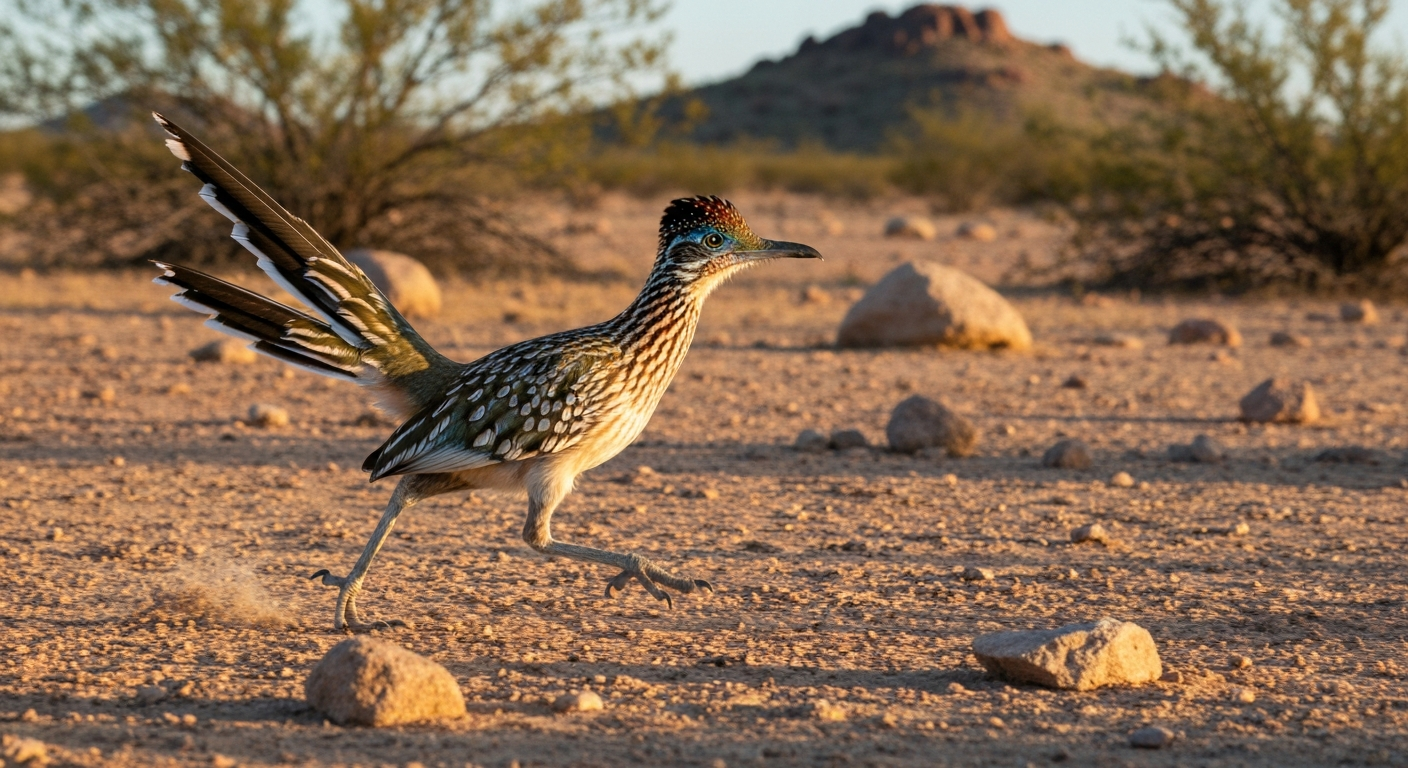
Is a roadrunner a desert bird? The quick answer
Roadrunners are desert birds in every meaningful sense of the term. Their range is centered on some of North America's driest ecosystems, including the Sonoran, Chihuahuan, and Mojave deserts. Peer-reviewed habitat studies published in the Journal of Field Ornithology and Western North American Naturalist explicitly describe Greater Roadrunners as birds of arid and semi-arid ecosystems. WWF ecoregion frameworks place their core distribution squarely within desert and arid shrubland classifications. Their behavior, physiology, diet, and nesting habits all reflect millions of years of adaptation to landscapes where rainfall is unreliable and shade is precious. This is not a bird that happens to pass through the desert on migration. It lives there year-round.
Taxonomy and species: where roadrunners sit in the bird family tree
Roadrunners belong to the genus Geococcyx, which is placed within the family Cuculidae, the same family as the common cuckoo. The name Geococcyx comes from Greek roots meaning roughly 'earth cuckoo,' which tells you a lot about how taxonomists viewed these birds from the start. The IOC World Bird List and the Clements/AOU checklists, the two major classification systems used by professional ornithologists, both recognize exactly two living species in the genus.
Greater Roadrunner (Geococcyx californianus)
This is the species most North Americans are familiar with, and the one that inspired the Looney Tunes character. Adults typically measure around 56 to 61 cm (22 to 24 inches) from bill tip to tail tip, making them one of the larger ground-dwelling birds in the region. They have a distinctive streaked brown and white plumage, a shaggy crest they raise and lower depending on mood, and a bare patch of skin behind each eye that flashes blue and red. The Greater Roadrunner is found year-round across the southwestern United States and much of Mexico.
Lesser Roadrunner (Geococcyx velox)
The Lesser Roadrunner is slightly smaller, a bit less boldly streaked, and has a range restricted almost entirely to Mexico and parts of Central America, including Guatemala, Honduras, Nicaragua, and El Salvador. It occupies similar arid and semi-arid scrubland habitats to its northern relative. Because it doesn't range into the United States, it receives far less attention in English-language birding resources, but it is just as real and just as much a desert bird as the Greater Roadrunner.
Geographic range and typical habitats
USGS range maps show the Greater Roadrunner maintaining a year-round, non-migratory presence across a broad swath of the American Southwest and Mexico. Its range stretches from coastal California east through Nevada, Utah, Colorado, and Kansas, and south through the entirety of the Chihuahuan and Sonoran desert regions of Mexico. eBird abundance data from Cornell Lab confirm that core populations are densest in the arid and brushy parts of this range, not in wetter peripheral areas. eBird Status and Trends maps (Greater Roadrunner, eBird Status and Trends (Cornell Lab)) show core abundance concentrated in arid, brushy southwestern landscapes Greater Roadrunner — eBird Status and Trends (Cornell Lab).
Within that range, roadrunners are not found everywhere uniformly. They prefer a specific microhabitat: a mix of open, bare, or short-grass ground for running and hunting, interspersed with dense low shrubs, mesquite thickets, or chaparral for cover and nesting. Flat, featureless bare desert with no shrub structure is actually less attractive to them than rocky ridge habitats or brushy arroyos. The Audubon Field Guide describes their typical habitat as desert scrub, mesquite-dominated brushland, and chaparral, which captures the pattern well. These are not lush environments by any measure.
Why roadrunners count as desert and arid-land birds
The classification of a bird as a 'desert bird' is not just about where it shows up occasionally. It is about whether a species is ecologically tied to arid systems, meaning it reproduces there, feeds there year-round, and has traits shaped by those conditions. Roadrunners check every box. They are year-round residents, not seasonal visitors. They breed in desert scrub. They hunt desert prey. Their physiology manages the heat and water stress that arid environments impose. Research by Montalvo and colleagues published in Western North American Naturalist documented Greater Roadrunner home ranges specifically within arid rangeland in west Texas, showing that individuals select shrubby desert habitat over open or wet alternatives when given a choice. That is habitat selection in the strictest ecological sense, not opportunistic wandering.
From a conservation planning perspective, the blank" rel="noopener noreferrer">WWF ecoregion framework places Greater Roadrunner populations primarily within Arid and Semi-Arid ecoregions: the Sonoran Desert, the Chihuahuan Desert, the Mojave, and associated shrublands. When a species' distribution map aligns this precisely with desert ecoregion boundaries, calling it a desert bird is not just a casual label. It is a biologically meaningful classification.
Avian traits that confirm roadrunners are birds, full stop
This might seem obvious, but on a site dedicated to bird classification, it is worth being explicit. Roadrunners share every defining feature that separates birds from other vertebrates. They have feathers covering their bodies. They have a toothless beak (bill). They are warm-blooded. They lay hard-shelled eggs and incubate them. They have a four-chambered heart and hollow, lightweight bones optimized for an active lifestyle. Smithsonian National Museum of Natural History and American Museum of Natural History specimen collections both hold Geococcyx californianus specimens confirming standard avian morphology.
On the skeletal side, anatomical research including work published in The Anatomical Record confirms that Geococcyx material shows a keeled sternum (the attachment point for flight muscles), a furcula (wishbone), and the other skeletal hallmarks of birds. The keel is proportionally smaller than in strong fliers, which makes sense given the roadrunner's limited flight, but it is present. Their foot arrangement is zygodactyl, meaning two toes point forward and two point backward, a trait shared with other members of the cuckoo family. You can read this directly from their X-shaped footprints in desert sand, which is a satisfying field confirmation.
Can roadrunners actually fly? Flight ability and locomotion
Yes, roadrunners can fly, but they prefer not to and are not built for sustained aerial travel. Their wings are relatively short and rounded, providing enough lift for short bursts, low glides off elevated terrain, and quick hops into shrubs to roost or escape a threat. National Geographic species summaries note that running is their primary mode of locomotion, and they are genuinely fast on the ground, reaching speeds of around 17 mph (27 km/h) in a sprint. For a bird of their size, that is impressive.
The reduced reliance on flight is an evolutionary trade-off common in ground-dwelling birds that live in open habitats with abundant terrestrial prey. Think of it like a track athlete who has built their entire training program around the 100-meter dash and sees no need to practice the high jump. Roadrunners pursue lizards, snakes, and insects across open ground, and their long legs, long balancing tail, and muscular hindlimbs are all tuned for that lifestyle. Flying away from every problem would burn calories and water, two things that are hard to replace in a desert environment.
Diet and hunting behavior in the desert
Roadrunners are opportunistic carnivores with a broad palate. Classic stomach-content surveys going back to Bryant (1916) and Gorsuch (1932), along with modern accounts from Cornell's All About Birds, document a diet dominated by animal prey: large insects and other arthropods (grasshoppers, beetles, scorpions, centipedes), lizards, small snakes including rattlesnakes, small mammals, nestling birds, eggs, and even the occasional fruit or seed when animal prey is scarce.
Their method for handling venomous prey is worth noting. When a roadrunner catches a snake or large lizard, it repeatedly slams the prey against a hard surface (a rock, a branch) to subdue it before swallowing it head-first. A 2018 paper in The Southwestern Naturalist documented Greater Roadrunner predation on juvenile quail, confirming that they are genuine vertebrate predators, not just insect-pickers. This places them in a meaningful ecological role as mid-level predators in desert food webs, controlling populations of lizards, snakes, and large arthropods.
| Prey category | Examples | Notes |
|---|---|---|
| Arthropods | Grasshoppers, scorpions, beetles, centipedes | Dominant prey by volume in many surveys |
| Reptiles | Lizards, small snakes, rattlesnakes | Killed by bludgeoning against hard surfaces |
| Small mammals | Mice, voles | Opportunistic; less frequent |
| Birds and eggs | Nestlings, juvenile quail, eggs | Documented in field and published research |
| Plant matter | Fruits, seeds | Minor; consumed when animal prey is scarce |
How roadrunners survive the desert: physiological and behavioral adaptations
Desert life imposes two constant challenges: managing body temperature and conserving water. Roadrunners have behavioral and physiological answers to both. On cool desert mornings, they engage in a behavior called sun-basking: they fluff their feathers, orient their back toward the sun, and expose a patch of dark, heat-absorbing skin on their back to solar radiation. This warms their body using free solar energy rather than burning metabolic calories, which is an elegant way to avoid the cost of maintaining body temperature through shivering or elevated metabolism on cold nights.
Water economy is equally important. Roadrunners obtain most of their water from prey, not from drinking standing water, which is often unavailable in the Chihuahuan or Sonoran deserts. They also produce highly concentrated urine and excrete salt through nasal salt glands, reducing the water lost during waste excretion. During the hottest part of the day, roadrunners reduce activity and seek shade, a simple but effective behavioral thermoregulation strategy documented in Calder's 1968 behavioral study in The Condor.
Nesting behavior also reflects desert conditions. Roadrunner nests are typically placed in low trees, dense shrubs like cholla or mesquite, or in cacti, usually 1 to 3 meters off the ground. This positioning provides shade and protection from ground-based predators. Clutch sizes and breeding timing are calibrated to the spring pulse of insect and lizard prey that follows winter rains in the Southwest, connecting their reproductive cycle directly to the seasonal rhythms of the arid landscape.
Roadrunners compared to similar ground-dwelling birds
Roadrunners are sometimes loosely compared to other ground-preferring birds, and it is worth briefly placing them in context. Rails, for example, are true birds in the family Rallidae that also run more than they fly and have a somewhat secretive, ground-level lifestyle. But rails are birds of wetlands and marshes, the ecological opposite of desert scrub. The similarity in behavior (preferring to run, reluctant fliers) reflects convergent lifestyle rather than close relationship. Roadrunners are cuckoos; rails are in a completely different order.
Other ground-birds like quail (family Odontophoridae) share the southwestern desert habitat with roadrunners and are frequently encountered in the same landscapes. Roadrunners actually prey on juvenile quail, so the two groups interact as predator and prey rather than as ecological equivalents. The roadrunner's place in desert ecosystems is more like a small terrestrial hawk than like the gallinaceous seed-eaters it shares territory with.
Roadrunner vs. rail vs. similar ground birds: a quick comparison
| Feature | Greater Roadrunner | Rail (family Rallidae) | California Quail |
|---|---|---|---|
| Family | Cuculidae (cuckoos) | Rallidae | Odontophoridae |
| Primary habitat | Desert scrub, arid brushland | Wetlands, marshes, dense reeds | Chaparral, arid grassland |
| Flight ability | Limited; prefers to run | Limited; prefers to run | Short bursts; prefers to walk/run |
| Diet | Carnivore/omnivore; vertebrates and large invertebrates | Omnivore; seeds, invertebrates, small vertebrates | Primarily seeds and plant material |
| Arid-land specialist? | Yes | No | Partially |
Settling common confusions: what is and isn't a roadrunner-type bird
Because this site fields questions about creatures that people sometimes confuse with birds, it is worth addressing a few related sources of confusion directly. Is Trails a type of bird? A short note distinguishes fictional characters named Trails from real avian species so readers don't confuse names with taxonomic identity. Rodan, the giant flying creature from Japanese kaiju films, is not a bird. It is a fictional monster with pterosaur-like anatomy, and no amount of feathered fan art changes its fictional status. Similarly, Rayman is a video game character with no consistent anatomical classification at all, fictional by design and not modeled on any real bird lineage. If you're curious about whether Rayman is a bird, see the related discussion 'Is Rayman a bird?' (427b7656-03cd-4877-ab32-19a7b5739169).
The real roadrunner, on the other hand, is unambiguously a bird. If you have seen search results or forum posts asking 'is the roadrunner a real bird,' the answer is a straightforward yes. The Looney Tunes Roadrunner was directly inspired by Geococcyx californianus, exaggerating the real bird's speed and elusive desert-running behavior for comedic effect. For more detail on whether the roadrunner is a real bird, see is the roadrunner a real bird. The real bird cannot outrun a coyote by a factor of ten, but it is fast, clever, and genuinely hard to catch, which apparently gave the animators enough to work with.
Conservation status and population trends
The Greater Roadrunner is currently assessed as Least Concern on the IUCN Red List, with a large extent of occurrence and no evidence of rapid population-wide decline. BirdLife International and the U.S. Fish and Wildlife Service treat it as not globally threatened. That said, some localized declines have been documented in California, where habitat conversion, urban sprawl, and changing land use have reduced available desert scrub and brushland in parts of the species' western range. The roadrunner is not in crisis, but it is not immune to the habitat pressures that affect most arid-land wildlife in the southwestern United States.
The Lesser Roadrunner (Geococcyx velox) is assessed separately by BirdLife/IUCN. Its more restricted range in Mexico and Central America means that regional habitat changes carry greater proportional risk, though it is also currently listed as Least Concern. Both species are non-migratory, which makes them sensitive to localized habitat degradation in ways that migratory birds can sometimes avoid.
Key identification facts at a glance
| Feature | Greater Roadrunner | Lesser Roadrunner |
|---|---|---|
| Scientific name | Geococcyx californianus | Geococcyx velox |
| Family | Cuculidae | Cuculidae |
| Length | 56–61 cm (22–24 in) | 46–51 cm (18–20 in) |
| Range | SW United States, Mexico | Mexico, Guatemala, Honduras, Nicaragua, El Salvador |
| Habitat | Desert scrub, mesquite, chaparral | Arid scrub, dry open woodland |
| IUCN status | Least Concern | Least Concern |
| Flight | Limited; primarily terrestrial | Limited; primarily terrestrial |
| Diet | Insects, lizards, snakes, small mammals, birds | Similar to Greater; insects, lizards, small vertebrates |
Practical tips for spotting a roadrunner in the field
If you are in the southwestern United States and want to find a roadrunner, the most reliable approach is to scan open desert roadsides and brushy arroyos in the early morning. Roadrunners are most active in the first few hours after sunrise, when they are warming up and beginning to hunt. Their upright posture and long tail held roughly horizontal make them unmistakable once you have the image in your head. They tend to pause in the open briefly before darting into cover, so slow driving on rural desert roads in Arizona, New Mexico, or Texas gives you reasonable odds of an encounter.
- Look for a large, streaked brown bird with a shaggy crest and a very long tail running across open ground or roadsides
- Early morning activity is peak, especially on cool desert mornings when they bask with their backs to the sun
- Their call is a descending dove-like coo (often described as mournful), not the cartoon 'beep beep'
- Zygodactyl (X-shaped) footprints in dry sand or mud confirm a roadrunner passed through
- Look in mesquite thickets, cholla patches, and brushy dry washes for nesting pairs in spring
- They are often unbothered by slow-moving vehicles, making roadsides in the Sonoran and Chihuahuan desert regions reliable spots
The bottom line
A roadrunner is a desert bird by every measure that matters: taxonomy, range, habitat selection, physiology, behavior, and ecology. It is a real, classifiable, well-documented species in the family Cuculidae, genus Geococcyx, with two living species distributed across the arid landscapes of North and Central America. Its adaptations to heat, water scarcity, and desert prey are not coincidental. They are the product of a long evolutionary relationship with some of the driest ecosystems on the continent. The cartoon got the setting right, even if it exaggerated everything else.
FAQ
Is a roadrunner (Genus Geococcyx) a desert or arid‑land bird?
Yes. Roadrunners (Genus Geococcyx) are desert and arid‑land birds: authoritative range maps and species accounts (USGS, eBird/Cornell, Audubon) place Greater and Lesser Roadrunners primarily in Sonoran/Chihuahuan/Mojave and other arid to semi‑arid scrublands and brush habitats, and peer‑reviewed habitat studies describe their selection of arid and semi‑arid shrub/grassland areas.
What is the taxonomy of the roadrunner?
Roadrunners belong to genus Geococcyx within the cuckoo family Cuculidae. Major taxonomic checklists (IOC, Clements/AOU, ITIS) list two extant species: Greater Roadrunner (Geococcyx californianus) and Lesser Roadrunner (Geococcyx velox).
Which roadrunner species are recognized and where do they occur?
Two recognized species: Greater Roadrunner (Geococcyx californianus) — native to the southwestern United States and much of northern and central Mexico (year‑round in desert and adjacent brush/grassland); Lesser Roadrunner (Geococcyx velox) — ranges in parts of Mexico and Central America. Range info is summarized by USGS, eBird, and regional field guides.
What habitat do roadrunners prefer and why are they classed as desert birds?
Roadrunners prefer arid to semi‑arid habitats — desert scrub, mesquite/chaparral, thorn scrub, and open brush with patches of bare ground. These habitat preferences, documented in Audubon, eBird, USGS maps and peer‑reviewed studies, align with standard desert/arid‑land ecoregion classifications (Sonoran, Mojave, Chihuahuan), which is why they are classed as desert/arid‑land birds.
What avian traits confirm a roadrunner is a real bird?
Roadrunners have standard avian features: feathers, beak, eggs, a flight skeleton (furcula, keel on sternum), and other typical bird osteological characters. Museum specimens and anatomical studies (Smithsonian/NMNH records; comparative osteology papers) document these features.
How do roadrunners fly? Do they fly long distances?
Roadrunners can fly but are primarily terrestrial. They use short, rapid flights for roosting, brief escapes, or to reach low branches; sustained, long‑distance flight is limited. Field guides and species accounts (Cornell, National Geographic) describe running as their primary locomotion.
Next Articles
Is Trails a Type of Bird? Quick Verdict and ID Guide
Is Trails a bird? Clear verdict, ID test, roadrunner & rail profiles, plus tips to verify ambiguous names.

Is Rayman a Bird? What Makes a Bird in Taxonomy
Find out whether Rayman is a bird using real bird taxonomy criteria and why looks-like mascots usually do not count.
Is Rodan a Bird? How to Verify What Rodan Means
Learn if Rodan counts as a real bird using a biology trait checklist and tips to verify the exact meaning.