"Trails" is not a recognized type of bird. No bird species, genus, or widely accepted common name spelled exactly T-R-A-I-L-S appears in any major taxonomic checklist, including HBW/BirdLife, Clements, or Avibase. What you are almost certainly thinking of is either "Traill's" (as in Traill's Flycatcher, the historical name for what is now the Willow Flycatcher, Empidonax traillii) or "rails" (family Rallidae), a very real and widespread bird family. One misheard syllable or a missing apostrophe-plus-letter is all it takes to send a search in the wrong direction.
Is Trails a Type of Bird? Quick Verdict and ID Guide

Marcus Hendricks
4 Aug 2026
What people could mean when they say "Trails"
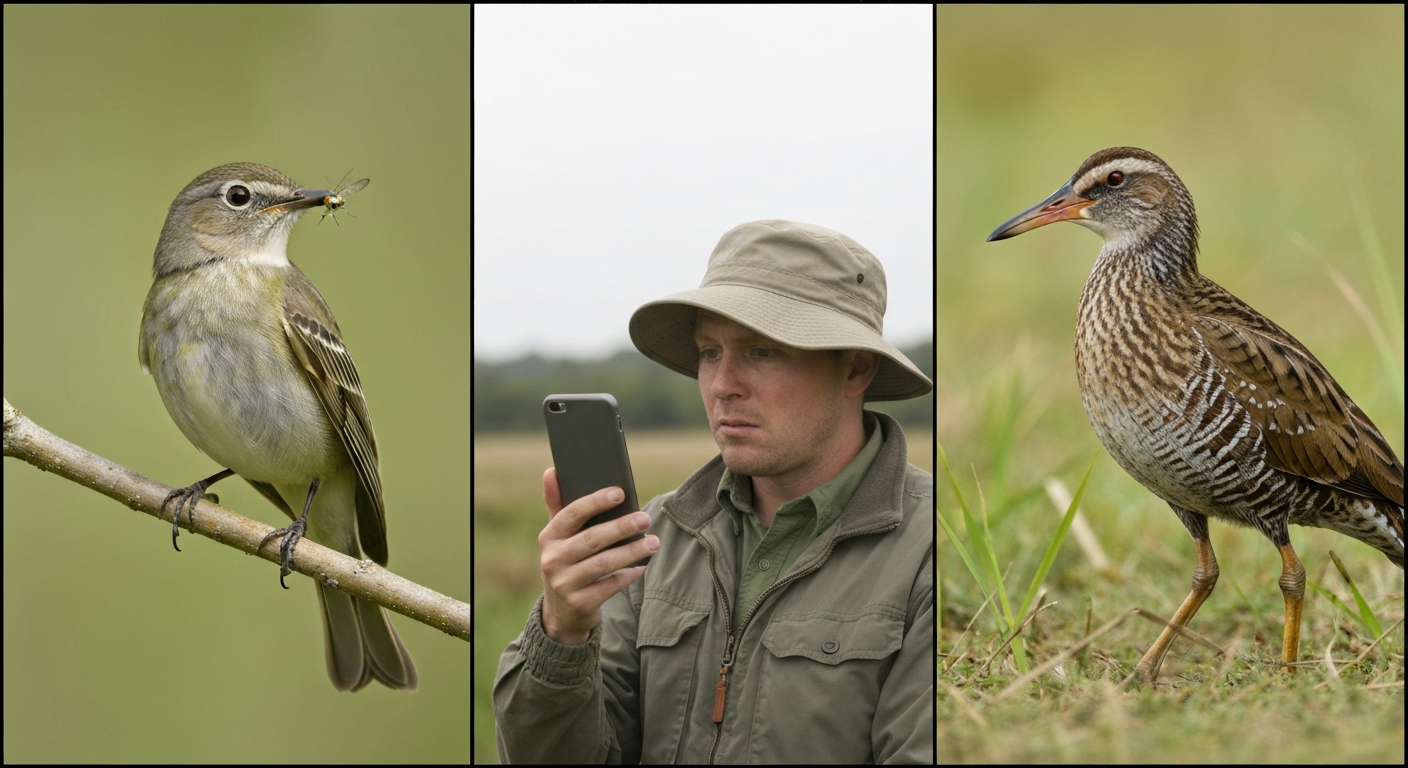
When this question lands in a search bar, it usually comes from one of three places. First, and most likely, the person heard or half-read the old common name "Traill's Flycatcher" and the possessive ending got dropped, leaving just the phonetic sound "trails." Second, someone may be thinking of "rails" (the bird family) and accidentally added a "t" at the front, either while typing or mis-hearing someone else say it. Third, "trails" could be a totally unrelated proper noun, a brand name, a trail system, or even a gaming term, none of which have anything to do with ornithology.
The historical bird connection is the most interesting of the three. John James Audubon named a small flycatcher Muscicapa traillii in honor of Scottish physician and naturalist Thomas Stewart Traill in the early 19th century. That bird was known colloquially as "Traill's Flycatcher" for well over a century. In the 1970s, taxonomists recognized that what everyone was calling Traill's was actually two cryptic species: the Willow Flycatcher (Empidonax traillii) and the Alder Flycatcher (Empidonax alnorum). The Cornell Lab of Ornithology's Willow Flycatcher overview notes that "Traill's Flycatcher" was historically used for what are now the Willow and Alder Flycatchers blank" rel="noopener noreferrer">Willow Flycatcher overview — Cornell Lab of Ornithology (All About Birds). The species epithet traillii survived on the Willow Flycatcher, and many birders still use "Traill's" informally in the field when they spot an Empidonax flycatcher they cannot separate to species by sight alone. For an example of this shorthand in fall banding reports, see the Kiawah Island Banding Station (example banding report referencing “Traill's” flycatcher usage), which uses “Traill’s” when Empidonax flycatchers cannot be separated by plumage alone.
Trails vs. Rails: how one letter changes everything
This is one of those confusions that makes perfect sense in spoken English. Say "rails" and "trails" out loud and the only difference is a "t" at the start. In a noisy field, a fast podcast, or a rushed conversation, that distinction can easily disappear. Rails (family Rallidae) are completely real birds found on every continent except Antarctica, and they are genuinely interesting enough that someone mentioning them might spark a curious Google search. If you heard someone say "Are trails a type of bird?" in conversation, there is a fair chance they actually said "Are rails a type of bird?" and the answer to that question is a firm yes. More on rails below.
The same phonetic swap can happen with the Traill's/trails confusion. "Traill's" is pronounced exactly like the English word "trails," so anyone listening rather than reading could easily transcribe it wrong. The apostrophe and the extra "l" that distinguish the bird name from the common word are invisible in speech. That is the kind of everyday language trap that brings a lot of people to bird classification sites in the first place.
How to tell whether a named creature is actually a bird
Before diving into specific names, it helps to have a quick diagnostic toolkit. Biologists classify birds as members of the class Aves, and every true bird shares a core set of features that no other living animal group has all at once. You do not need a microscope or a university degree to apply this test: most of these traits are visible in a photograph or a field guide illustration.
- Feathers: the single most reliable marker. No other living animal has true feathers. If it has feathers, it is a bird. If it does not, it is not.
- Beak or bill: birds have keratinous beaks and no teeth (in living species). Beaks vary enormously in shape but are always present.
- Wings: birds have forelimbs modified into wings. Even flightless birds like penguins and ostriches have wings, though they use them differently.
- Warm-blooded (endothermic): birds regulate their own body temperature internally.
- Egg-laying with hard or leathery shells: birds lay amniotic eggs; most lay hard-shelled eggs.
- Hollow or pneumatized bones: bird skeletons are lightweight and structurally specialized for either flight or ground movement.
- Classified within Aves: if it appears in a reputable taxonomic database (Cornell's Birds of the World, GBIF, ITIS, BirdLife) as a species within class Aves, it is a bird by scientific consensus.
Run any name through these criteria and you will get a reliable answer. A creature that lacks feathers, has no beak, and does not appear in any taxonomic checklist is not a bird, regardless of how bird-like it might look or how the name sounds.
Step-by-step: applying the test to "Trails" or any ambiguous name
- Search the exact spelling in a reputable database. Start with Avibase, GBIF, or Cornell's Birds of the World. Type the name exactly as you have it. If nothing comes back, that is a meaningful result.
- Try phonetic or near-spelling variants. Swap letters, add or remove an apostrophe, or try plural and singular forms. "Trails" → "Traill's" → "traillii" is a good example of how a small change leads to a real taxonomic match.
- Check for a scientific (Latin) name. Real bird species always have a two-part Linnaean name (genus + species epithet) registered with bodies like ITIS or NCBI Taxonomy. Empidonax traillii is a valid name; "Trails" is not.
- Look for physical images from verified sources. Search museum collections (Audubon Society, Smithsonian, natural history museums) for photographs or illustrations. If the creature has feathers and a beak in those images, it is a bird.
- Ask whether it is fictional or commercial. Characters from films, video games, and brand logos are not taxonomic entries. If the name points to a franchise or a movie monster, it is not a biological bird regardless of appearance.
- Cross-check the common name against multiple checklists. A legitimate common name appears consistently across BirdLife, Clements, and the IOC World Bird List. If a name only shows up in a single informal source, treat it with skepticism.
Applied to "Trails": Step 1 returns no valid species. Step 2 reveals Traill's Flycatcher and Empidonax traillii. Step 3 confirms the scientific name is valid but attached to the Willow Flycatcher, not a bird called "Trails." Verdict: "Trails" by itself is not a bird name; Traill's (the historical common name) points to real birds in the genus Empidonax.
Roadrunner: yes, it is a real bird
The Greater Roadrunner (Geococcyx californianus) is a legitimate North American bird species, not just a cartoon. It belongs to the cuckoo family (Cuculidae) and lives across the southwestern United States and Mexico, favoring open desert scrub, chaparral, and grasslands. See also: a roadrunner is a desert bird. Adults reach about 56 to 61 centimeters in length and are more comfortable sprinting along the ground at speeds up to roughly 32 kilometers per hour than flying. They have long tails, shaggy crests, and strong, slightly hooked bills that they use to kill prey as large as rattlesnakes. They lay eggs, they have feathers, they have a two-part scientific name registered in every major checklist: every box on the bird diagnostic test is checked. The animated cartoon character associated with the name is fictional, but the bird itself is entirely real and surprisingly tough. If you’re asking "is the roadrunner a real bird", the answer is yes, the roadrunner (Genus Geococcyx) is a genuine bird species in the cuckoo family found in the southwestern U.S. and Mexico.
Rails: a real bird family worth knowing
Rails (family Rallidae) are one of the most geographically widespread bird families on the planet, with roughly 135 to 150 species depending on the checklist. The family includes rails, crakes, gallinules, moorhens, and coots. Is a rail a bird? See the Rails overview for a concise answer. They thrive in wetlands, marshes, reed beds, and even dense grasslands, and they are famous for being secretive: you will often hear a rail's loud, repetitive call long before you ever see it. Classic features include laterally compressed bodies (the phrase "thin as a rail" almost certainly comes from these birds), strong legs built for walking through thick vegetation, moderately short wings, and relatively short bills that vary from species to species.
Rails pass every criterion on the bird checklist with ease: feathers, beak, wings, warm-blooded, egg-laying, and a well-documented place in Aves. If someone asked you whether rails are birds, the answer is an unambiguous yes. The Sora (Porzana carolina), the American Coot (Fulica americana), and the Common Moorhen (Gallinula chloropus) are all Rallidae, and all are birds you can look up in any field guide.
Fictional characters and mascots people mistake for birds
Not every creature with wings or a beak qualifies as a bird, and not every name that sounds bird-related is one. Two names that come up frequently in bird classification searches are Rodan and Rayman, and both fall cleanly outside the category of birds.
Rodan
Rodan is a fictional kaiju created by Toho Studios, first appearing in the 1956 Japanese film of the same name. Visually, Rodan is modeled loosely on pterosaurs (ancient flying reptiles) rather than birds. Pterosaurs were not birds: they were a separate reptile lineage that went extinct at the end of the Cretaceous period and had membranous wings rather than feathered ones. Rodan has no feathers, no beak in the avian sense, no place in any taxonomic database, and no biological existence at all. It is a fictional monster. Applying the five-point test takes about ten seconds: no feathers, no scientific name, not in any checklist. Not a bird.
Rayman
Rayman is a video game character created by Ubisoft, first released in 1995. He is a humanoid with no visible limbs connecting his hands, feet, and head to his torso, which is a design quirk rather than a biological trait of any kind. Rayman has no feathers, no beak, no wings, and no scientific name. He exists in the Ubisoft franchise universe, not in the class Aves. If you search for Rayman in GBIF or Cornell's Birds of the World, you will not find him. Not a bird. For more on this topic, see the short entry titled "is Rayman a bird" (internal reference).
| Name | Real or fictional? | Has feathers? | In taxonomic database? | Verdict |
|---|---|---|---|---|
| Trails | Word / possible misspelling | No | No | Not a bird name |
| Traill's Flycatcher | Real (historical common name) | Yes | Yes (Empidonax traillii) | Bird (Willow Flycatcher) |
| Rails (Rallidae) | Real bird family | Yes | Yes | Birds |
| Greater Roadrunner | Real species | Yes | Yes (Geococcyx californianus) | Bird |
| Rodan | Fictional kaiju | No | No | Not a bird |
| Rayman | Fictional game character | No | No | Not a bird |
How to verify any ambiguous name yourself
When you encounter a name you are not sure about, three practical steps will resolve most questions in under five minutes. First, go to GBIF (gbif.org) or Avibase and search the name in the species lookup. These are curated, globally maintained databases that aggregate taxonomic records from thousands of institutions. A genuine bird species will have a species page, a scientific name, and usually distribution maps and specimen records. If the name returns nothing or only returns informal mentions, that is a strong signal the name is not a recognized bird.
Second, check museum and image archives. Natural history museum collections (Smithsonian, Natural History Museum London, the American Museum of Natural History) hold physical specimens with verified identifications. If a bird has a specimen record with photographs of the actual animal, that is authoritative confirmation. For historical names like Traill's Flycatcher, the Metropolitan Museum of Art's Audubon archives and the Cornell Lab's Macaulay Library both hold illustrations and recordings tied to verified specimens.
Third, check whether the name appears consistently across multiple independent checklists: IOC World Bird List, Clements Checklist, and BirdLife/HBW are the three most authoritative global lists. A legitimate species name or common name will appear on at least two of the three. A name that only surfaces in casual internet posts or a single blog is not confirmed. Cross-referencing takes two minutes and saves a lot of confusion.
Quick checklist: is this name a true bird?
- Does the creature have feathers? (If yes, strong indicator of a bird; if no, likely not a bird)
- Does it have a keratinous beak or bill (no teeth)?
- Does it have wings or modified forelimbs, even if flightless?
- Is it warm-blooded and egg-laying?
- Does it appear in GBIF, Avibase, or Cornell's Birds of the World with a valid two-part scientific name?
- Does the common name appear in at least two of the three major checklists (IOC, Clements, BirdLife)?
- Is it a real biological organism rather than a fictional character, mascot, or brand name?
- If the spelling is unusual, have you tried phonetic variants or near-spellings to check for a match?
If you can answer yes to the first six points and yes to the last two screening questions, the name almost certainly refers to a real bird. "Trails" scores no on most of these. "Traill's" (pointing to Empidonax traillii) scores yes on all of them. That single apostrophe-plus-letter makes all the difference.
FAQ
Is "Trails" a type of bird?
Short answer: No — there is no recognized bird species whose accepted common name is spelled exactly “Trails.” The closest legitimate bird names are “Traill’s” (with two l’s and often an apostrophe) as in the historical vernacular Traill’s Flycatcher, and unrelated common names like “rails” (family Rallidae). Major taxonomic checklists do not list a species called “Trails.”
What does "Traill’s" refer to in bird names?
“Traill’s” (pronounced like “trails”) is a historical/common name associated with Empidonax traillii, the Willow Flycatcher. Historically one taxon was called Traill’s Flycatcher before it was split into Willow Flycatcher (Empidonax traillii) and Alder Flycatcher (E. alnorum). The species epithet traillii honors Thomas Stewart Traill and remains in scientific names and checklists.
How can I tell if a named creature is truly a bird? Quick checklist of defining bird traits
Use these practical diagnostic tests: 1) Feathers — unique to birds; presence of feathers strongly indicates Aves. 2) Wings/modified forelimbs — birds have feathered wings, even if reduced. 3) Beak/bill with no teeth — a keratinous bill is typical. 4) Egg-laying with hard-shelled eggs. 5) Anatomical/phylogenetic placement — it must be classified in Aves in taxonomic databases (e.g., HBW, Clements, ITIS, NCBI). If a creature meets these and appears in major bird checklists, it’s a bird.
Why might people confuse “Trails” with other bird names?
Common sources of confusion: 1) Pronunciation and informal writing — “Traill’s” sounds like “trails,” so casual typing can drop the apostrophe or duplicate l. 2) Mis‑hearing “rails” (Rallidae) as “trails.” 3) Fictional or brand names (Rodan, Rayman) that sound avian to some listeners. 4) Search/autocomplete errors that return unrelated results for the English word “trail.”
Is a roadrunner a bird? Is the roadrunner a real bird?
Yes. The Greater Roadrunner (Geococcyx californianus) is a real bird in the cuckoo order (Cuculiformes/Cuculidae‑related groupings in older treatments). It is a ground‑adapted, long‑legged bird native to parts of the southwestern United States and Mexico, well documented in field guides and species accounts (e.g., Cornell Lab, Audubon).
Is Rodan a bird?
No. Rodan is a fictional kaiju from Toho films, usually depicted as a giant pterosaur‑like monster. It is not a real taxonomic bird species; pterosaurs were flying reptiles (not birds) and Rodan is a fictional character, not a scientific name.
Next Article
Is Rayman a Bird? What Makes a Bird in Taxonomy
Find out whether Rayman is a bird using real bird taxonomy criteria and why looks-like mascots usually do not count.