A sparrow is a bird, and because birds are animals, a sparrow is both. It sits in Kingdom Animalia, Class Aves, Order Passeriformes, the perching birds. There is no biological ambiguity here. Whether you are looking at a House Sparrow pecking at crumbs outside a café or a Song Sparrow singing from a roadside shrub, you are watching a warm-blooded, feathered, egg-laying vertebrate animal.
Sparrow: Is a Sparrow a Bird or an Animal? Quick Guide

Marcus Hendricks
23 Jul 2026
What exactly is a bird? The short taxonomy lesson
Birds belong to Kingdom Animalia, the same kingdom as mammals, reptiles, fish, and insects. Within that kingdom they form Class Aves, a group of roughly 10,000 living species defined by a shared set of traits that no other living animal group has all at once. Feathers are the single biggest giveaway, no living non-avian animal has them. But the full diagnostic package goes further than that.
- Feathers covering the body (unique to birds among living animals)
- A toothless, horny beak instead of toothed jaws
- Endothermy (warm-blooded, internally regulated body temperature)
- Oviparous reproduction with hard or leathery calcified shells
- Pneumatized (air-filled) bones that reduce skeletal weight
- A lung-and-air-sac system that produces largely unidirectional airflow, far more efficient than mammalian tidal breathing
- A high metabolic rate to power flight and maintain body temperature
These traits collectively separate birds from mammals (which have fur, teeth, and give birth to live young in most cases), reptiles (which are ectothermic and lack feathers), and invertebrates like insects (which lack a vertebral column entirely). So when someone asks whether a sparrow is a bird or an animal, the answer is: it is an animal that belongs to the bird class. The two are not mutually exclusive, 'animal' is the broader category, and 'bird' is a specific type within it.
Where sparrows sit in the classification tree
The word 'sparrow' is a common name applied to birds in at least two separate families, which causes a fair amount of confusion on its own. Old World sparrows, the ones most people picture, including the ubiquitous House Sparrow, belong to family Passeridae. New World sparrows, the American species like the Song Sparrow, are placed in family Passerellidae. For example, the Song Sparrow (Melospiza melodia), a member of Passerellidae, typically measures about 13–18 cm (5–7 in) and shows heavy breast streaking; see Song Sparrow, All About Birds (Cornell Lab species account) blank" rel="noopener noreferrer">Song Sparrow — All About Birds (Cornell Lab species account). These two families are not closely related in the way the shared name implies. They were lumped together historically, but modern phylogenetic work separated them, and major taxonomic authorities including the IOC World Bird List, the Clements/eBird checklist, ITIS, and the American Ornithological Society (AOS) all reflect that split.
The House Sparrow (Passer domesticus) is the most recognized species in the Passeridae family and arguably the most widespread wild bird on the planet. Its scientific name is where the entire order gets its label: Passeriformes comes from the Latin passer, meaning sparrow. So when ornithologists say 'passerine,' they are literally saying 'sparrow-like.' That is a satisfying etymological full circle.
| Taxonomic rank | Old World sparrows | New World sparrows |
|---|---|---|
| Kingdom | Animalia | Animalia |
| Phylum | Chordata | Chordata |
| Class | Aves | Aves |
| Order | Passeriformes | Passeriformes |
| Family | Passeridae | Passerellidae |
| Example genus | Passer | Melospiza, Zonotrichia, Junco |
| Example species | Passer domesticus (House Sparrow) | Melospiza melodia (Song Sparrow) |
What a sparrow actually looks like and does
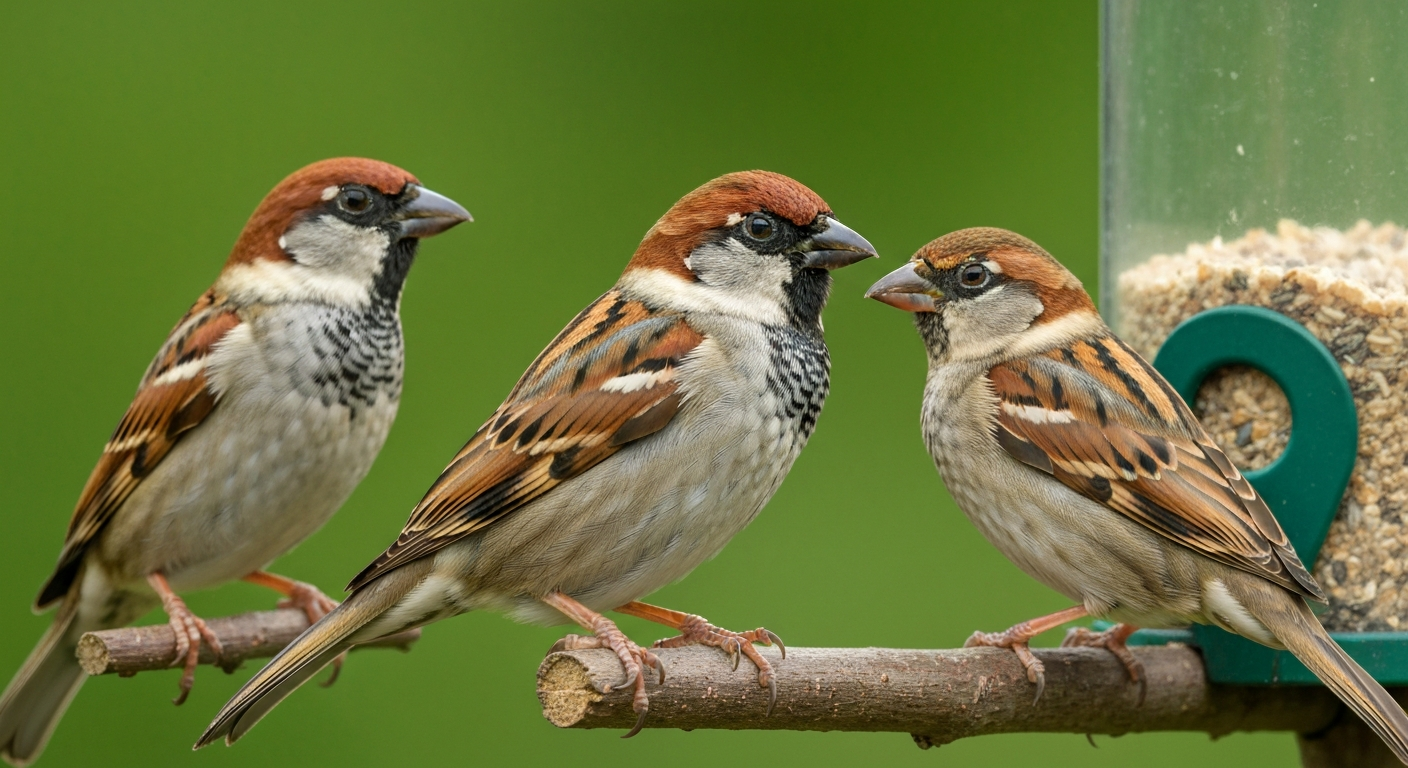
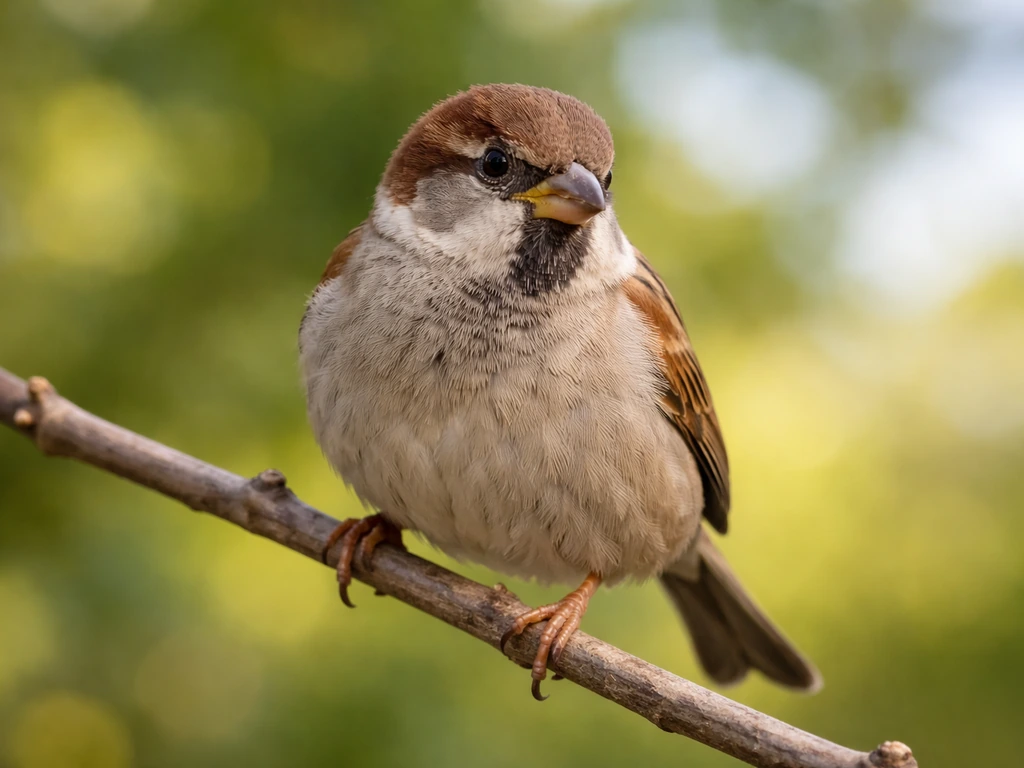
Sparrows are small, stocky birds. A House Sparrow typically measures 12 to 17 cm (4.7 to 6.7 inches) in length, with a wingspan of roughly 18 to 24 cm and a body mass of about 24 to 38 grams, roughly the weight of a large marshmallow. That compact, plump silhouette is one of the fastest field ID clues you have.
The bill is the other instant giveaway. Sparrows have a short, robust, conical beak designed for cracking seeds. It is not the fine, pointed bill of an insect-catcher, not the hooked bill of a raptor, and definitely not the wide, flat gape of a swallow. If you see a small brown bird picking up seeds off the ground and crushing them with a triangular beak, you are almost certainly looking at a sparrow or a close relative in the same ecological guild.
- Size: small and stocky, typically 12–17 cm long and 24–38 g
- Bill: short, thick, conical — adapted for seed cracking
- Plumage: generally streaked brown, gray, and buff tones; males of some species have chestnut, black, or white head markings
- Behavior: ground-foragers that hop and peck; often found near human habitation (especially House Sparrow)
- Diet: primarily seeds, supplemented by insects (especially when feeding nestlings)
- Song: varies widely by species; House Sparrow produces repetitive chirping phrases; Song Sparrow produces complex, musical, regionally variable songs
- Nesting: cup or domed nests in cavities, eaves, dense vegetation, or on the ground depending on species
Sparrows are perching birds, here is what that actually means
All sparrows are passerines, which means they belong to Order Passeriformes, the perching birds. If you want a direct answer to the query 'is sparrow a perching bird', see the linked explanation which confirms sparrows are passerines (perching birds). That name is functional, not just poetic. Passerines have an anisodactyl foot: three toes pointing forward and one (the hallux) pointing backward. When a sparrow lands on a branch or wire, a specialized tendon arrangement automatically locks the toes around it as the leg bends, so the bird can sleep on a perch without falling off. No conscious effort required, gravity does the gripping.
Passerines are also characterized by a complex syrinx, the avian vocal organ located at the junction of the trachea and bronchi. Oscine passerines, the songbirds, which include sparrows, have an elaborately muscled syrinx that enables learned, complex vocalizations. That is why Song Sparrows in one valley can sound noticeably different from Song Sparrows in the next valley over: they learn their songs regionally, much like human dialects. This vocal complexity is both a biological diagnostic and a practical field ID tool once you get your ear in.
Sparrow vs swallow, two very different birds with similar names
This is one of the most common points of confusion, and it is worth settling clearly. Sparrows and swallows are both passerines and are both small birds, but they look and behave very differently. For a focused point-by-point comparison, see the section on whether are sparrows and swallows the same bird which contrasts their anatomy, feeding behavior, and flight adaptations. Swallows (family Hirundinidae) are aerial insectivores built for speed and agility in open air. Sparrows are seed-cracking ground foragers built for hopping around dense vegetation. The bill alone tells the story: a sparrow's conical seed-crusher versus a swallow's tiny, flat bill with an enormous gape for scooping insects mid-flight.
| Feature | Sparrow | Swallow |
|---|---|---|
| Body shape | Stocky, plump | Slender, streamlined |
| Bill | Short, thick, conical | Small, flat, very wide gape |
| Tail | Short to medium, rounded or notched | Long, often deeply forked |
| Wings | Short, rounded | Long, pointed, swept back |
| Flight style | Direct, fluttery, relatively slow | Agile, swooping, acrobatic |
| Legs | Strong, suited for hopping and perching | Very short, rarely walk on ground |
| Feeding | Seeds and insects on or near the ground | Insects caught exclusively in the air |
| Preferred habitat | Dense vegetation, scrub, farmland, urban areas | Open sky above water, fields, cliffs |
If you see a small bird repeatedly diving and curving through the air above a pond or field, it is almost certainly a swallow or swift, not a sparrow. If it is hopping on a pavement outside a bakery and picking up crumbs, that is your sparrow. The behaviors alone separate them before you even raise your binoculars.
Sparrow quick-reference fact table
| Attribute | Detail |
|---|---|
| Kingdom | Animalia |
| Class | Aves (birds) |
| Order | Passeriformes (perching birds / passerines) |
| Old World family | Passeridae |
| New World family | Passerellidae |
| Representative species | House Sparrow (Passer domesticus), Song Sparrow (Melospiza melodia), White-throated Sparrow (Zonotrichia albicollis) |
| Typical body length | 12–17 cm (4.7–6.7 in) for House Sparrow; New World sparrows up to ~18 cm |
| Typical wingspan | 18–24 cm |
| Typical body mass | 24–38 g |
| Diet | Seeds (primary), insects, occasional plant matter |
| Global range | Nearly worldwide; House Sparrow introduced to every inhabited continent |
| Wild lifespan | Typically 2–5 years; up to 7–13 years recorded in banded individuals |
| Conservation status (House Sparrow) | Least Concern (IUCN), though declining in parts of Europe |
| Taxonomic authority | IOC World Bird List, AOS Checklist, Clements/eBird, ITIS |
Pop culture, anime, and oddly-spelled searches, handling the ambiguous ones
A meaningful chunk of people searching 'sparrow is a bird or animal' are not actually confused about biology, they are trying to verify something they saw in a show, a game, or a story. The most common example is Zenitsu Agatsuma's sparrow in Demon Slayer. That small yellow-and-white bird acts as his communication companion and is indeed depicted as a sparrow within the fiction. Whether it maps onto a real sparrow species or is a stylized anime design is a separate question, the in-universe label 'sparrow' refers to something bird-shaped, but it would need context-checking against real sparrow morphology to confirm any species match. The same logic applies to named characters like 'Maya bird': if a source calls something a sparrow, your first job is to check whether the description matches actual sparrow traits (conical bill, seed-eating, Passeridae or Passerellidae placement) or whether 'sparrow' is being used loosely. If you want to check whether the Maya bird is considered a sparrow, see the Maya bird page for specifics.
Then there are the mis-typed searches. 'Is a skewer a bird' almost certainly started as 'is a sparrow a bird' and took a wrong turn on a phone keyboard. If you ended up here via that route, the answer is the same: yes, a sparrow is a bird. A skewer is a metal or wooden cooking implement and is definitively not a bird.
How to verify whether a named 'sparrow' is a real bird
- Find the original source. Is it an anime, a mascot, a video game, or a brand? If so, 'sparrow' may be a stylistic or thematic name, not a taxonomic one.
- Check the visual design. Does the depicted bird have a short conical bill, streaked brown plumage, and a stocky body? Those are real sparrow traits.
- Search the IOC World Bird List or Cornell's All About Birds by name. If the species appears there with a binomial (genus + species name), it is a real, formally described bird.
- Cross-reference the family. Real sparrows sit in Passeridae or Passerellidae. If a source places your bird elsewhere without explanation, treat the 'sparrow' name as informal.
- Use image search plus 'bird' as a modifier. Comparing a fictional design against real sparrow photos often resolves the question quickly.
How to identify a sparrow in the field
Cornell Lab's 'Four Keys' approach, size and shape, color pattern, behavior, and habitat, works very well for sparrow ID. Start with the silhouette before you try to read plumage details. A sparrow is compact and round-headed, sitting low, often on or near the ground. Then move to the bill: is it short and triangular? Cornell Lab's Bird ID Skills: Size & Shape notes that bill shapes and overall silhouettes, like a short, conical bill, are key ID clues for seed‑eating sparrows Bird ID Skills: Size & Shape — All About Birds (Cornell Lab guidance on bill shapes and silhouettes). That locks in the seed-eater profile. After that, look at color pattern and specific field marks.
When photographing a sparrow for later identification, try to capture these specific features: the full head profile showing bill shape and any head-stripe pattern, the back showing streaking patterns, the breast (plain, streaked, or spotted?), the wing bars if present, the tail shape and length, and the feet showing the anisodactyl toe arrangement. Behavior is also evidence, note whether the bird is hopping on the ground, clinging to a grass stem, or feeding at a feeder, and what it is eating.
- Head: look for supercilium (eyebrow stripe), crown stripes, ear-patch color
- Bill: confirm it is short, thick, and conical — not fine or hooked
- Breast: check for streaking, spotting, or plain coloring — a central breast spot is a Song Sparrow hallmark
- Back and wings: note streaking intensity and presence of wing bars
- Tail: length relative to body, and whether it is rounded, notched, or pointed
- Feet: three toes forward, one back (hallux) — visible in perched birds
- Behavior: hopping vs walking, ground foraging vs aerial feeding
- Season and region: range maps and seasonal presence narrow the species list dramatically
Apps and tools that actually help
For anyone doing real-world ID, three digital tools cover almost every situation. Merlin Bird ID (Cornell Lab) uses photo ID and sound ID, you can point your phone at a singing bird and it will identify it in real time from the sound alone, which is genuinely useful for sparrows that are heard more than seen in dense shrubbery. eBird (also Cornell Lab) gives you range maps, recent sighting data from other birders in your area, and the Clements/IOC taxonomy as a backbone. iNaturalist is broader (covering all of nature) but has a strong community of birders who can confirm or correct your ID from your uploaded photos.
For printed resources, a regional field guide beats any app for understanding the local sparrow landscape. In North America, The Sibley Guide to Birds and the National Geographic Field Guide to the Birds of North America both give detailed sparrow accounts. In Europe and beyond, Collins Bird Guide covers the Old World Passeridae species comprehensively. Always check the guide's publication date against current taxonomy, because family placements like the Passerellidae split are recent enough that older editions may still list New World sparrows under Emberizidae.
When the bird name is ambiguous, mascots, hybrids, and look-alikes
Not every bird called a 'sparrow' is one. Java Sparrows (Padda oryzivora) are actually waxbills in family Estrildidae, not Passeridae, just named 'sparrow' because of their seed-eating, stocky build. Grasshopper Sparrows and Savannah Sparrows in North America are Passerellidae members, correctly called sparrows. Cape May Warbler is sometimes confused with sparrows by beginners despite being an entirely different family (Parulidae). Mascot birds and stylized brand logos labeled 'sparrow' may not correspond to any species at all.
The rule of thumb: a bird is a real sparrow only if it appears on a recognized taxonomic checklist (IOC, AOS, Clements/eBird) under a family that includes sparrows. Common names are inconsistent across cultures and languages. Scientific names and family placements are the stable reference points.
Suggested images for this article
- House Sparrow (Passer domesticus) — male perched on a branch or feeder, showing conical bill and chestnut-and-gray plumage; female showing streaked brown tones
- Silhouette comparison panel: sparrow (stocky, rounded tail, short bill) vs swallow (streamlined, forked tail, tiny bill) at the same scale
- Close-up of sparrow bill: side profile showing the thick, conical shape used for seed cracking
- Close-up of sparrow foot: anisodactyl arrangement with three forward toes and one backward hallux, ideally shown gripping a narrow perch
- Song spectrogram or sonogram: visual representation of a House Sparrow chirp sequence alongside a Song Sparrow's more complex melodic phrase
- Taxonomy tree diagram: Kingdom Animalia → Class Aves → Order Passeriformes → Passeridae / Passerellidae
Quick checklist: is what you are looking at a real sparrow?
- Is it a living or depicted bird (not a mascot logo, cooking tool, or fictional emblem used purely symbolically)?
- Does it appear on the IOC World Bird List, AOS Checklist, or Clements/eBird under family Passeridae or Passerellidae?
- Does it have a short, thick, conical bill rather than a fine, hooked, or wide-gaped one?
- Is the body compact and stocky with a relatively short tail?
- Does it forage primarily on the ground or in low vegetation for seeds?
- Does it show the anisodactyl foot structure (three toes forward, one back) typical of passerines?
- If you are working from a pop-culture source, does the visual design or species description match the above traits — or is 'sparrow' just a thematic label?
- If still uncertain, upload a photo to Merlin Bird ID or iNaturalist and cross-check the result against All About Birds species accounts.
Sparrows are unambiguously birds, and birds are unambiguously animals. The confusion usually comes from either a genuine mix-up between 'bird' and 'animal' as categories (where people treat them as alternatives rather than nested groups), or from pop-culture uses of the word 'sparrow' that have nothing to do with Passeridae or Passerellidae. Once you know what makes a bird a bird, feathers, conical beak, air-sac lungs, pneumatized bones, oviparous reproduction, and what makes a sparrow a sparrow within that class, the taxonomy falls into place quickly. Keep a checklist like the one above on hand, use Merlin or eBird when you need confirmation, and the next time someone asks whether a sparrow is a bird or an animal, you can answer before they finish the sentence.
FAQ
Quick answer: Are sparrows birds (and therefore animals)?
Yes. Quick science-backed answer: Sparrows are birds (Class Aves) and therefore animals (Kingdom Animalia). They are small passerine (perching) birds commonly placed in families such as Passeridae (Old World sparrows, e.g., House Sparrow Passer domesticus) and Passerellidae (New World sparrows). Authoritative sources: Cornell Lab All About Birds, AOS checklist, ITIS.
SEO title and meta description for the article
Title: "Are Sparrows Birds or Animals? Clear Taxonomy, ID Tips, and Look‑Alikes" Meta description (≤160 chars): "Yes — sparrows are birds (Class Aves) and therefore animals. Learn taxonomy, ID traits, look‑alike differences, pop‑culture checks and quick field tips."
What defines a "bird" and how are birds different from other animals?
Definition and diagnostic traits: Birds are vertebrates in Class Aves (Kingdom Animalia). Key traits used in taxonomy and field identification include: feathers (unique to birds and their dinosaur ancestors), a toothless horny beak, oviparity with hard-shelled eggs, endothermy (warm-blooded physiology), a lightweight skeleton often with pneumatized (air-filled) bones, and an avian lung–air‑sac system. These traits distinguish birds from mammals (hair, mammary glands), reptiles (scales, ectothermy), amphibians and invertebrates. Sources: Cornell Lab/Handbook of Bird Biology; peer-reviewed reviews on avian anatomy.
How are sparrows specifically classified (families, typical genera, common species)?
Sparrow taxonomy and common examples: The English name "sparrow" covers small, seed-eating passerines in more than one family. Major groupings: - Old World sparrows: Family Passeridae. Example: House Sparrow, Passer domesticus (Order Passeriformes). - New World sparrows: Family Passerellidae (formerly placed in Emberizidae). Example: Song Sparrow, Melospiza melodia. Order for both is Passeriformes (passerines). For authoritative, up-to-date lists consult IOC World Bird List, AOS checklist, ITIS, and Clements/eBird. Typical species measures (House Sparrow): length ~12–17 cm, mass ~24–38 g (ranges vary by region). Sources: AOS checklist, Natural History Museum, Cornell Lab.
What are the diagnostic field traits of sparrows (size, beak, plumage, behavior, song)?
Common diagnostic traits: - Size/shape: small, compact/stocky, often 'plump' silhouette. - Bill: short, robust, conical seed‑crushing bill. - Plumage: generally drab brown/gray with streaking and limited bright colors (sexes/subspecies vary). - Behavior: ground-foraging and hopping, often in flocks; seed‑focused diet. - Song/calls: many are simple chips, short trills or patterned series; as passerines they may produce learned song (oscine syrinx in many species). Use these together — bill + silhouette + behavior + habitat — for reliable ID. Sources: Cornell Lab All About Birds; Bird ID keys.
What does it mean that sparrows are passerines (perching birds)?
Passerine meaning and anatomy: "Passerine" (Order Passeriformes) literally means 'sparrow‑like' from Latin passer. Passerines are characterized by an anisodactyl foot (three toes forward, one back) adapted to perching, a specialized perching tendon mechanism that locks toes around a branch, and in many oscines a complex syrinx enabling learned vocalizations. Practically, passerines are often called perching birds or songbirds; sparrows are typical passerines. Source: Handbook of Bird Biology (Cornell Lab), comparative anatomy literature.
Next Articles
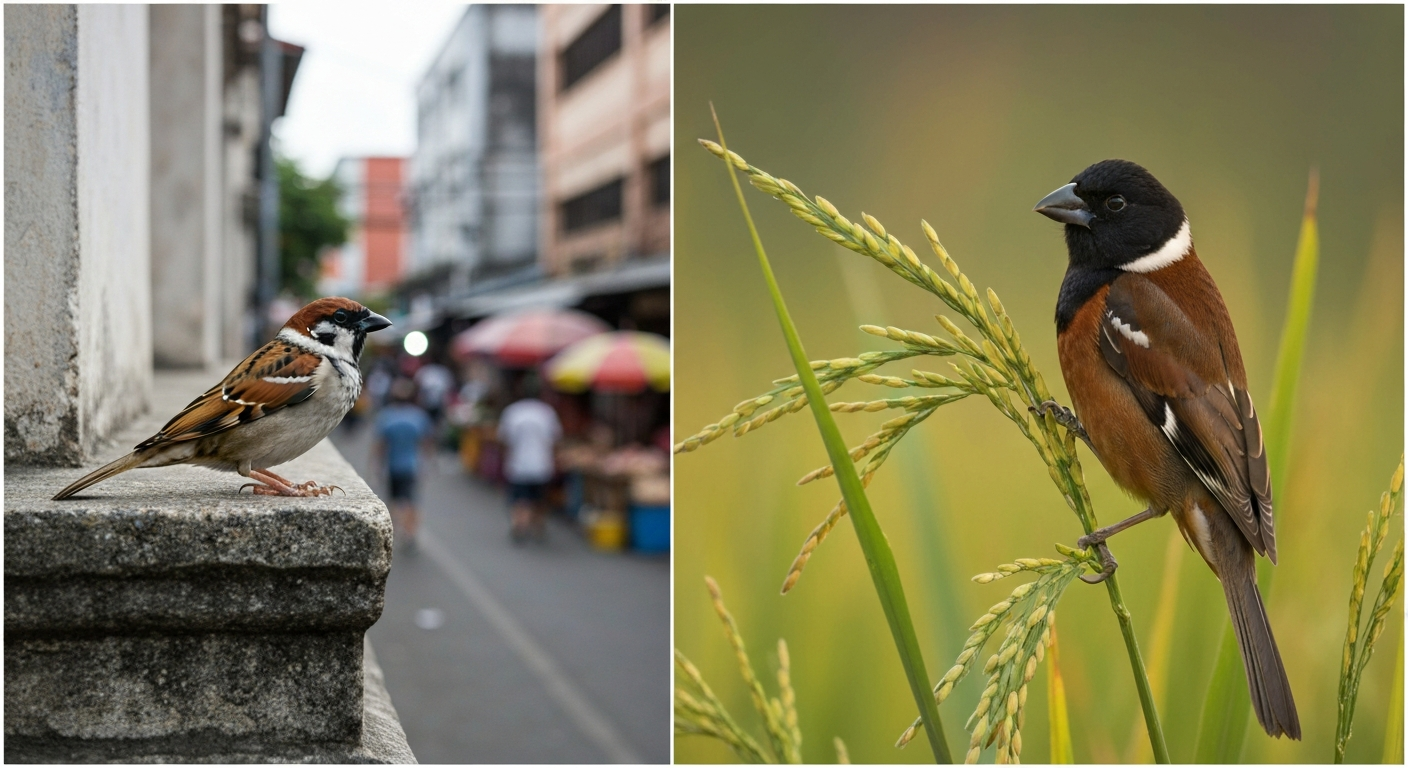
Is Maya Bird a Sparrow? Clear ID & Classification Guide
Is a maya bird a sparrow? Science-backed ID, taxonomy, and a quick checklist to confirm.
Is 'Skewer' a Bird? Quick Answer and Likely Alternatives
No, 'skewer' isn't a bird. Read why, common confusions (skua, siskin, sparrow) and how to verify identifications.
Is Sparrow a Bird? Traits, Taxonomy, and Easy ID Checks
Learn if sparrows are birds, their taxonomy, key traits, and quick ID checks plus common look-alikes.