Title: Is Maya Bird a Sparrow? The Truth Behind the Name
Is Maya Bird a Sparrow? Clear ID & Classification Guide

Marcus Hendricks
22 Jul 2026
Meta description: Is maya bird a sparrow? Some maya birds are, some aren't. Find out which species hide behind the name and how to tell them apart.
Quick Answer: Is 'Maya' a Sparrow?
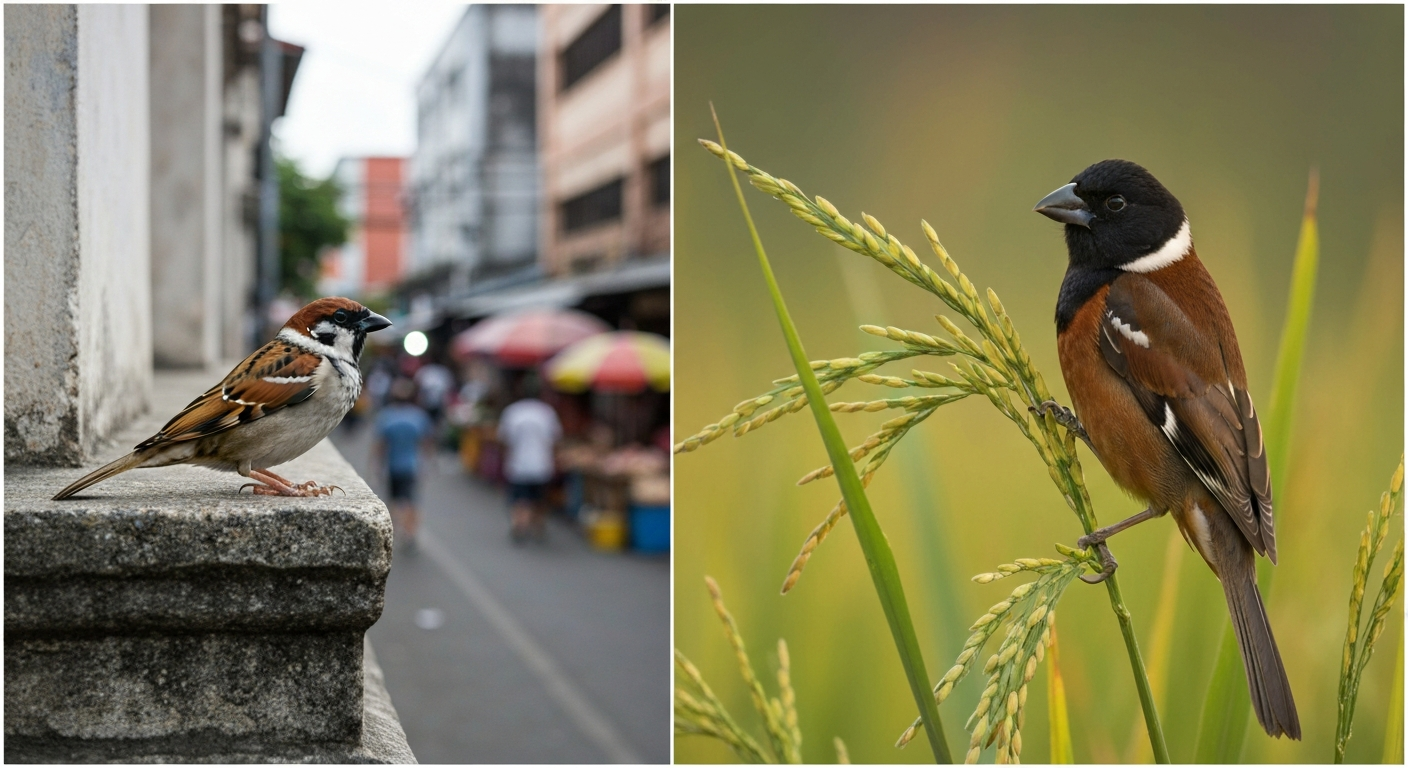
Sometimes yes, sometimes no, and that answer is not a cop-out. 'Maya' is a folk name used in the Philippines for several small, seed-eating passerine birds, and depending on which species someone is actually talking about, you could be looking at a true sparrow or a completely different family of birds. The most common 'maya' seen hopping around Philippine churches and street corners is the Eurasian Tree Sparrow (Passer montanus), which is a genuine, card-carrying member of family Passeridae, the Old-World sparrow family. Macaulay Library / eBird media catalog (example: Scaly‑breasted Munia media) provides high‑quality comparative photos and sound recordings useful for identifying tree sparrows and munias. But the bird historically celebrated as the classic Philippine maya, the one that was even the national bird until 1995, is the Chestnut Munia (Lonchura atricapilla), which belongs to family Estrildidae and is not a true sparrow at all. So 'maya' is not one species, it is a cultural umbrella name, and whether it points to a sparrow depends entirely on which maya you mean.
What People Mean by 'Maya': Local and Common Uses
In everyday Philippine usage, 'maya' functions the way 'sparrow' or 'little brown bird' works in casual English conversation in other parts of the world. It covers a cluster of small, finch-like birds that live near people, eat seeds, and look vaguely similar to anyone who is not actively studying them. Regional names add even more precision, or sometimes more confusion, by tacking on a descriptive prefix.
Here are the main birds that fall under the 'maya' label in Philippine folk taxonomy, along with their scientific identities:
- Mayang simbahan ('church maya'): Eurasian Tree Sparrow, Passer montanus (family Passeridae) — a true Old-World sparrow, introduced and now extremely common in Philippine towns and cities.
- Mayang pula ('red maya'): Chestnut Munia, Lonchura atricapilla (family Estrildidae) — an estrildid finch, historically the 'national maya' and the Philippines' national bird until 1995.
- Mayang paking: Scaly-breasted Munia, Lonchura punctulata (family Estrildidae) — another estrildid finch, common in grasslands, paddy fields, and cultivated areas across South and Southeast Asia.
- Mayang Java / Mayang Costa: Java Sparrow, Padda oryzivora (family Estrildidae) — native to Indonesia and introduced elsewhere; despite having 'sparrow' in its English name, it is also an estrildid finch, not a Passeridae sparrow.
The reason the Eurasian Tree Sparrow has come to dominate the 'maya' label in modern urban Philippines is actually a story of ecological displacement. Introduced Eurasian Tree Sparrow (Passer montanus) has become commonly called 'maya' in urban Philippines, while traditional 'maya' names included native munias such as mayang pula (Lonchura atricapilla) blank" rel="noopener noreferrer">Introduced Eurasian Tree Sparrow (Passer montanus) has become commonly called 'maya' in urban Philippines, while traditional 'maya' names included native munias such as mayang pula (Lonchura atricapilla).). This introduced species thrives in cities, nesting in building crevices, scavenging crumbs, and generally doing very well around human infrastructure. As urbanisation expanded, the tree sparrow became the maya most people actually see on a daily basis, and the folk name gradually shifted toward it. Meanwhile, the native munias that carried the 'maya' name historically have retreated to fields and grasslands, less visible to most city residents. It is a classic case of a common name drifting with the times.
What Is a Sparrow? Taxonomy, Groups, and Key Features
The word 'sparrow' is one of those English bird names that looks tidy until you pull on it. There are actually two major, unrelated groups of birds called sparrows, plus a handful of birds that carry the name purely by coincidence of appearance or local convention.
- Old-World sparrows (family Passeridae): This is what most people in Europe, Asia, and the Philippines picture when they hear 'sparrow.' The genus Passer is the core group here, including the House Sparrow (Passer domesticus) and the Eurasian Tree Sparrow (Passer montanus). These are small, plump, seed-eating birds with short, stout conical bills, streaked brown plumage, and a habit of living close to humans. They measure roughly 12 to 14 cm in length.
- New-World sparrows (family Passerellidae): Found across the Americas, these include birds like the Song Sparrow and White-throated Sparrow. They were previously grouped with Old World buntings in Emberizidae but are now placed in their own family. They share the conical bill and seed-eating lifestyle but are not closely related to Passeridae.
- Estrildid finches with 'sparrow' in the name: The Java Sparrow (Padda oryzivora) is the most prominent example. Despite the name, it belongs to Estrildidae and is more closely related to munias and waxbills than to any true sparrow.
The key physical traits that define true sparrows in Passeridae are: a short, triangular conical bill built for cracking seeds, a compact and slightly rounded body, relatively short tail, brownish or streaked plumage, and short legs suited to hopping on the ground. Passer species also tend to show characteristic face markings, the Eurasian Tree Sparrow has a crisp chestnut crown and a black cheek spot that makes it one of the more distinctive members of the family.
Are Sparrows Birds or Animals? A Short Clarification
Sparrows are absolutely birds, and birds are animals. See is skewer a bird for a related question about whether a particular name refers to an actual bird species. For a short, clear explanation, see is sparrow a bird. This is worth saying plainly because the question 'sparrow is a bird or animal' comes up often, and it seems to reflect a common but mistaken idea that 'animal' refers only to mammals like dogs and cats. Biologically, 'animal' means any member of the kingdom Animalia, which includes birds, mammals, reptiles, insects, fish, and a lot more. Sparrows are birds, birds are a class of vertebrate animals (class Aves), and Aves sits comfortably inside kingdom Animalia. There is no contradiction there. A sparrow is simultaneously a bird, a passerine, a vertebrate, and an animal, all at once. For a concise clarification of the question 'sparrow is a bird or animal', see a short explanation that places sparrows within class Aves and kingdom Animalia.
Are Sparrows Perching Birds? Passeriformes Explained
Yes, sparrows are perching birds. The technical term is passerine, from the order Passeriformes, which is the largest order of birds on the planet, covering roughly 60 percent of all living bird species. The name comes from the Latin 'passer,' meaning sparrow, which gives you a sense of how central these birds were to early ornithological classification.
The defining physical feature of Passeriformes is their foot structure. Passerines have three toes pointing forward and one (the hallux) pointing backward, all at the same level. When a bird grips a branch, this arrangement automatically locks the toes in place, a passive mechanism that lets perching birds sleep on branches without falling off. It requires no muscular effort to maintain, which is genuinely elegant engineering. Every maya bird discussed above, whether it is a Passeridae sparrow or an Estrildidae munia, is a passerine and therefore a perching bird. Swallows are also passerines, though as we will see below, that shared order membership does not make them sparrows.
Sparrows vs Swallows: Not Even Close
I understand why people confuse the names, they sound similar and both appear in lists of common small birds. But sparrows and swallows are dramatically different birds with almost nothing in common beyond being passerines. If you're wondering 'are sparrows and swallows the same bird', the answer is no, they belong to different families with distinct bodies and behaviors. Swallows belong to family Hirundinidae and are built for a completely different lifestyle: catching flying insects in mid-air. Their whole body plan reflects this. Long, pointed wings for fast, agile flight. Forked or notched tails for steering. Tiny, wide-gaping mouths that can snap up insects on the wing. Short, weak legs that are next to useless for ground-hopping. A sparrow sitting next to a swallow does not look like a close relative. It looks like a completely different kind of bird, which is exactly what it is.
| Feature | Sparrow (Passeridae) | Swallow (Hirundinidae) | Munia (Estrildidae) |
|---|---|---|---|
| Order | Passeriformes | Passeriformes | Passeriformes |
| Family | Passeridae | Hirundinidae | Estrildidae |
| Bill shape | Short, stout, conical | Short, wide gape | Short, conical (often blue-grey) |
| Wing shape | Short, rounded | Long, pointed | Short, rounded |
| Tail | Short to medium, square | Forked or notched | Short, often pointed |
| Diet | Seeds, grains | Flying insects | Seeds, grasses |
| Foraging style | Ground-hopping, perching | Aerial pursuit | Ground-level and seed heads |
| Legs | Short, strong for hopping | Short, weak | Short, strong for clinging |
| Philippine 'maya' link | Mayang simbahan (P. montanus) | Not called maya | Mayang pula, mayang paking |
| Size (approx.) | 12–14 cm | 12–17 cm (varies by species) | 10–15 cm |
The simplest way to tell a sparrow from a swallow in the field: watch what it does. If it is gliding and swooping through the air chasing invisible insects, it is almost certainly a swallow. If it is hopping along the ground or perched on a seed head, cracking something open with that chunky bill, you are looking at a sparrow or munia. Behaviour alone will resolve the confusion nine times out of ten before you even look at the shape of the wings.
A Practical ID Checklist: Which 'Maya' Are You Looking At?
If you are in the Philippines and trying to figure out whether the little brown bird in front of you is a true sparrow or one of the munias, here is what to look for:
- Check the head: Eurasian Tree Sparrow (P. montanus) has a rich chestnut-brown crown and a bold black spot on the white cheek. If you see those two marks together, you have a true sparrow.
- Check the body colour: Chestnut Munia (L. atricapilla) has a black head and breast with chestnut-brown upperparts and pale or scaled underparts. Scaly-breasted Munia (L. punctulata) has a plain brown head and breast with distinctive scaly spotting on the underparts.
- Check the bill: All three have conical bills, but the Java Sparrow's bill is noticeably large, pale pinkish-red, and almost parrot-like in profile. That makes it the easiest of the group to identify by bill alone.
- Listen: The Eurasian Tree Sparrow gives short, sharp 'chip' or churring calls. Munias produce softer, high-pitched chittering sounds. If you can record the call, compare it on Xeno-canto for confirmation.
- Note the location: If you are in a city, around buildings, or near a church (hence 'mayang simbahan'), you are most likely looking at P. montanus. If you are in a rice field or open grassland, the munias become much more likely.
- Check the size: Tree sparrows run about 12 to 14 cm; munias are slightly smaller at around 10 to 12 cm; the Java Sparrow is the largest of the group at 13 to 15 cm.
- Confirm with photos: Macaulay Library (via eBird) and Wikimedia Commons both have extensive, freely viewable photo sets for all of these species. A quick side-by-side with a reference image will settle most identifications.
Pop Culture Note: Zenitsu's Sparrow
For anyone arriving here from a slightly different direction: the sparrow associated with Zenitsu Agatsuma in the anime Demon Slayer is indeed depicted as a sparrow-type bird, consistent with the Japanese cultural connection between sparrows (suzume) and thunder or lightning imagery. It is not a Philippine maya, but it is a relevant reminder that 'sparrow' shows up as a culturally significant bird across many Asian traditions, which is part of why the name carries so much weight in folk taxonomy from Japan to the Philippines.
The Bottom Line on Maya and Sparrows
The honest answer to 'is maya bird a sparrow' is: it depends on which maya. The one you probably see most often in a Philippine city, the small brown bird with the chestnut cap and black cheek patch hopping around markets and churchyards, is the Eurasian Tree Sparrow, a true Passeridae sparrow. The historically significant 'national maya,' however, is the Chestnut Munia, an estrildid finch that is related to sparrows only in the broadest sense of both being passerines. The folk name 'maya' has always been a practical, people-facing label for 'small common seed-eating bird,' not a scientific one, and it has shifted over time as the ecology of Philippine urban environments has changed. Understanding that distinction is the key to understanding both the birds and the naming confusion around them.
FAQ
Natural, search‑friendly article title to use
Is a “maya” bird a sparrow? Clear ID, species mapped to local names, and a practical checklist
≤160‑character meta description
Learn what Filipinos mean by “maya,” which species that name covers, and how to tell true sparrows from munias, swallows, and other look‑alikes.
Core question: Is a “maya” bird a sparrow?
Sometimes — “maya” is a folk name covering several small passerines. In the Philippines it can mean the Eurasian Tree Sparrow (a true Old‑World sparrow, Passer montanus) but also several munias/finches (Lonchura spp.) that are not true sparrows.
Which species are commonly called “maya” in the Philippines?
Common mappings: mayang simbahan (church maya) = Eurasian Tree Sparrow (Passer montanus, Passeridae); mayang pula (red maya) = Chestnut Munia (Lonchura atricapilla, Estrildidae); mayang paking = Scaly‑breasted Munia (Lonchura punctulata, Estrildidae). Other local variants can include Java Sparrow and other small seed‑eaters.
Is the Eurasian Tree Sparrow (Passer montanus) a “true” sparrow?
Yes. Passer montanus is an Old‑World or “true” sparrow in family Passeridae and matches English usage for a sparrow.
Are munias (Lonchura spp.) sparrows?
No. Munias (Estrildidae) are estrildid finches — small, conical‑billed seed eaters often called “munia” or sometimes locally lumped under “maya,” but taxonomically they are not Passeridae sparrows.