A kookaburra is not a bird of prey. It is a kingfisher, classified in genus Dacelo within the family Alcedinidae, and no major ornithological authority places it among the raptors. Yes, it eats snakes, lizards, and mice with obvious relish, and yes, it will beat a skink against a branch until the poor thing stops wriggling. That looks predatory because it is predatory. But being a carnivore does not make a bird a raptor, any more than a wolverine becomes a big cat because it hunts similar prey. The classification comes down to anatomy and taxonomy, not dinner choices.
Is a Kookaburra a Bird of Prey? Clear, Evidence-Based Answer

Marcus Hendricks
18 Jul 2026
What actually makes a bird a bird of prey?
The word 'raptor' comes from the Latin rapere, meaning to seize, and that etymology is a useful anchor. In ornithology, birds of prey are not simply birds that eat other animals. They are birds whose entire body plan is built around seizing, restraining, and killing vertebrate prey. The classical raptor orders are Accipitriformes (hawks, eagles, kites, harriers, ospreys), Falconiformes (falcons and caracaras), and Strigiformes (owls). Some authorities also group in Pandionidae (the osprey) separately. Every bird in these groups shares a suite of functional adaptations that you can see and measure.
The anatomy that defines a true raptor
Three physical features are the diagnostic package that ornithologists look for when assessing whether a bird qualifies as a raptor. They are not arbitrary: each one does a specific mechanical job in catching and subduing prey.
- Strongly hooked, sharp-edged bill: The curved tip generates leverage for tearing flesh and cutting through tissue. The hook is not just a gentle curve; in raptors it is pronounced enough to be obvious in silhouette.
- Enlarged, strongly curved talons: Talon curvature and the size of the flexor tubercle (the bony anchor for the toe tendons) are the most reliable markers of raptorial function. Peer-reviewed biomechanical studies show that talon curvature correlates directly with the size of prey a raptor can subdue and kill. These are killing tools, not just gripping toes.
- Robust, grasping foot musculature: Raptors have hypertrophied flexor muscles in the legs and feet that allow them to clamp down on struggling prey and maintain that grip. An eagle's grip force is extraordinary; a kookaburra's is not in the same mechanical category.
A hooked bill alone is not enough (plenty of parrots have strongly hooked bills and eat seeds). Talons alone are not enough (lots of birds have curved claws). It is the combination, concentrated in those specific taxonomic orders, that defines a raptor. Ornithologists do note that the term is used variably in popular writing, but when scientists talk about raptors they almost always mean birds with that full morphological and taxonomic package.
Where kookaburras actually sit in bird classification
Kookaburras belong to genus Dacelo, placed within the family Alcedinidae (the kingfishers) and subfamily Halcyoninae (the tree kingfishers). The order is Coraciiformes, which also includes rollers, bee-eaters, and motmots. This grouping has nothing to do with raptors. The IOC World Bird List, BirdLife DataZone, and the NCBI Taxonomy database all list kookaburras firmly under Alcedinidae. There are four recognized Dacelo species: the Laughing Kookaburra (Dacelo novaeguineae), Blue-winged Kookaburra (Dacelo leachii), Spangled Kookaburra (Dacelo tyro), and Rufous-bellied Kookaburra (Dacelo gaudichaud). The Laughing Kookaburra is the one most people know, native to eastern Australia and introduced to southwestern Australia and parts of New Zealand. See the Australian Museum species page 'Laughing Kookaburra (Dacelo novaeguineae), Australian Museum species page' for authoritative details on the species’ range, identification, and natural history Laughing Kookaburra (Dacelo novaeguineae) — Australian Museum species page.
Kookaburra anatomy, diet, and how it hunts
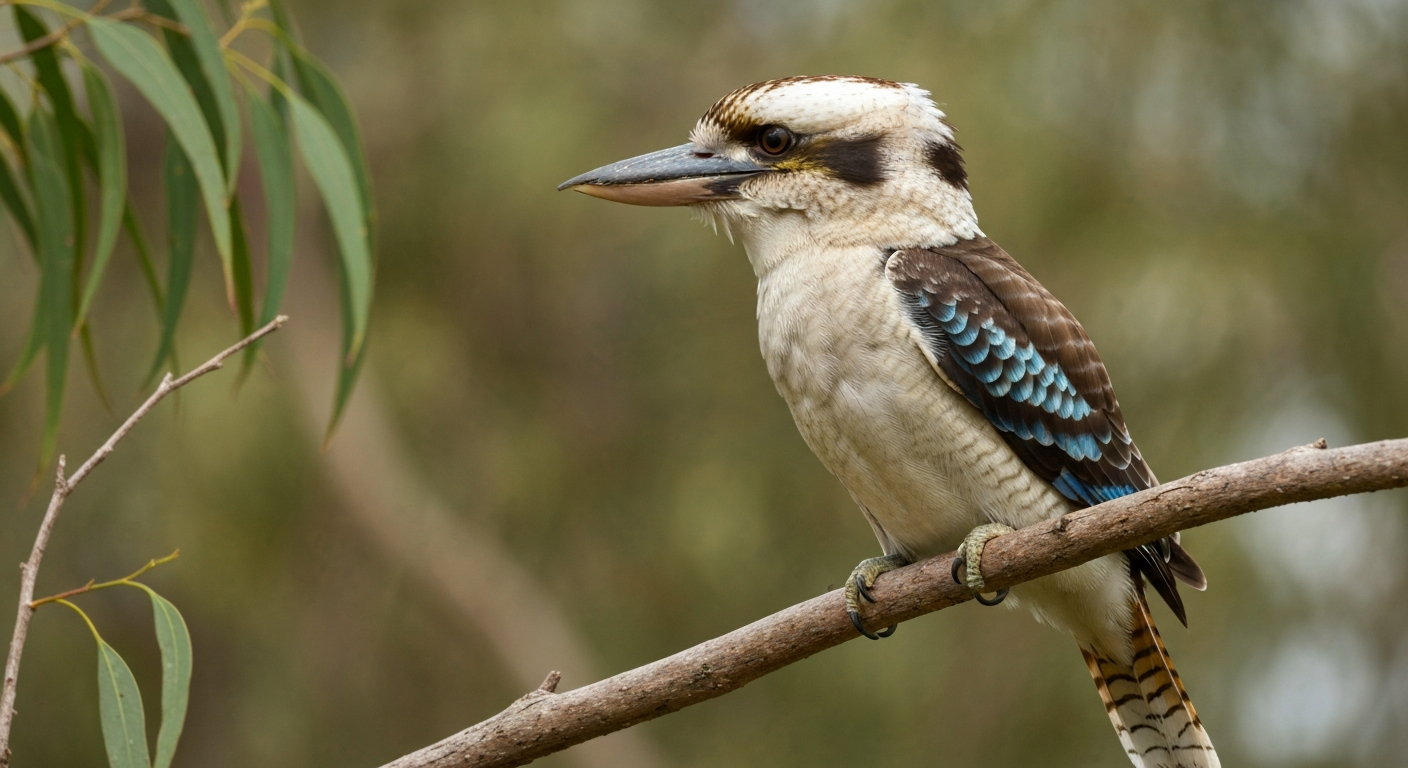
The Laughing Kookaburra is big for a kingfisher, typically 41 to 47 cm long and averaging around 335 to 350 g in body mass. Its bill is long, stout, and slightly compressed, built for seizing and gripping rather than for the tearing-and-ripping work a raptor does. The upper mandible has a slight kink toward the tip, but it is nothing like the pronounced hook of a hawk or falcon. A study published in PeerJ used digital dissection and 3D modelling to document the jaw musculature of the Laughing Kookaburra and found a powerful cranial musculoskeletal apparatus suited to handling relatively large prey for a kingfisher. Crucially, the researchers did not suggest reclassifying it as a raptor; they were documenting how kingfisher anatomy had been modified to cope with bigger prey items.
The feet tell a clearer story. Kookaburras have syndactyl feet, meaning the second and third toes are fused for part of their length, which is a characteristic of kingfishers and related groups. The toes end in curved claws, but those claws are not the biomechanically reinforced, enlarged killing talons of raptors. They are sufficient for perching and for gripping prey briefly, but the bird does not kill by foot-strike the way a hawk or owl does.
As for diet: kookaburras eat large invertebrates, small reptiles including snakes, small mammals, frogs, and nestling birds. They hunt by sit-and-wait tactics from an exposed perch, dropping onto prey on the ground below. They carry larger prey back to the perch and beat it against the branch or the ground repeatedly to stun it and break bones before swallowing. You can find photographs and video from the Macaulay Library at Cornell Lab documenting exactly this behaviour with snake prey. It is an impressive and slightly brutal hunting style, but the mechanics are kingfisher mechanics, not raptor mechanics.
Why a kookaburra is not a raptor, point by point
The confusion is understandable, so it helps to put the comparison side by side. Here are the key points of difference between kookaburras and true raptors.
| Feature | True Raptors (e.g., hawks, falcons, owls) | Kookaburra (Dacelo spp.) |
|---|---|---|
| Taxonomic order | Accipitriformes, Falconiformes, Strigiformes | Coraciiformes |
| Family | Accipitridae, Falconidae, Strigidae, etc. | Alcedinidae (kingfishers) |
| Bill shape | Strongly hooked, sharp cutting edge | Long, stout, slight kink at tip, not strongly hooked |
| Talon morphology | Enlarged, strongly curved, biomechanically reinforced killing talons | Curved claws, not enlarged or raptorially reinforced |
| Foot type | Anisodactyl with hypertrophied flexor musculature | Syndactyl (fused toes), typical of kingfishers |
| Killing method | Foot-strike and talon grip kills prey | Bill-grab then beating prey against a surface |
| Diet | Vertebrate prey, primarily killed by talons | Invertebrates, small vertebrates; prey subdued by beating |
| Raptor status | Yes | No |
The core point is that kookaburras are carnivorous, predatory birds whose anatomy has been modified within the kingfisher body plan to handle larger prey than most kingfishers attempt. That is a fascinating evolutionary story. But it is not the same evolutionary story as raptors, and the two lineages arrived at predatory lifestyles via completely different anatomical routes.
Why predatory birds get mistaken for raptors
This is a really common category error and it is worth addressing directly, because kookaburras are far from the only offender. The mental shortcut most people use is something like: 'this bird eats vertebrates, therefore it is a bird of prey.' That shortcut fails in several directions. Herons eat fish and frogs but are wading birds. Pelicans eat fish but are pelicans. Magpies will take nestlings but are corvids. And kookaburras eat snakes but are kingfishers. What all of these birds have in common is that natural selection has shaped their anatomy for a predatory role, but along completely different anatomical and evolutionary pathways than the one that produced raptors. The technical term for this is convergent evolution: similar ecological outcomes through different means.
The other driver of confusion is that kookaburras look chunky and powerful, and when you watch one dispatch a brown snake you are not immediately thinking 'ah yes, a kingfisher.' Their large heads, strong bills, and confident demeanour read as predator, and that instinct is correct in a behavioural sense. The classification, though, follows the skeleton, the musculature, and the evolutionary lineage, not the vibe.
Quick verdicts on related birds
Several related search questions come up alongside the kookaburra one, and it is worth giving clear answers to each since the logic is similar in some cases and quite different in others.
Is a kite a bird of prey?
Yes. Kites (including the Red Kite, Milvus milvus) are placed in the family Accipitridae within Accipitriformes. They have hooked bills and raptorial talons, and they are unambiguously birds of prey. The Red Kite in particular is a large, fork-tailed raptor native to Europe, easily identified in flight by its rusty-red body and distinctive tail shape.
Is a kestrel a bird of prey?
Yes. Kestrels are falcons, order Falconiformes, family Falconidae. The Common Kestrel (Falco tinnunculus) is one of the most recognizable raptors in Europe and Asia, famous for its hovering hunting technique. Hooked bill, curved talons, grasping feet: the full raptor package. See the related article "Is a kestrel a bird of prey" for a focused discussion of kestrel anatomy, behaviour, and raptor status.
Is a kingfisher a bird of prey?
No, and this is the closest parallel to the kookaburra question since kookaburras are themselves kingfishers. Kingfishers (family Alcedinidae) are carnivorous birds with strong bills that eat fish, invertebrates, and small vertebrates. But they sit in Coraciiformes, lack raptorial talon morphology, and are not classified as birds of prey. The kookaburra is simply a very large, terrestrially-adapted example of this same group.
Is a shrike a bird of prey?
No, and shrikes are the single most instructive comparison here. Shrikes (family Laniidae) are passerine songbirds that hunt vertebrate prey, sometimes impale it on thorns or barbed wire to store it, and have a hooked bill tip. Cornell Lab's All About Birds calls them 'songbirds with a raptor's habits,' which is exactly right: the habits are raptorial, but the taxonomy and anatomy are not. Shrikes lack the enlarged curved talons of raptors and sit firmly in the order Passeriformes. They are the textbook example of predatory behaviour without raptor classification. See the related page Is a shrike a bird of prey? for a focused comparison.
Is a shrew a bird?
This one gets asked more often than you might expect. No, a shrew is not a bird in any sense. Shrews are small insectivorous mammals in the order Eulipotyphla. They are warm-blooded, have fur rather than feathers, give birth to live young, and do not have wings, a beak, or any avian anatomical features. The name similarity with 'shrike' may be part of the confusion, but shrew and shrike are completely unrelated animals from different classes of vertebrates. For a full explanation, see the related article Is a shrew a bird? which details why shrews are classified as mammals rather than birds (b54d655a-f1f4-46a7-be5c-4c6c7dd78c6e).
Field ID tips: telling true raptors from predatory non-raptors
If you are out in the field and want to quickly assess whether a bird you are watching is a true raptor or a carnivorous non-raptor like a kookaburra or shrike, here is a practical checklist of things to look at.
- Bill profile: Does the bill have a strongly hooked, downward-curving tip that is obvious even at a distance? In true raptors this hook is pronounced and immediately visible. A slight kink at the bill tip (as in kookaburras) is not the same thing.
- Foot posture and talon size: Can you see the toes? In raptors the talons are visibly enlarged and strongly curved. A perched hawk or falcon will often show this clearly. Kingfisher-type birds show smaller, less curved claws.
- Hunting method: Raptors typically strike prey with their feet. Watch for a foot-first diving strike. Kookaburras and kingfishers strike bill-first and then carry prey back to a perch to beat it. Shrikes carry prey to a thorny impalement site.
- Wing shape and flight style: Many raptors soar on broad wings using thermals, or stoop at speed. Kookaburras are not soaring birds; they fly with direct, slightly undulating wingbeats between perches and rarely soar.
- Silhouette: Raptors often show a broad-winged, fan-tailed or notched-tailed silhouette in flight. Kookaburras in flight look blocky and large-headed with a relatively short tail.
- Taxonomy check: If you can identify the family, do so. Any bird in Accipitridae, Falconidae, Strigidae, Tytonidae, or closely associated families is a raptor. Any bird in Alcedinidae (kingfishers), Laniidae (shrikes), or Ardeidae (herons) is not, regardless of what it eats.
Kookaburra at a glance: key facts
| Attribute | Detail |
|---|---|
| Common name | Laughing Kookaburra (best-known species) |
| Scientific name | Dacelo novaeguineae |
| Order | Coraciiformes |
| Family | Alcedinidae (kingfishers) |
| Subfamily | Halcyoninae (tree kingfishers) |
| Raptor / bird of prey? | No |
| Body length | 41–47 cm |
| Body mass | Approximately 335–350 g (mean across sexes) |
| Bill type | Long, stout, slightly kinked; not strongly hooked |
| Foot type | Syndactyl (fused second and third toes) |
| Diet | Large invertebrates, small reptiles, snakes, frogs, small mammals |
| Hunting style | Sit-and-wait from perch; bill-strike; beats prey before swallowing |
| Native range | Eastern Australia; introduced to SW Australia and New Zealand |
| Distinguishing feature | Loud, laughing call; large head; distinctive brown-and-white plumage |
Image suggestions
For the main hero image, a close-up photograph of a Laughing Kookaburra (Dacelo novaeguineae) perched on a branch showing the full bill profile would be ideal, with a caption along the lines of: 'The Laughing Kookaburra's bill is strong and stout, but lacks the strongly hooked profile of a true raptor.' Wikimedia Commons hosts CC0 and Creative Commons images of kookaburras that may be suitable, though you should verify the specific licence on any asset before reuse. A second image showing the kookaburra's feet would be particularly useful for illustrating the syndactyl toe arrangement and the modest claw curvature compared with, say, a Red Kite or a Common Kestrel. A side-by-side comparison image or composite showing a kookaburra foot beside a raptor talon would make the anatomical difference immediately obvious to readers. For a behaviour shot, images from the Macaulay Library at Cornell Lab document kookaburras handling snake prey; check individual contributor licences before reusing Macaulay Library assets as photographers typically retain copyright.
Where to read more on this site
If this article has left you wanting to dig further, the most useful next reads on this site are the full definition of what a raptor is and how that category is applied in modern ornithology, the kingfisher family overview covering Alcedinidae and where kookaburras sit within it, individual species pages for Dacelo novaeguineae and its relatives, and the raptor identification guides that walk through the diagnostic features of Accipitriformes and Falconiformes in more detail. The related articles on whether a kite, Red Kite, kestrel, kingfisher, and shrike qualify as birds of prey each apply this same framework to their respective species, and together they build a fairly complete picture of how ornithologists draw the line between predatory birds and true raptors. See the short guide Is a kite a bird of prey? for a focused answer on kites and how they fit the raptor definition.
FAQ
Is a kookaburra a bird of prey (raptor)?
No. By ornithological standards a kookaburra (genus Dacelo) is not classified as a bird of prey (raptor). Kookaburras are kingfishers (family Alcedinidae) that are carnivorous and predatory, but they lack the specialized raptorial foot anatomy and taxonomic placement that define raptors.
What is meant by 'bird of prey' or 'raptor'?
'Raptor' (bird of prey) commonly means a bird specialized to seize and kill vertebrate prey using morphological adaptations: strongly hooked cutting bill, enlarged curved talons and grasping feet with powerful leg musculature. Ornithologists usually apply the term to classical raptorial groups (diurnal birds like hawks, eagles, kites, falcons, and nocturnal owls) rather than to every carnivorous bird.
Why aren't kookaburras considered raptors if they eat vertebrates?
Classification as a raptor depends on functional morphology and taxonomic context, not just diet. Kookaburras do take vertebrate prey but lack the hypertrophied curved talons and the specialized foot musculature characteristic of raptors. Taxonomically they belong to the kingfisher lineage (Alcedinidae), not to raptorial orders (Accipitriformes, Falconiformes, Strigiformes).
What is the taxonomy of kookaburras?
Kookaburras are in genus Dacelo, family Alcedinidae (kingfishers), order Coraciiformes (as treated in modern checklists). Major taxonomic authorities (IOC, NCBI, BirdLife) list Dacelo under kingfishers, with species such as the Laughing Kookaburra (Dacelo novaeguineae).
What are the key anatomical traits that define raptors?
Key raptor traits: strongly hooked cutting bill for tearing flesh; enlarged, strongly curved talons and robust grasping feet for seizing and restraining vertebrate prey; reinforced leg musculature and skeletal features associated with gripping and subduing prey; in many diurnal raptors, soaring/stooping flight and certain wing shapes adapted for raptorial hunting.
How does kookaburra anatomy compare to raptors?
Kookaburras have a large stout bill and powerful head/neck musculature for grasping and handling prey, but their feet and claws are typical of kingfishers (straight to mildly curved toes and claws), not the hypertrophied talons and grasping foot structure of true raptors. Their skull/jaw power enables prey handling but not the specialized talon-based killing seen in raptors.