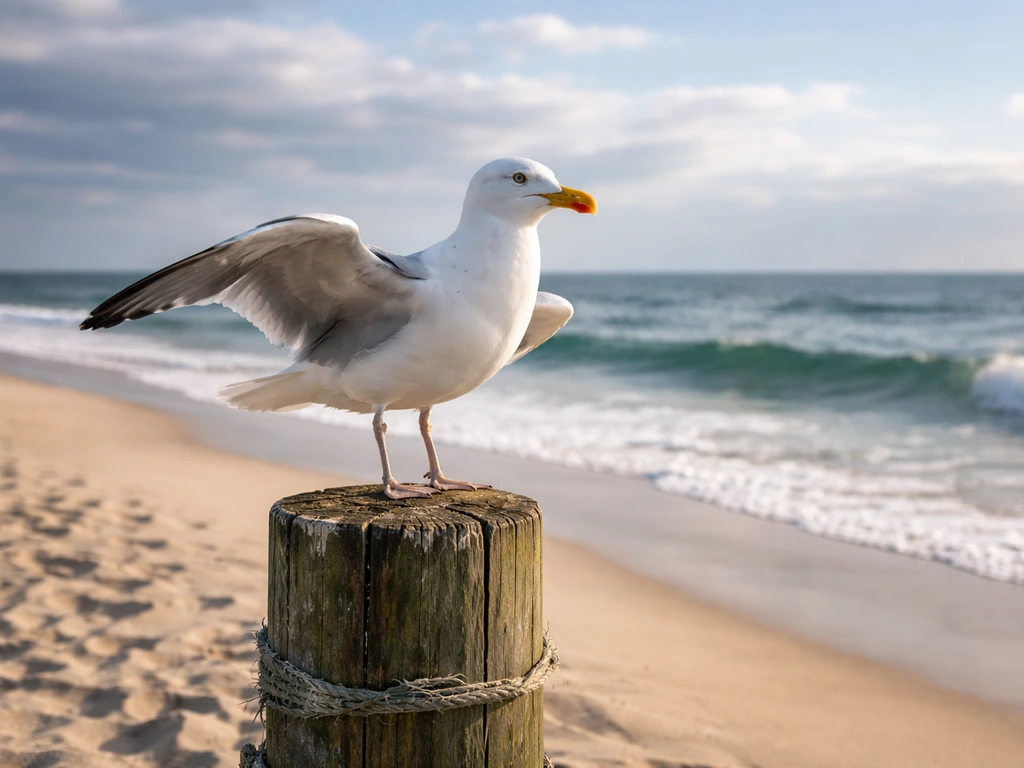
No, a seagull is not a bird of prey. Seagulls belong to the family Laridae within the order Charadriiformes, which puts them firmly in the shorebird and seabird camp alongside terns and skimmers. Birds of prey, or raptors, come from entirely different orders: Accipitriformes (hawks, eagles, kites), Falconiformes (falcons), and Strigiformes (owls). Gulls are bold, opportunistic, and sometimes aggressive, but that behavior does not make them raptors any more than stealing a chip from your hand makes a crow a falcon.
Is a Seagull a Bird of Prey? Science-Backed Answer

Marcus Hendricks
2 Jul 2026
What "bird of prey" actually means
The term gets used loosely in everyday speech, but ornithologists and major reference sources are pretty consistent about what it covers. Merriam-Webster defines a bird of prey as a carnivorous bird, such as a hawk, eagle, vulture, or owl, that feeds wholly or chiefly on meat taken by hunting or on carrion. Cambridge puts it more simply: a bird like an eagle or hawk that kills and eats small birds and animals. The key there is kills.
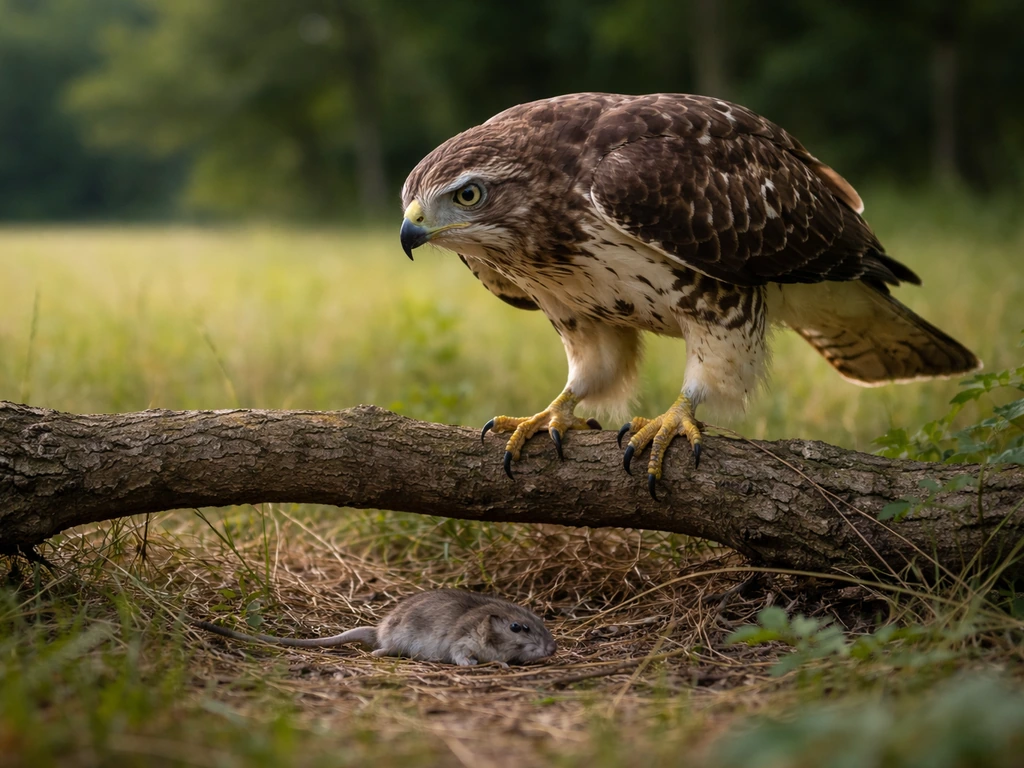
The University of Minnesota Raptor Center narrows it down to three physical hallmarks that define a true raptor: a hooked beak designed to tear meat, sharp curved talons used to seize and immobilize prey, and exceptionally keen eyesight (roughly six times better than human vision, according to U.S. Fish and Wildlife Service materials). These are not just incidental features. The talons in particular are specialized predatory tools, and their size and shape actually vary by hunting style: a peregrine falcon's talons differ from a red-tailed hawk's because they are solving different killing problems.
It is worth noting that even among scientists the term has a slightly fuzzy edge. Some sources restrict it to Accipitriformes and Falconiformes (the daytime hunters) while others include owls (Strigiformes). Some include New World vultures, some do not. But in every version of the definition, gulls are nowhere in the picture.
What seagulls actually eat and how they get it
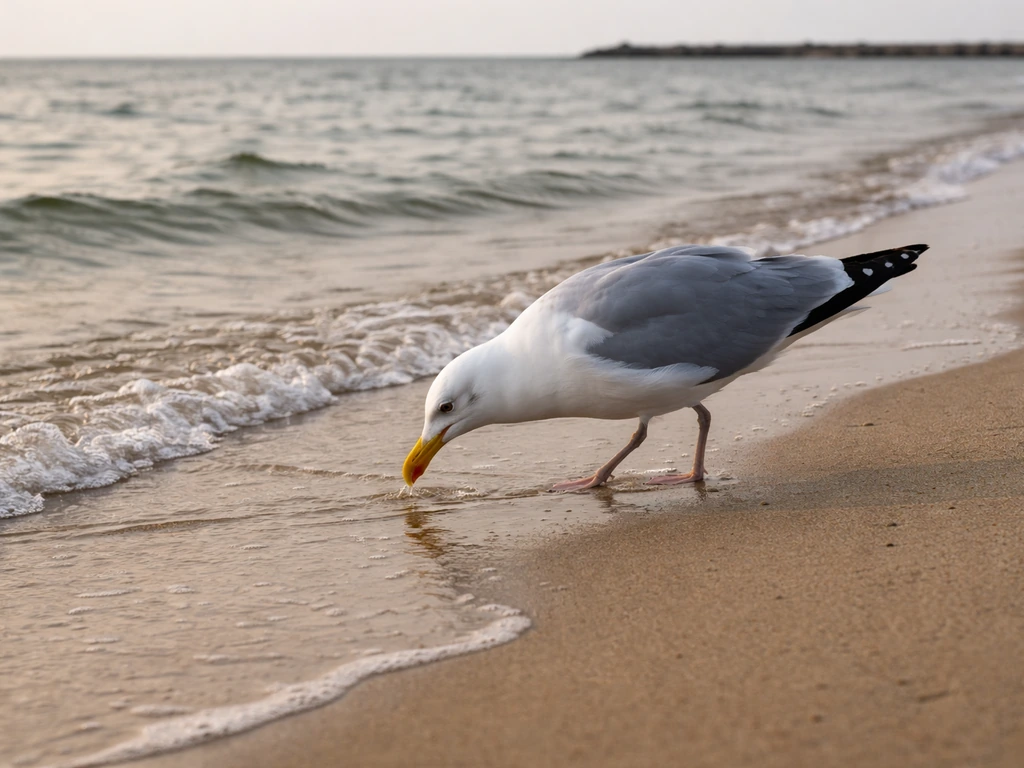
Watch a herring gull for ten minutes at a beach or a landfill and you will get a masterclass in opportunistic foraging. Audubon describes their feeding methods as walking along the shoreline, swimming, dipping down from flight to grab items off the water surface, and occasionally plunge-diving. The menu is genuinely eclectic: fish, crustaceans, mollusks, sea urchins, marine worms, insects, eggs, other birds, and plenty of human leftovers. If it fits in their bill and it is not actively fighting back too hard, a gull will consider it food.
A big part of gull feeding is kleptoparasitism, which is a scientific word for stealing food from other animals. Peer-reviewed research documents gulls robbing puffins by waiting outside their burrows, lunging in, and shaking them until they drop fish. That boldness and aggression is what makes people think of them as predatory, but it is fundamentally different from a raptor hunting and killing live prey is a puffin a bird of prey. Glaucous gulls steal bivalves from common eider ducks. And yes, they steal chips from tourists, behavior that National Geographic researchers confirmed by running controlled experiments with french fry bags. That boldness and aggression is what makes people think of them as predatory, but it is fundamentally different from a raptor hunting and killing live prey.
Landfills are also well-documented as predictable food sources for gulls. A peer-reviewed gull deterrence study notes that scavenging seabirds treat landfills as reliable foraging sites. This is not raptor behavior. Eagles and hawks are not competing with gulls for yesterday's pizza.
Are seagulls classified as raptors? No, and here is why
The clearest way to settle this is taxonomy. The IOC World Bird List, one of the standard references in ornithology, places Laridae under Charadriiformes and maps "raptor" orders separately as Accipitriformes and Falconiformes (with Strigiformes for owls). The U.S. Fish and Wildlife Service taxonomic tree confirms Laridae sits inside Charadriiformes. These are not cosmetic categories: they reflect genuine evolutionary lineages. Gulls are more closely related to plovers and sandpipers than they are to hawks or falcons.
The Wikipedia entry on birds of prey makes this explicit, noting that ornithologists use a narrower definition that generally excludes many seabirds, specifically naming gulls and skuas. Gulls are not in the raptor club by anatomy, evolutionary history, or scientific convention.
Why people think seagulls might be birds of prey
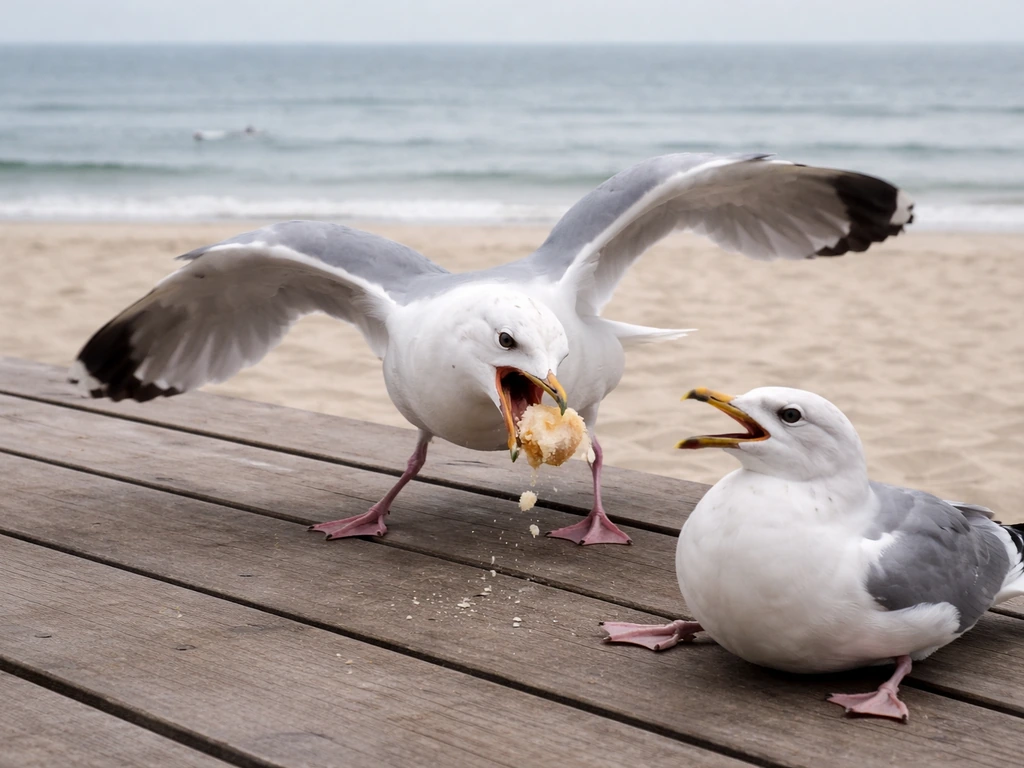
The confusion is understandable. Seagulls are loud, confident, and shamelessly aggressive about food. They will snatch something right out of your hand and stare you down afterward. They have a pointed bill that looks sharp. They circle overhead like they are targeting something. If you have never thought carefully about what raptor anatomy actually looks like, it is easy to lump "bold, feathery, and slightly threatening" into the bird-of-prey category. But “bird of prey” is a specific kind of carnivorous hunter, not just any bold predator-looking bird bird-of-prey category.
The kleptoparasitism behavior is probably the biggest driver of the misconception. Gulls chasing other birds and stealing their food looks predatory. The lunge-and-grab move gulls use to rob puffins or eiders looks like an attack. But there is a crucial difference: a raptor hunts, kills, and eats. A gull waits for someone else to do the hard work and then swoops in to take the reward. It is opportunism, not predation in the raptor sense.
Where seagulls fit in the wider bird family tree
Charadriiformes is a large and diverse order that includes shorebirds, gulls, terns, skimmers, and auks. The MeSH medical classification describes it as birds that primarily occupy coastal waters, beaches, and marshes, which lines up exactly with gull ecology. The MeSH medical classification describes Charadriiformes as birds that primarily occupy coastal waters, beaches, and marshes, matching gull ecology The MeSH medical classification describes it as birds that primarily occupy coastal waters, beaches, and marshes. Within Charadriiformes, Laridae (gulls, terns, and skimmers) forms its own family. So when you see a herring gull on a pier, you are looking at a shorebird-lineage bird, not a scaled-down eagle.
This matters for understanding why gulls look and behave the way they do. Their webbed feet are built for swimming and walking on wet surfaces, not for gripping and killing prey. Their bills are strong and versatile but not hooked the way a hawk's or falcon's is. Their whole body plan reflects a generalist coastal forager, not a specialized aerial predator. Similar questions come up about other familiar birds: pigeons, geese, puffins, and parrots are all birds, but none of them are raptors either, for the same fundamental reasons.
Seagull vs. raptor: how to tell them apart on sight
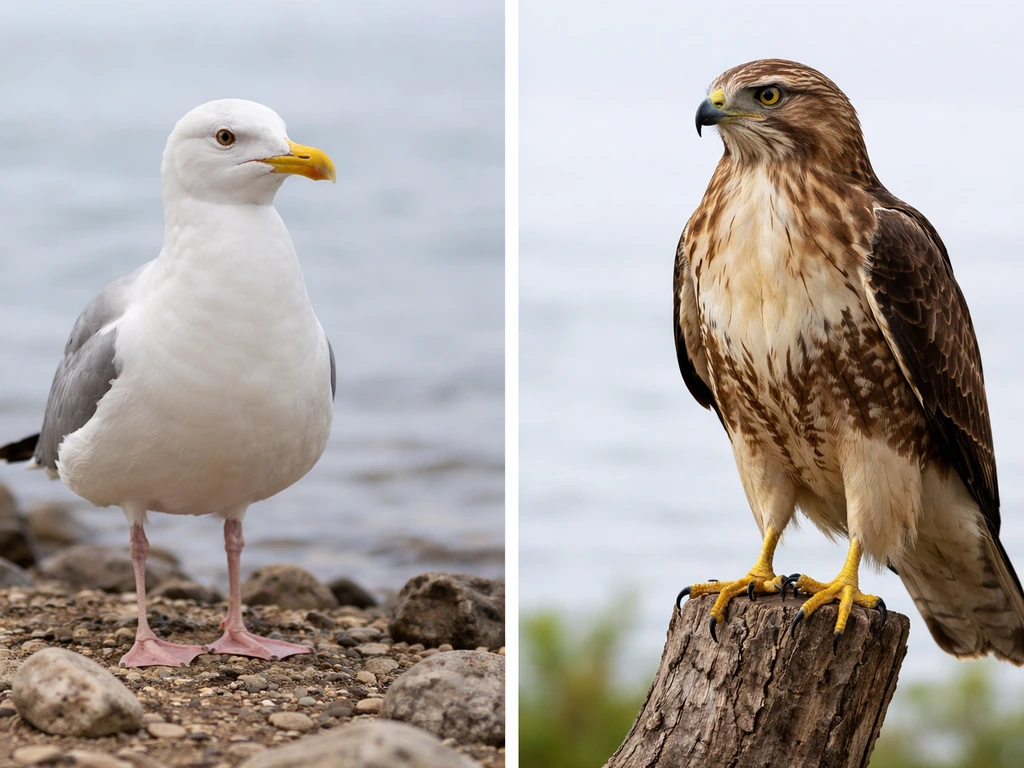
You do not need a field guide or a taxonomy textbook to tell a seagull from a bird of prey. The physical differences are visible from a reasonable distance, and once you know what to look for, the distinction is obvious.
| Feature | Seagull (Laridae) | Typical Raptor (hawk/eagle/falcon) |
|---|---|---|
| Feet | Webbed, built for swimming and walking on flat surfaces | Large, unwebbed, with long curved talons for gripping prey |
| Beak | Strong and slightly hooked at the tip, but thick and blunt overall | Sharply and deeply hooked, purpose-built for tearing meat |
| Body shape | Stocky, medium-sized, often pale/white and grey plumage | Streamlined with broad or pointed wings depending on species; varied earth tones |
| Hunting method | Dipping, walking, scavenging, stealing food from others | Stooping dives, aerial pursuit, talons-first strike on live prey |
| Habitat cues | Coasts, landfills, urban waterfronts, harbors | Forests, open fields, cliffs, grasslands; often seen perching on elevated posts or soaring high |
| Flock behavior | Often feeds in noisy groups; highly social | Mostly solitary hunters; rarely forages in flocks |
The feet are honestly the fastest giveaway. Flip a mental image of a gull's webbed, flat-footed stance against a red-tailed hawk perched with its talons wrapped around a branch, and you will never mix them up again. The University of Minnesota Raptor Center emphasizes that talon specialization is one of the defining features of raptors, and gulls simply do not have it. Webbed feet are for water, not for hunting.
The behavior seals it. If you see a bird dipping to the water surface, walking the shoreline picking up scraps, chasing another bird to steal its catch, or raiding a bin, that is a gull doing gull things. If you see a bird folding its wings into a steep dive toward a mouse in a field, or locking its talons around a rabbit mid-air, that is a raptor doing raptor things. The overlap between those two descriptions is essentially zero. If you are wondering is a bird a predator or prey in general, that same logic about what it hunts versus what it steals helps interpret cases like gulls versus raptors.
FAQ
Do all seagulls count as birds of prey, or is it only some species?
Not in the biological sense. “Seagull” is a common name for several species in the gull family (Laridae), and none of them are classified as raptors because they lack raptor-specific hunting anatomy, especially the hooked beak and specialized talons built for seizing and immobilizing prey.
What’s the difference between a gull’s pointed beak and a raptor’s hooked beak?
They can look “sharp,” but gull bills are typically straight to slightly curved for grasping and tearing flexible food items, not for tearing flesh with a hooked predatory shape. Raptors also have talons that grip and immobilize, gulls usually do not.
If a gull steals food, does that mean it’s hunting like a raptor?
Kleptoparasitism, where a gull steals from other animals, can mimic hunting because it includes chases and sudden dives. The key check is whether the bird captures and kills prey itself (raptor behavior) or takes food after someone else has caught it or opened access (gull behavior).
Are aggressive gulls more likely to be birds of prey?
Yes, it can still be a gull even if it behaves aggressively toward you. Tourists and controlled baiting studies show gulls will target human food sources, but that is opportunistic foraging, not the raptor pattern of killing live prey.
If a seagull circles and then dives, how can I tell whether it’s hunting or just feeding?
Usually no, because gliding, circling, and “dive-like” motions happen in many seabirds. To avoid confusion, focus on the hunting outcome and anatomy: raptors end with prey capture and immobilization using talons, gulls more often end with scavenging or surface grabbing.
What should I look for first when trying to identify a gull versus a hawk or eagle from a distance?
A quick field cue is the feet. Gulls have webbed, flattened feet designed for swimming and walking on wet surfaces, while raptors have gripping, curved talons. If you cannot see talons wrapping tightly onto a branch, that leans away from “raptor.”
Does it change at night, are seagulls birds of prey after dark?
Owls are raptors, but gulls are not, regardless of time of day. If you are seeing a bird at night near shore, the odds still favor confusion with a different coastal bird group rather than a gull becoming a raptor.
Are seagulls predators or just scavengers?
It helps to separate “prey” (what an animal is consumed by) from “predator” (what kills and eats). A gull may consume prey items, but it does not fit the raptor category because its primary strategy is coastal foraging and stealing rather than specialized killing using raptor tools.
Why do people still call seagulls “birds of prey” even when scientists don’t?
Yes. Many people use “bird of prey” to mean any bird that seems threatening or eats meat. If the bird’s feeding pattern is mainly shoreline foraging, surface dipping, or taking food from others or from human sources, that supports “not a bird of prey” in the raptor sense.
What quick checklist can I use on my next beach visit to be sure I’m not mislabeling a gull as a raptor?
One practical next step is to compare a specific bird you see against a raptor checklist: hooked beak, grasping curved talons, and evidence of killing and immobilizing live prey. If you do not see those elements and the bird is taking items from water, trash, or other animals, treat it as a gull-type shore forager rather than a raptor.