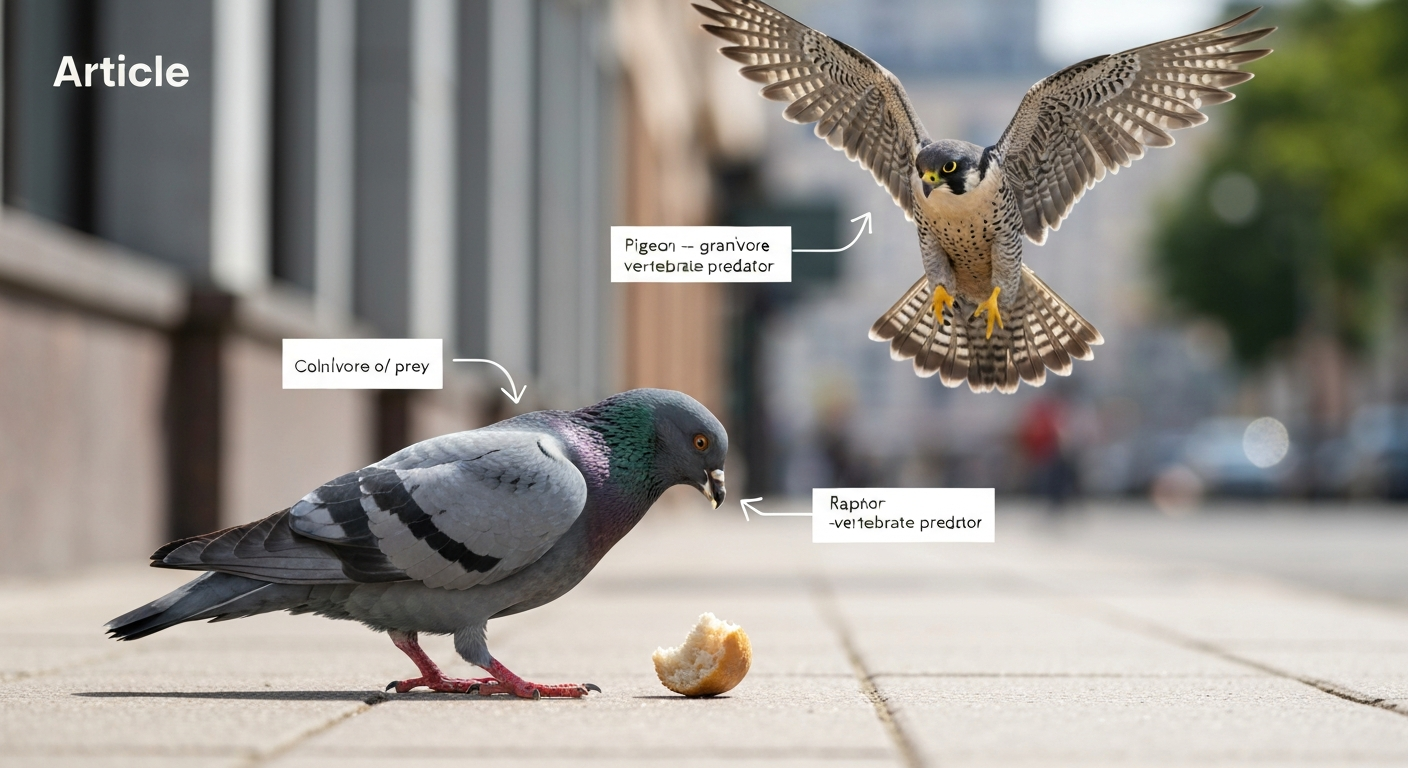
No, a pigeon is not a bird of prey. Pigeons belong to the family Columbidae and order Columbiformes, a group of seed and fruit eaters with small conical bills and standard perching feet. They have none of the defining anatomy or hunting behavior that classifies a bird as a raptor: no hooked tearing bill, no enlarged curved talons, and no habit of chasing down and killing vertebrate prey. A pigeon is, in fact, one of the most common prey items for actual raptors in cities worldwide.
Is a Pigeon a Bird of Prey? Clear Answer and Comparison, Definitive Guide

Marcus Hendricks
28 Jul 2026
What actually makes a bird a bird of prey?
The term 'bird of prey' and 'raptor' are often used interchangeably, though ornithologists note there is no single, universally agreed technical definition. The Raptor Research Foundation and researchers writing in the Journal of Raptor Research have highlighted this ambiguity while proposing working definitions built around two core pillars: diet and morphology.
On the diet side, raptors are primarily carnivorous, hunting or scavenging vertebrate prey. A bird that eats mainly seeds does not qualify no matter how dramatic it looks in flight. On the anatomy side, raptors have a strongly hooked, laterally compressed bill designed for tearing flesh, and powerful feet with large, recurved talons used to seize and kill prey. Those talons are not just big claws; they are backed by hypertrophied grasping musculature that is simply absent in other bird groups.
Taxonomically, the classical raptor families fall into three main orders: Accipitriformes (hawks, eagles, Old World vultures, ospreys), Falconiformes (falcons and caracaras), and Strigiformes (owls). Some researchers also group in the secretarybird and New World vultures depending on the definition used. What none of those groups include, at any level of classification, is a pigeon.
The key anatomical hallmarks of a raptor
- Strongly hooked bill with a sharp tomium (cutting edge) for tearing meat
- Large, recurved talons on robust feet with hypertrophied flexor musculature
- Forward-oriented hunting posture and flight silhouette (broad-winged soaring or compact falcon shape)
- Primarily vertebrate-carnivorous diet, whether by active hunting or scavenging
- Eyes typically positioned for wide binocular overlap, supporting precise prey targeting
Where pigeons fit in bird classification
The rock pigeon (Columba livia) is the species most people picture when they think 'pigeon,' and it is the ancestor of every feral city pigeon you have ever side-stepped on a sidewalk. According to the IOC World Bird List, Columba livia sits firmly in the family Columbidae within the order Columbiformes. This order contains roughly 350 species of pigeons and doves spread across every continent except Antarctica, and not one of them is classified as a raptor.
Columbiformes are actually one of the more ancient and ecologically important bird lineages. They are predominantly granivorous and frugivorous, meaning seeds and fruit make up the bulk of their diet. Many Columbidae species are critical seed dispersers in tropical and subtropical forests, which makes them ecologically closer to a delivery service than a predator. Urban and feral rock pigeons expand their menu to include human food scraps and occasional invertebrates, but there is no documented record of any Columbidae species routinely hunting and subduing vertebrate prey the way raptors do.
Why pigeons are definitely not raptors
Let me walk through the specific differences, because this is where the answer becomes really clear if you have ever looked at both birds up close.
Bill shape
A pigeon's bill is short, slender, and slightly bulbous at the tip, with a soft cere at the base. It is built for picking up seeds and pecking at fruit. Compare that to a peregrine falcon or a red-tailed hawk, where the bill curves sharply downward into a hook that can tear through flesh and bone. That hooked shape is not decorative; it is a specialized tool for a specific feeding strategy that pigeons simply do not use.
Feet and talons
This is probably the most decisive difference. Pigeons have anisodactyl feet: three toes pointing forward and one pointing back, which is good for perching on wires and walking along pavements. Their claws are relatively small and flat. Raptors, by contrast, have hypertrophied curved talons backed by powerful grasping muscles. An eagle or hawk does not just scratch prey; it drives talons in and locks them there using a specialized tendon mechanism. A pigeon's foot anatomy, as described in standard avian veterinary references, contains none of that raptorial apparatus.
Diet and hunting behavior
Cornell Lab's species account for the rock pigeon describes a diet dominated by seeds and grains, supplemented by fruit and, in urban populations, whatever edible scraps humans leave behind. Cornell Lab species accounts for the Rock Pigeon (Columba livia) note a diet dominated by seeds and grains, supplemented by fruit and urban food scraps (Rock Pigeon (Columba livia), All About Birds (Cornell Lab of Ornithology)) blank" rel="noopener noreferrer">Rock Pigeon (Columba livia) — All About Birds (Cornell Lab of Ornithology). There is no record in the peer-reviewed literature of rock pigeons or any Columbidae species hunting and killing vertebrate prey. Raptors, by definition, do exactly that. They stoop, strike, pursue, ambush, or wait and pounce, depending on species, and they regularly take prey larger than insects. The hunting mechanics are entirely different.
Ecological role
In most ecosystems and certainly in urban environments, pigeons occupy the ecological position of prey, not predator. They convert seeds and scraps into pigeon biomass, and that biomass feeds raptors. It is a tidy system. Calling a pigeon a bird of prey would be like calling a rabbit a predator because it sometimes eats insects.
Predator or prey: where do pigeons sit in the food web?
This is worth addressing directly because 'is a bird a predator or prey' is a genuinely interesting question, and the answer is often both, depending on the species and context. Many birds eat insects, worms, or small vertebrates (making them predators at some level) while simultaneously being hunted by larger animals (making them prey). Pigeons sit at the prey end of that spectrum much more than the predator end. They do eat the occasional invertebrate, so you could technically argue they are micro-predators of insects, but that is a stretch by any reasonable definition.
In urban ecosystems especially, rock pigeons have become a keystone prey species supporting healthy raptor populations. Studies of peregrine falcon diet, for instance, consistently show Columba livia as one of their most important prey items. Cooper's hawks in cities also depend heavily on pigeons and other Columbiformes, with peer-reviewed diet studies using nest provisioning records and pellet analysis confirming pigeons as a substantial component of prey biomass.
Common predators of pigeons
- Peregrine falcon (Falco peregrinus): arguably the primary urban pigeon predator; uses high-speed stoops to strike pigeons in flight
- Cooper's hawk (Accipiter cooperii): an agile, short-winged accipiter that pursues pigeons through urban cover
- Eurasian sparrowhawk (Accipiter nisus): the Old World equivalent, regularly takes stock doves and feral pigeons
- Merlin (Falco columbarius): smaller falcon that can take juvenile or small pigeon species
- Red-tailed hawk (Buteo jamaicensis): an opportunistic hunter that will take pigeons from the ground or in low flight
- Great horned owl (Bubo virginianus) and Eurasian eagle-owl (Bubo bubo): nocturnal raptors that take roosting pigeons
- Domestic cats and foxes: non-avian predators that take ground-foraging or ground-roosting birds
Field checklist: raptor vs. non-raptor in the wild
If you are out birdwatching and genuinely unsure whether the bird in front of you is a raptor, run through these four checks. They will settle the question for the vast majority of species you encounter.
- Bill shape: Is it strongly hooked and curved downward from the base? Raptor. Is it straight, conical, flat, or only mildly curved? Probably not a raptor.
- Feet and talons: Are the talons noticeably large, curved, and sharp, with thick, powerful toes? Raptor feet. Are they modest and flat, better suited to perching or walking? Non-raptor.
- Hunting posture and behavior: Does the bird stoop, strike, pursue prey actively, or sit tall on a perch scanning for vertebrate prey? Raptor behavior. Does it peck at the ground for seeds, wade for fish, or filter-feed? Not a raptor.
- Flight silhouette: Broad, fingered wings for soaring (buteo/eagle type) or swept-back, pointed wings for high-speed pursuit (falcon type)? Raptor silhouette. Round wings, rapid shallow beats, or erratic flapping? Look elsewhere.
- Diet evidence: Pellets, prey remains, or direct observation of vertebrate prey? Raptor sign. Seeds in droppings or seed husks near a foraging bird? Granivore, not a raptor.
A pigeon fails every single one of these checks. Short conical bill, flat perching feet, ground-pecking behavior, rounded wing shape in flight, and a diet made up of seeds. It is about as far from a raptor as a bird can get while still being a bird.
Are these other common birds raptors? A quick comparison
Pigeons are not the only birds that get caught up in this question. Here is a concise answer for several common species that come up repeatedly in bird classification debates.
| Bird | Bird of Prey? | Why / Why Not |
|---|---|---|
| Pigeon (Columba livia) | No | Seed and fruit eater; anisodactyl perching feet; no hooked bill or hunting talons; primary prey for actual raptors |
| Chicken (Gallus gallus domesticus) | No | Galliform bird; omnivorous ground feeder; lacks hooked bill and raptorial feet; no vertebrate-hunting behavior |
| Seagull / Gull (Larus spp.) | No | Opportunistic predator and scavenger; can take vertebrate prey but lacks raptorial feet and talons; not classified in any raptor family |
| Canary (Serinus canaria) | No | Small passerine finch; strict granivore; tiny conical bill, perching feet; no predatory anatomy or behavior whatsoever |
| Goose (Anser / Branta spp.) | No | Large waterfowl; primarily herbivorous grazer; flat bill, webbed feet; no raptorial traits despite territorial aggression |
| Parrot (order Psittaciformes) | No | Highly intelligent frugivore and seed eater; hooked bill is for cracking hard seeds/nuts, not tearing prey; not a raptor |
| Puffin (Fratercula spp.) | No | Seabird that dives for fish; bill is specialized for fish-carrying, not prey-seizing; classified in Charadriiformes, not raptor families |
A note on parrots, because their hooked bills cause genuine confusion: a parrot's bill curves downward, which looks superficially raptor-like, but the hook evolved for cracking open hard-shelled seeds and nuts, not for tearing vertebrate flesh. The function and the underlying anatomy are completely different from a hawk or falcon. Similarly, gulls can behave in surprisingly predatory ways, snatching chicks or small birds, but predatory behavior alone does not equal raptor status. Raptors are defined by the combination of specific morphology and a primary carnivorous diet, and gulls lack the raptorial feet that are central to that definition. See the related article Is a parrot a bird of prey for a focused comparison.
The bottom line on pigeons and raptors
Pigeons are birds, full stop. For a related question, see Is a canary a bird Is a canary a bird?. They are well-classified, ecologically important, and genuinely fascinating members of the order Columbiformes. What they are not is birds of prey. For a direct comparison, see the related piece Is a goose a bird of prey, which explains why geese are also non-raptors. For a related question about domestic fowl, see the article titled "is a chicken a bird of prey" for a quick comparison of chickens and true raptors. They lack the hooked bill, the powerful grasping talons, the vertebrate-hunting diet, and the predatory behavior that define raptors. For related questions, see Is a puffin a bird of prey? (internal reference f143e7e1-bbb2-4367-a154-9d5f7f3892c0). If anything, the pigeon's relationship to birds of prey is the relationship of lunch to the diner. The next time you watch a feral pigeon pecking at a pretzel on a city street, just remember that somewhere above you, a peregrine falcon is probably watching it too, and for very different reasons. For a similar question about small songbirds, see Is a canary a bird of prey Is a canary a bird of prey?.
FAQ
Article title
Is a pigeon a bird of prey? Clear answer and guide
Meta description
Is a pigeon a bird of prey? Short, science-backed answer, ID checklist, comparison with common birds, predators, and sources. (≤160 characters)
Core question — Is a pigeon a bird of prey?
No. Pigeons (family Columbidae, e.g., Rock Pigeon Columba livia) are not classified as birds of prey (raptors). Authoritative taxonomy places pigeons in Columbiformes, separate from raptor orders, and their anatomy and diet do not match standard raptor definitions. Sources: IOC World Bird List (classification) and Cornell Lab species account: https://www.worldbirdnames.org/new/ ; https://www.allaboutbirds.org/guide/Rock_Pigeon/overview
What is a “bird of prey” (raptor)?
A practical, widely used definition emphasizes: (1) primarily vertebrate‑eating (hunting or scavenging) diet, and (2) raptorial morphology — a strongly hooked bill and feet with enlarged, recurved talons used to seize and kill prey. Field manuals and raptor-research guidance add hunting behaviors and flight silhouettes as functional criteria. Sources: Journal of Raptor Research commentary; Cornell Lab overview of raptor feet; Raptor Research Foundation techniques manual: https://bioone.org/journals/journal-of-raptor-research/volume-53/issue-4/0892-1016-53.4.419/Commentary-Defining-Raptors-and-Birds-of-Prey/10.3356/0892-1016-53.4.419.full ; https://academy.allaboutbirds.org/all-about-raptor-feet/ ; https://raptorresearchfoundation.org/wp-content/uploads/2023/02/Techniques_Manual_Chapter-2.pdf
Why aren’t pigeons considered raptors? (diet and behavior)
Pigeons are primarily granivorous/frugivorous or omnivorous foragers that eat seeds, grains, fruit and urban food scraps; they do not hunt and kill vertebrate prey using raptorial strikes. Species accounts and diet studies show pigeons forage on the ground or in flocks, not by predatory capture of vertebrates. Source: Animal Diversity Web and Cornell Lab: https://animaldiversity.org/accounts/Columba_livia/ ; https://www.allaboutbirds.org/guide/Rock_Pigeon/overview
Why aren’t pigeons considered raptors? (anatomy)
Pigeons have short, conical bills adapted for pecking seeds and anisodactyl feet (three toes forward, one back) for perching and walking. They lack the hypertrophied curved talons, powerful grasping feet, and strongly hooked tearing bill typical of raptors. Comparative ornithology and veterinary resources document these differences. Sources: Gill (Ornithology), veterinary/zoological summaries: https://www.sfsu.edu/people/feinberg/gill.pdf ; https://veteriankey.com/columbiformes/