A parrot is both an animal and a bird. These are not two different answers competing with each other. Birds are a group within the animal kingdom, so saying a parrot is a bird is the same as saying it is an animal. Specifically, parrots belong to Kingdom Animalia, Class Aves (birds), and Order Psittaciformes. If you landed here because something online gave you a confusing answer, the confusion is simply about how biological classification works, and this article will clear that up in plain language.
Is a Parrot an Animal or a Bird? Clear Scientific Answer

Marcus Hendricks
13 Aug 2026
The one-line answer
A parrot is a bird, and all birds are animals, so a parrot is both simultaneously. There is no contradiction.
What actually makes something a bird?
Before we get into why parrots qualify, it helps to know what biologists actually look for when they say something is a bird. Class Aves is defined by a set of physical and physiological traits that no other living animal group has in combination. You do not need a lab to spot most of them.
- Feathers: the single most reliable feature. Every bird has feathers, and no living non-bird animal does. They are made of keratin and serve functions from flight to insulation to display.
- A toothless, horny beak: modern birds lost teeth roughly 100 million years ago. What you see instead is a keratinous bill in every shape imaginable, from the hooked beak of a raptor to the flat bill of a duck.
- Egg-laying with hard or leathery shells: birds are oviparous, meaning they reproduce by laying eggs. Parrot eggs have hard, calcium-carbonate shells.
- Endothermy (warm-bloodedness): birds regulate their own body temperature internally, powered by a high metabolic rate and a fully four-chambered heart.
- Furcula (wishbone): the fused clavicles form a springy structure that helps absorb and store energy during the flight stroke. It is a standard avian skeletal marker.
- Keeled sternum: in flying birds, the breastbone has a prominent ridge (the carina) that anchors the large pectoral flight muscles. Flightless birds have a reduced or absent keel.
- Pneumatized (hollow) bones: many bird bones contain air spaces connected to the respiratory air-sac system. This reduces weight without sacrificing structural strength.
- Pygostyle: the last several tail vertebrae are fused into a single structure that supports the tail feathers.
Hit all of those traits and you have a bird. Miss even a few and you are looking at something else. As we will see, parrots check every box.
Why parrots are definitely birds
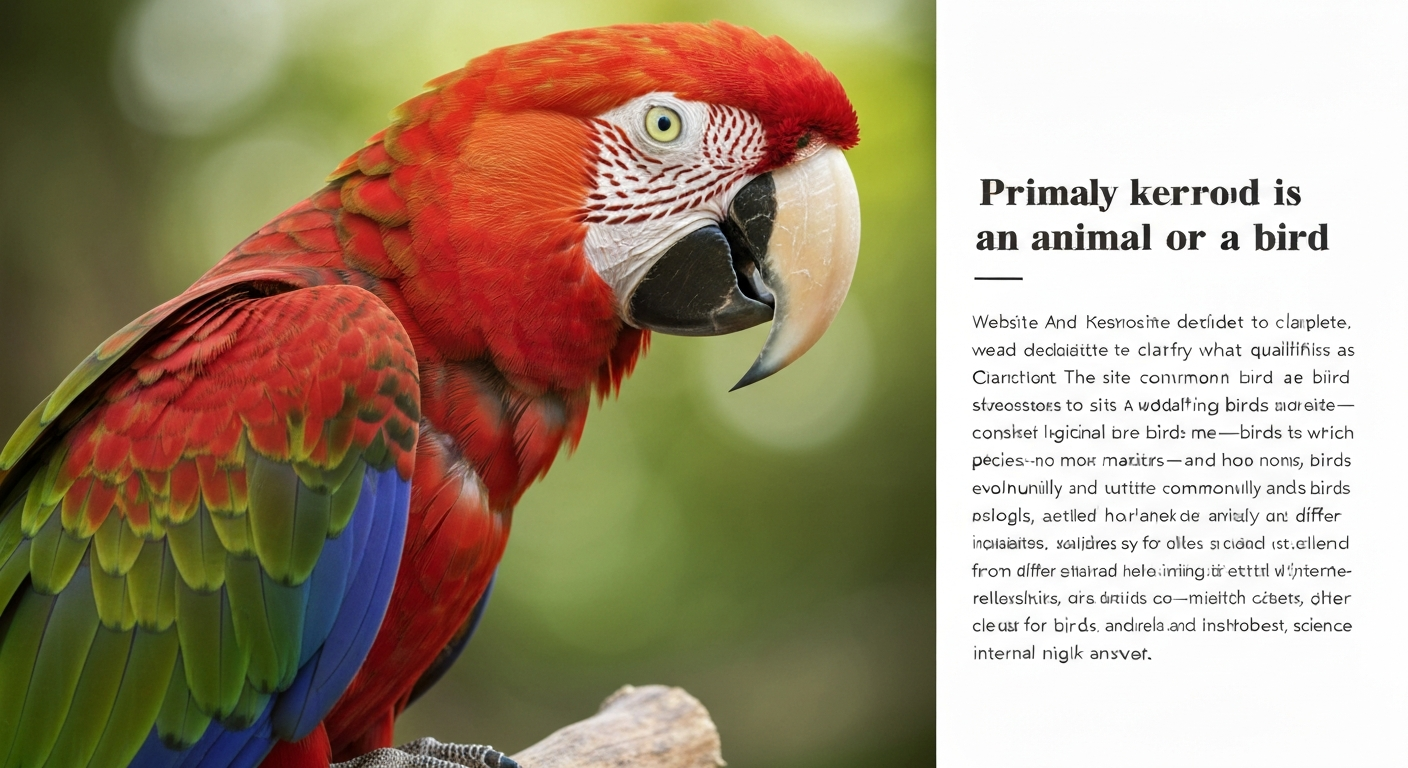
Parrots have feathers, full stop. Their plumage ranges from the brilliant scarlet of a macaw to the subtle grey of an African grey, but every species in Order Psittaciformes is covered in feathers from head to tail. That alone places them firmly in Aves.
They also have the hooked, toothless beak that is characteristic of the parrot group specifically, a strong curved upper mandible and a sturdy lower mandible adapted for cracking seeds and nuts. They lay hard-shelled eggs, are warm-blooded with a four-chambered heart, and possess all the skeletal hallmarks: the furcula, a keeled sternum (parrots are capable fliers in most species), pneumatized bones, and a pygostyle. The Smithsonian National Museum of Natural History, Bird Bones (avian osteology overview) documents these avian skeletal features, including the furcula, keeled sternum, pneumatized bones, and pygostyle The Smithsonian National Museum of Natural History — Bird Bones (avian osteology overview) documents these avian skeletal features, including the furcula, keeled sternum, pneumatized bones, and pygostyle.. Every diagnostic trait that separates birds from reptiles, mammals, amphibians, and fish is present in a parrot.
The thing that tends to confuse people is the talking. Parrots can mimic human speech, which feels almost mammalian, even almost human. But vocalization ability has nothing to do with taxonomic classification. A parrot producing the sounds of words is still doing so through a syrinx, the uniquely avian vocal organ found nowhere else in the animal kingdom. It is a bird talking like a human, not a human-adjacent creature that happens to have feathers.
Where parrots sit in the tree of life
Taxonomy gives us a formal address for every species, and parrots have a very clear one. Starting from the broadest level and working down, here is where parrots live in the classification system.
- Kingdom: Animalia (all animals, from sponges to elephants to parrots)
- Phylum: Chordata (animals with a notochord at some point in development, including all vertebrates)
- Class: Aves (all birds, roughly 10,000 living species)
- Order: Psittaciformes (the parrots, approximately 400 species)
Notice that Kingdom Animalia sits at the very top. Everything below it, including every bird, every mammal, and every fish, is an animal. Reaching Class Aves does not take you out of the animal kingdom; it just narrows down which kind of animal you are looking at.
The four families within Psittaciformes
Modern checklists, including the IOC World Bird List and the eBird/Clements Checklist from Cornell Lab, divide Order Psittaciformes into four families. Different authorities (IOC, Clements, HBW/BirdLife) agree on the broad order but can differ on exact genus placements between families, so the family-level splits below follow the IOC arrangement, which is the most widely cited.
| Family | Common name | Example species |
|---|---|---|
| Strigopidae | New Zealand parrots | Kākāpō (Strigops habroptilus), Kea (Nestor notabilis) |
| Cacatuidae | Cockatoos | Sulphur-crested cockatoo (Cacatua galerita), Cockatiel (Nymphicus hollandicus) |
| Psittacidae | New World & African parrots | Scarlet macaw (Ara macao), African grey (Psittacus erithacus), Amazon parrots (Amazona spp.) |
| Psittaculidae | Old World parrots | Ring-necked parakeet (Psittacula krameri), Lovebirds (Agapornis spp.), Rainbow lorikeet (Trichoglossus moluccanus) |
Strigopidae is the oldest lineage, containing only three living New Zealand species. Cacatuidae (cockatoos) split off next. The remaining two families, Psittacidae and Psittaculidae, cover the bulk of the roughly 400 parrot species people know from pet shops, wildlife documentaries, and tropical forests around the world.
Parrots are animals AND birds: a quick comparison
The table below shows how parrots compare to other major vertebrate classes across the key diagnostic features. It makes visually clear why the answer to 'animal or bird' is always 'both.'
| Trait | Parrot (Aves) | Mammal (e.g., dog) | Reptile (e.g., lizard) | Fish (e.g., salmon) |
|---|---|---|---|---|
| Kingdom Animalia | Yes | Yes | Yes | Yes |
| Feathers | Yes | No | No | No |
| Beak (no teeth) | Yes | No (teeth present) | No (teeth in most) | No (teeth in most) |
| Hard-shelled eggs | Yes | No (live birth in most) | Leathery eggs in most | No (water eggs) |
| Warm-blooded (endothermic) | Yes | Yes | No (ectothermic) | No (ectothermic) |
| Four-chambered heart | Yes | Yes | Partial (3 or 4 chambers) | No (2 chambers) |
| Furcula (wishbone) | Yes | No | No | No |
| Keeled sternum | Yes (flying species) | No | No | No |
| Classified as Aves | Yes | No | No | No |
The first row tells the whole story. Every class in the table is part of Kingdom Animalia. The rows beneath it show what separates birds from everything else. Parrots share the 'Yes' in Animalia with dogs and lizards and salmon, but they are the only column that also checks every bird-specific box.
Quick answers to closely related questions
A few questions that land near this topic deserve short, direct answers because they come up constantly in searches and in the comments on articles like this one.
Are lovebirds parrots?
Yes, lovebirds are parrots. The genus Agapornis, which includes all nine lovebird species, sits within the family Psittaculidae (Old World parrots) in Order Psittaciformes. They have all the parrot hallmarks: the hooked beak, the zygodactyl feet (two toes forward, two back), feathers, and hard-shelled eggs. The name 'lovebird' is a common name based on their pair-bonding behavior, not a separate taxonomic category.
Is a partridge a bird?
Yes, a partridge is absolutely a bird, but it is not a parrot or anything close to one. For more detail on partridges and their classification, see Is a partridge a bird. Partridges, including the Grey Partridge (Perdix perdix) and various Alectoris species like the Red-legged Partridge, belong to blank" rel="noopener noreferrer">family Phasianidae in Order Galliformes, the same order as chickens, turkeys, and pheasants. Their evolutionary lineage split from parrots tens of millions of years ago. A partridge and a parrot are about as closely related as a bat and a whale, both animals, both sharing a broader group, but very distant cousins.
What about searches for 'is par a bird'?
'Par' on its own is not a bird, an animal, or a species of any kind. It is a term from golf referring to the expected number of strokes for a hole or round, and it also has uses in finance and general English meaning equal or standard level. If you searched 'is par a bird' and ended up here, the most likely explanation is an autocomplete misfire or a very abbreviated version of 'is a parrot a bird.' The answer to the intended question is yes: a parrot is a bird.
Image suggestion: labeled parrot anatomy diagram
Placement: after the 'Why parrots are definitely birds' section, before the taxonomy breakdown. A labeled diagram of a parrot (ideally a macaw or African grey for recognizability) with callouts pointing to: feathers, hooked beak (upper and lower mandible), zygodactyl feet (two toes forward, two back), keel region on the chest, and tail feathers anchored by the pygostyle. A second optional image, placed near the taxonomy table, could be a simplified cladogram showing the four Psittaciformes families branching from a common ancestor, with Strigopidae at the base and Cacatuidae, Psittacidae, and Psittaculidae as the remaining branches. Caption for the anatomy diagram: 'Key features that identify a parrot as a bird: feathers, toothless hooked beak, zygodactyl feet, and avian skeletal structures including the keeled sternum and pygostyle.' Caption for the cladogram: 'Simplified family tree of Order Psittaciformes showing the four families recognized by the IOC World Bird List.'
Putting it all together
The reason the question 'is a parrot an animal or a bird' persists is that many people were taught to think of 'animal' as meaning mammal, something furry that gives birth to live young. But in biology, 'animal' means any member of Kingdom Animalia, a group that includes insects, fish, reptiles, birds, and mammals. Birds are a subset of animals, not a separate kingdom next to them. A parrot is a bird the same way a golden retriever is a mammal: the second label is more specific, but both labels are true at the same time. Parrots are birds, birds are animals, and parrots are therefore animals. That is the whole answer, backed by every major taxonomic authority from ITIS to the IOC World Bird List.
FAQ
Is a parrot an animal or a bird?
A parrot is both: it is an animal (Kingdom Animalia) and specifically a bird (Class Aves), placed in the order Psittaciformes (the parrots).
One-line answer for quick searches: is parrot an animal or a bird?
Short answer: a parrot is a bird — which means it is also an animal.
What traits qualify parrots as birds?
Parrots have the diagnostic features of birds: feathers, a horny toothless beak (bill), oviparity with hard‑shelled eggs, endothermy (warm‑blooded physiology), a four‑chambered heart, and avian skeletal traits such as a furcula (wishbone), a keeled sternum (in flighted species), and pneumatized (light, air‑filled) bones.
What is the taxonomic placement of parrots?
Taxonomically: Kingdom Animalia → Phylum Chordata → Class Aves → Order Psittaciformes. Major checklists (IOC, eBird/Clements) split Psittaciformes into four families: Strigopidae (New Zealand parrots), Cacatuidae (cockatoos), Psittaculidae (Old World parrots, including Agapornis lovebirds) and Psittacidae (New World & African parrots).
How can I quickly compare birds vs other animal classes to see why parrots are birds?
Checklist (birds vs other vertebrate classes): • Feathers: present in birds (parrots) — absent in mammals, reptiles, amphibians, fish. • Beak without teeth: birds (parrots) — mammals have teeth, reptiles often have teeth. • Egg type: hard‑shelled eggs in most birds (parrots) — mammals mostly give live birth (except monotremes), amphibians/fish lay soft eggs. • Endothermy: birds (parrots) and mammals are warm‑blooded; reptiles, amphibians, fish are ectothermic. • Avian skeleton: furcula, keel, pneumatic bones typical of birds (seen in parrots). These differences show parrots meet the defining bird characters while also being animals.
Are lovebirds parrots?
Yes. 'Lovebirds' are members of the genus Agapornis and are treated as parrots in the Old World parrot family (commonly placed in Psittaculidae).