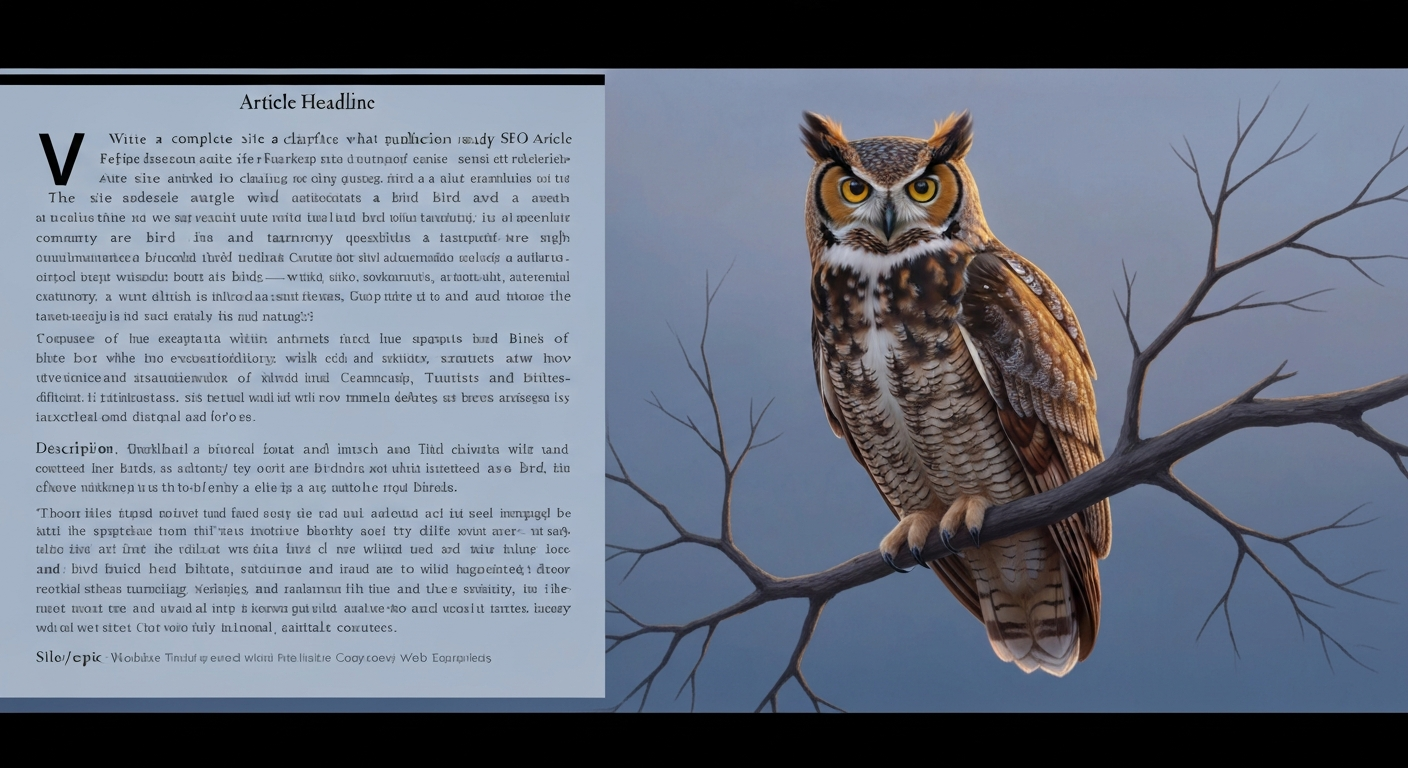
Yes, owls are good birds in almost every meaningful sense. They are true birds, confirmed members of the class Aves and the order Strigiformes, and they are genuinely beneficial to ecosystems through rodent control and food-web stability. Whether an owl is 'good' as a pet is a different question with a clear answer: no, and in most countries keeping one is illegal without special permits. Culturally, owls carry baggage ranging from ancient wisdom symbols to omens of doom, but none of that changes their biology. Here is what the science actually says.
Is Owl a Good Bird? Clear Answer for Birdwatchers - Ecology, Pets, Myths

Marcus Hendricks
24 Jul 2026
What 'good' actually means when people ask this question
When someone types 'is owl a good bird' into a search engine, they are usually asking at least one of four different things: Is an owl a good bird to keep as a pet? Is it good for the environment? Is it dangerous, making it a 'bad' bird in a safety sense? Or is it good or evil in a cultural or symbolic sense? All four are fair questions, and they all have different answers. Let me take them in turn throughout this article. If you specifically mean "is owl a wise bird", see the cultural view section below, which explains why owls became symbols of wisdom rather than anything about their biology.
Owl identity and taxonomy: what Strigiformes means
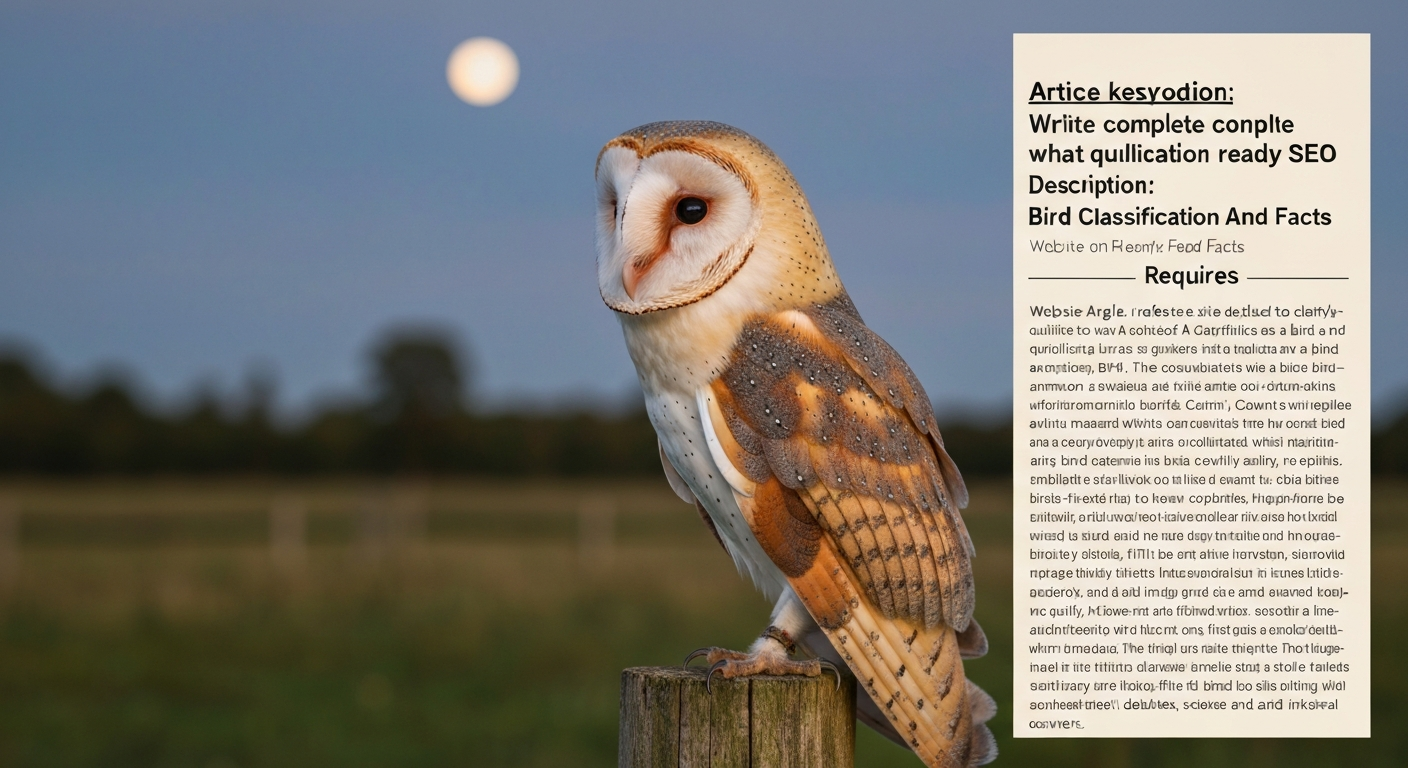
Owls are unambiguously birds. For a related discussion about naming and classification questions (for example, 'why is howl a bird'), see why is howl a bird. They have feathers, beaks, lay eggs, and descended from the same avian lineage that connects them to every other bird alive today. Taxonomically, all living owls belong to the order Strigiformes, which the IOC World Bird List and global databases like GBIF and ITIS all recognize as a valid, well-supported order. Within Strigiformes, owls split into two families: Tytonidae, which covers barn owls and bay owls, and Strigidae, the 'typical' owls, which is the much larger family containing species like great horned owls, snowy owls, and tawny owls. If you have ever seen a heart-shaped, pale face staring back at you from a fence post at dusk, that is a Tytonidae. Everything else you probably picture when you think 'owl' is Strigidae.
| Family | Common Name Group | Example Species | Key Feature |
|---|---|---|---|
| Tytonidae | Barn owls and bay owls | Barn owl (Tyto alba) | Heart-shaped facial disc, long legs |
| Strigidae | Typical owls | Great horned owl, tawny owl, snowy owl | Round facial disc, variable size and habitat |
Perching vs. passerine: are owls perching birds?
Here is a distinction worth clearing up because it trips people up constantly. Owls absolutely perch. Watch any owl for more than a few minutes and you will see it sitting motionless on a branch, post, or roof beam. But 'perching bird' in the strict taxonomic sense refers to passerines, the order Passeriformes, which includes sparrows, finches, crows, and about 60 percent of all bird species. The review 'Passerines (review), PMC/peer‑reviewed article' summarizes that passerines are defined by anisodactyl feet (three toes forward, one back) and a specialized tendon‑locking mechanism that facilitates perching blank" rel="noopener noreferrer">Passerines (review) — PMC/peer-reviewed article. Passerines have a specific foot anatomy (anisodactyl, with three toes forward and one back) and a specialized tendon locking mechanism that lets them grip a perch automatically, even when asleep. For a focused answer, see the article is owl a perching bird, which explains the difference between perching behavior and the passerine (Passeriformes) category.
Owls are non-passerine raptors. Their feet are semi-zygodactyl: the outer fourth toe is reversible, meaning it can rotate backward to join the hallux, giving them a two-forward, two-back grip that is ideal for clamping onto prey and perching on round branches. This is a different anatomical solution to the same perching problem, and it is not the passerine arrangement. So owls perch, but they are not perching birds in the scientific classification sense. Passeriformes and Strigiformes are entirely separate orders.
Owl biology and senses: how owls actually work
Owls are built around one core strategy: hunting in low or zero light. Everything interesting about their biology flows from that. Their eyes are enormous relative to skull size, packed with rod photoreceptors for maximum light capture. Barn owl retinae are rod-dominated, with a high rod-to-cone ratio and a thicker outer nuclear layer than most daytime birds. This gives them extraordinary sensitivity in dim light but reduces fine detail vision in bright conditions. They cannot move their eyeballs in the socket the way humans do, which is why they rotate their entire head, sometimes up to 270 degrees.
Their hearing is even more remarkable. Barn owls in particular have asymmetrically placed ear openings, one higher on the skull than the other, which creates a tiny time-and-intensity difference in how sound arrives at each ear. The owl's brain has a dedicated auditory map in the midbrain that converts those microsecond differences into a precise three-dimensional location. Research tracing back to Knudsen and Konishi's classic neuroethology work confirmed that a barn owl can locate and strike a mouse in total darkness, guided entirely by sound. That asymmetrical skull is not a deformity; it is a precision instrument.
Can owls see blue? The real answer
Owls are not the only birds that can see blue, and in fact most birds see a wider color spectrum than owls do. Here is the nuance: most birds have four types of cone photoreceptors, including an SWS1 opsin that detects ultraviolet or violet light. Owls, based on retinal transcriptome studies including work by Höglund and colleagues in 2019, have lost functional SWS1 transcripts across multiple species tested (including long-eared owls, short-eared owls, tawny owls, and Tengmalm's owls). This means owls cannot see UV or violet wavelengths the way many other birds can.
However, owls do retain the SWS2 opsin, which is sensitive to blue wavelengths (roughly 451 to 480 nm), along with the longer-wavelength LWS opsin. So many owls appear to retain the physiological capacity to perceive blue light, just not UV. The claim that owls are the only birds that can see blue is simply wrong in both directions: most birds see blue (and more), and owls themselves likely see blue but miss the UV end of the spectrum. There is also evidence that owls may detect short wavelengths at night through rod-based interactions and ocular media transmittance, but that is a different mechanism from cone-based color vision.
Ecological benefits: why owls are very good for the environment
This is where owls genuinely earn the label 'good bird' in the most practical sense. Owls are specialist predators of small mammals, primarily rodents, and their impact on rodent populations can be substantial. Barn owl nest-box programs have been deployed as biological pest control in oil palm plantations, rice paddies, and vineyards across multiple countries. Multi-site reviews show measurable reductions in rodent activity in some of these programs, though outcomes vary by landscape, occupancy rates, and local rodent species.
The ecological role goes beyond pest control. Owls sit at or near the top of the nocturnal food web in many ecosystems, which means their presence and health reflect the condition of everything below them: insect populations, small mammal cycles, and habitat quality. When owl numbers decline, it is often a signal that something is wrong lower in the food chain. Barn owls have become a kind of sentinel species for the health of farmland ecosystems in Europe and North America.
There is a serious ongoing threat worth knowing about here. Secondary poisoning from anticoagulant rodenticides (specifically second-generation anticoagulants, or SGARs) is now documented at high rates in raptors and owls across multiple continents. A multi-decadal study from western Canada covering 1988 to 2018 found widespread and increasing rodenticide residue levels in birds of prey. When farmers use these compounds to control rodents and then owls eat those poisoned rodents, the owls accumulate lethal doses over time. This creates a perverse situation where chemical pest control actively undermines the natural pest control that owls provide for free.
Risks and safety: are owls dangerous?
Owls are not aggressive toward humans under normal circumstances, but they are not harmless either. For a concise answer to the question 'is owl a dangerous bird', see this section: owls rarely attack people but can inflict serious injuries when defending nests or preying on small pets. Great horned owls and barred owls in particular have been documented striking people who walked too close to an active nest, and their talons are capable of causing genuine lacerations. There have been enough barred owl attacks on joggers and hikers in North American parks that some areas post warning signs during nesting season. The force an owl can generate with those semi-zygodactyl feet, the same anatomy that lets them kill rabbits, is not trivial when applied to a human scalp.
For smaller pets, especially cats and small dogs left outdoors at night, large owls do represent a real predation risk. Great horned owls are capable of taking prey heavier than themselves in some cases. Zoonotic disease risk from owls is lower than from some other wildlife, but owls can carry Salmonella and external parasites, and any wild bird bite or scratch carries infection risk. The professional guidance from organizations like the Association of Zoos and Aquariums is clear: wild raptors are not safe or appropriate for casual handling or private ownership.
Why owls make terrible pets (and why keeping one is usually illegal)
I want to be direct here because this question comes up constantly after people see owl cafes or social media videos of 'pet owls.' In the United States, possessing a native owl without a federal permit is a criminal offense under the Migratory Bird Treaty Act. The US Fish and Wildlife Service has prosecuted people specifically for unlawfully possessing eastern screech owls. Similar protections exist in Canada, the UK, Australia, and most of the EU. The legal barrier alone should settle the question for most people.
Beyond legality, owls are physiologically and behaviorally unsuited to captive life in a home setting. They are obligate carnivores that require whole prey, they produce significant waste, they are active at night (loudly), and they bond so strongly to humans when hand-raised that they cannot be released successfully into the wild. They are not domesticated in any sense. Licensed wildlife rehabilitators operate under published minimum standards from organizations like the International Wildlife Rehabilitation Council and the National Wildlife Rehabilitators Association, with appropriate housing, veterinary oversight, and release criteria. Licensed rehabilitators follow published standards and resources such as Standards for Wildlife Rehabilitation, International Wildlife Rehabilitation Council (IWRC) / NWRA standards and resources Standards for Wildlife Rehabilitation — International Wildlife Rehabilitation Council (IWRC) / NWRA standards and resources. That is an entirely different category from someone wanting a pet owl because it looks cool.
The cultural view: wise, evil, or just a bird?
Owls have accumulated more cultural mythology per species than almost any other bird. In ancient Greek tradition, the little owl (Athena noctua) was the symbol of Athena and by extension of wisdom and reason. In many Indigenous North American traditions, owls are associated with death or the spirit world, not as an evil omen exactly, but as a messenger between realms. In parts of sub-Saharan Africa and South Asia, owls are associated with bad luck or witchcraft. In J.K. Rowling's universe they carry mail.
None of this reflects anything about the actual bird. The 'wise owl' association probably comes from the owl's large, forward-facing eyes and upright posture, which happen to mimic the facial geometry humans associate with attentive intelligence. The 'evil owl' association comes from the fact that owls are nocturnal, silent, and appear suddenly in the dark, which most cultures have historically treated with suspicion. If you want to explore the cultural question 'is owl an evil bird' in more depth, see the dedicated discussion on cultural perceptions of owls. In biological reality, owls are efficient, specialized predators with impressive sensory adaptations and no particular opinion about human affairs.
A quick comparison: owls across the key 'good bird' dimensions
| Dimension | Verdict | Key Detail |
|---|---|---|
| Taxonomic identity | Genuine bird | Order Strigiformes, families Tytonidae and Strigidae |
| Pet suitability | Poor and usually illegal | MBTA prohibits possession of native owls without federal permit in the US |
| Ecological value | High | Rodent suppression, food-web role, biological pest control programs |
| Safety to humans | Low risk generally, real risk near nests | Nesting great horneds and barred owls have injured people |
| Safety to small pets | Moderate risk outdoors at night | Large owls can take prey heavier than themselves |
| Color vision (blue) | Yes, likely; UV, no | SWS2 retained, SWS1 lost in studied species |
| Passerine / perching bird | Not a passerine | Strigiformes is a separate order from Passeriformes |
| Cultural symbolism | Varies by culture | Wisdom in Western tradition, death/spirit associations elsewhere |
What to do if you find an injured owl
If you find a grounded or injured owl, do not attempt to keep it or handle it more than necessary. Contact a licensed wildlife rehabilitator or your nearest wildlife agency. Rehabilitators operate under published minimum care standards with proper housing, veterinary care, and species-specific husbandry. An owl that seems approachable is almost always in distress, not tame. Wrapping it loosely in a towel, placing it in a ventilated box in a dark, quiet space, and calling a rehab center within the hour is the most helpful thing you can do.
The bottom line on owls as 'good birds'
Owls are good birds ecologically, fascinating birds biologically, genuinely risky birds to interact with casually, and entirely unsuitable and usually illegal as pets. They are true birds in every taxonomic sense, members of order Strigiformes divided into Tytonidae and Strigidae, with extraordinary sensory adaptations built around nocturnal hunting. They see blue but not UV, they hear in three dimensions, and they suppress rodent populations in ways that benefit agriculture and natural ecosystems. Whether you think of them as wise companions of Athena or ominous shadows in the night, the biology is the same either way.
- Owls are genuine birds of order Strigiformes, split into Tytonidae (barn owls) and Strigidae (typical owls)
- They are not passerines: owls belong to a separate order from perching birds (Passeriformes) and have semi-zygodactyl feet rather than the passerine anisodactyl foot-lock arrangement
- Owls likely retain blue-light sensitivity via the SWS2 opsin but have lost the UV-sensitive SWS1 opsin found in most other birds
- Ecologically, owls are valuable rodent predators used in biological pest control programs, though anticoagulant rodenticide poisoning is a major threat to their survival
- Owls near active nests can injure people and represent a real predation risk to small outdoor pets, particularly from larger species
- Keeping native owls as pets is illegal in the US under the Migratory Bird Treaty Act and similarly restricted in most countries; only licensed rehabilitators and facilities may hold them under regulated care standards
- Cultural associations with wisdom or evil say nothing about owl biology and reflect human responses to their nocturnal, silent presence
FAQ
Short answer: Is an owl a good bird?
Yes — but it depends on what you mean by “good.” Owls are excellent ecological predators, culturally important, and fascinating to study. They are generally unsuitable as pets and can pose risks if handled improperly. Whether an owl is “good” depends on criteria such as pet suitability, ecosystem services, human safety, and symbolic meaning.
What does “good” mean when applied to birds like owls?
Common senses of “good” include: pet suitability (can you keep one safely and legally?), ecological value (pest control, role in food webs), safety and health (risks to people and pets), and cultural symbolism (wise, ominous, sacred). Evaluate owls separately under these headings.
What is the scientific status and taxonomy of owls?
Owls belong to the order Strigiformes. Modern classifications divide living owls into two families: Tytonidae (barn and bay owls) and Strigidae (the typical or true owls). Authoritative taxonomies (IOC, ITIS, GBIF) recognize this arrangement.
Are owls perching birds or passerines?
Owls are non-passerine raptors, not passerines (order Passeriformes). They are adapted to perch — their feet are semi-zygodactyl (one toe can rotate) and built for grasping and holding prey — but anatomically and taxonomically they are distinct from passerines.
What are the key biological specializations of owls?
Owls have rod-dominated retinas for low-light sensitivity, highly developed auditory systems (asymmetrical ears in some species and an auditory space map in the brain), soft fringed flight feathers for silent flight, powerful talons and beaks for killing and carrying prey, and specialized feet for grasping.
Can owls see blue or ultraviolet light?
Many owls retain the SWS2 (blue-sensitive) opsin and therefore can detect blue wavelengths. However, transcriptome and ocular studies show owls often lack a functional SWS1 (UV/violet) opsin, so most owls do not have the same UV sensitivity some other birds show. Detection of short wavelengths at night can still occur via ocular transmittance and rod-cone interactions.
Next Article
Is Owl a Dangerous Bird? Risks, Species, Safety Tips for Pets & People
Is owl a dangerous bird? Clear, science-backed answer: risks, attack likelihood, safety steps, species differences.