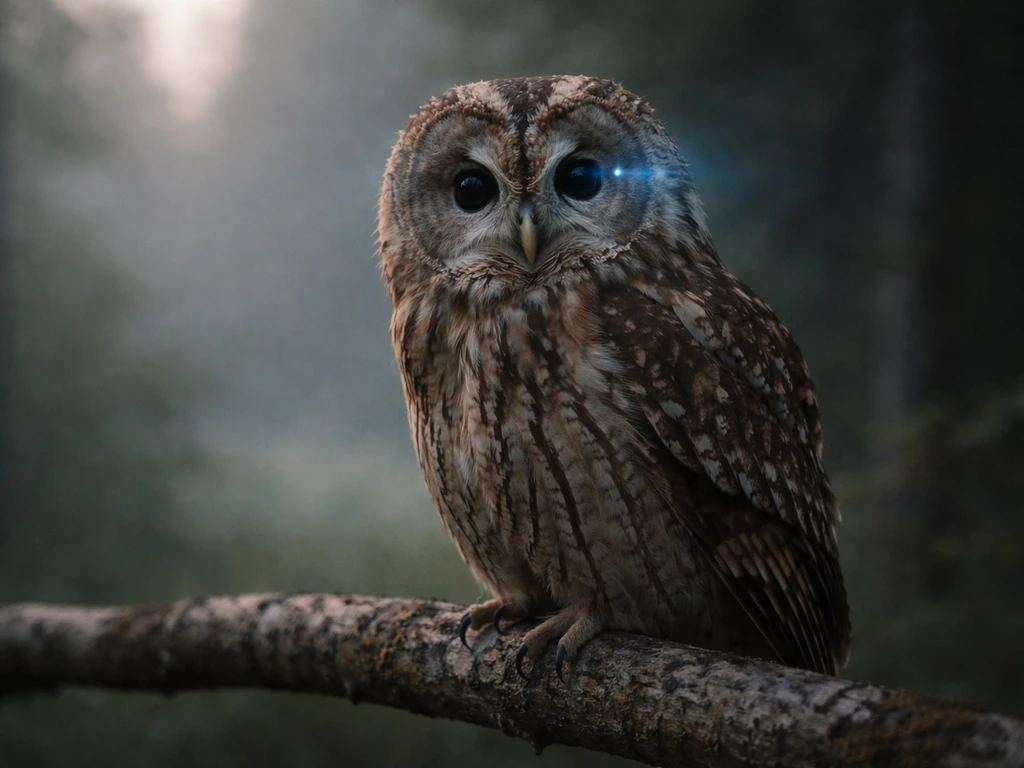
Owls are not perching birds in the taxonomic sense. The term 'perching bird' has a precise scientific meaning: it refers to the order Passeriformes, which includes sparrows, robins, crows, and about 6,500 other species. Owls belong to a completely separate order, Strigiformes, and have never been classified as passerines. That said, owls absolutely do perch. They sit on branches for hours, hunt from perches, and roost on them while sleeping. So the honest answer is: no in taxonomy, yes in behaviour.
Is Owl a Perching Bird? Clear Verdict, Anatomy, Tips & Safety

Marcus Hendricks
15 Jul 2026
What people actually mean by 'perching bird'
The phrase 'perching bird' gets used in two very different ways, and the confusion between them is what makes this question interesting. Understanding which sense someone means changes the answer completely.
The taxonomic meaning
In formal ornithology, 'perching birds' is the standard English label for the order Passeriformes. Major global checklists including the IOC World Bird List and the Clements Checklist use 'perching birds' as the plain-English description for that order. Passeriformes is the largest order of birds on Earth, containing roughly 60 percent of all living bird species. If someone uses 'perching bird' in this sense, they mean a passerine, and owls are definitively not passerines.
The functional/behavioural meaning
Many people use 'perching bird' to simply mean any bird that sits on a branch or wire, which is a reasonable everyday interpretation. By this definition, owls qualify easily. They routinely perch on fence posts, tree branches, and utility poles while scanning for prey, and they roost on perches while sleeping. The issue is that this casual definition applies to almost every bird alive. Herons perch. Hawks perch. Penguins, amusingly, do not perch in the same way. The functional definition is too broad to be scientifically useful, which is why taxonomy settled the question with anatomy instead.
Where owls sit in the bird family tree
Owls form their own distinct order, Strigiformes, which splits into two families that cover all living owl species. Tytonidae contains the barn owls and bay owls, recognisable by their heart-shaped facial discs and relatively long legs. Strigidae, the 'typical owls,' covers everything else: great horned owls, tawny owls, snowy owls, burrowing owls, and well over 200 additional species. Both families are found on every continent except Antarctica.
Where owls fit within the broader bird family tree is surprisingly tricky. Several large-scale genomic studies, including work by Jarvis and colleagues and Prum and colleagues, have struggled to pin down the exact relationship of owls to other non-passerine bird groups. The short version: owls are Neoaves (the large modern bird radiation), but their precise position within that group remains genuinely contested due to conflicting signals in the genome data. What nobody disputes is that they are nowhere near Passeriformes.
The anatomy that settles the debate: feet, toes, and tendons
The reason Passeriformes earned the 'perching bird' label in the first place is foot anatomy. Passerines have anisodactyl feet: three toes pointing forward and one (the hallux) pointing backward. More importantly, they have a specialised automatic perching mechanism, sometimes called the APM, which involves two linked subsystems: an automatic digital-flexor mechanism and a digital tendon-locking mechanism (DTLM). Experimental analyses such as Galton & Shepherd (2012). Automatic perching mechanism elements and experimental analysis (Journal of Experimental Zoology) support the view that the automatic digital‑flexor mechanism and the digital tendon‑locking mechanism function as complementary subsystems in perching birds. When a passerine lands on a branch and bends its legs, the tendons automatically tighten the grip on the branch. The bird can literally fall asleep while perching and not fall off, because the grip locks passively without muscle effort. This is why songbirds can sleep on thin branches through storms.
Owls have a digital tendon-locking mechanism too, but it works differently and serves a different primary purpose. Research by Einoder and Richardson (2007) showed that the TLM in owls varies in structure and location between the two families: Tytonidae and Strigidae differ in how their locking tendons are arranged, and the mechanism in owls is more strongly linked to gripping prey than to passive branch-perching. In simple terms, the owl's foot is built for seizing a mouse in mid-flight, not for delicately gripping a twig while napping.
Toe arrangement adds another layer. Many owls are anisodactyl like passerines, but several owl species can rotate their outer fourth toe sideways or backward, giving them a zygodactyl-like configuration (two toes forward, two back) when gripping. This versatility helps them grab irregularly shaped prey. Comparative studies of raptor hindlimbs, including work by Ward and colleagues, show that owls produce strong grip forces relative to their body size, and their talon and tarsus morphology is convergent with other raptorial birds rather than with small perching songbirds.
Owls do perch, they just do it differently
Despite all the anatomical distinctions, owls are enthusiastic perchers behaviourally. The Cornell Lab's accounts for species like the Great Horned Owl and Barn Owl both describe perch-hunting as the primary foraging strategy: the bird sits motionless on an elevated perch, listens and watches, then drops onto prey. Owls also show strong roost-site fidelity, returning to the same perch day after day. A tawny owl might use the same hollow branch as a day roost for years.
What separates owl perching from passerine perching is the biomechanical context. A sparrow perches to move between foraging locations, to sing, and to sleep, with its foot anatomy optimised for fine grip control on thin branches. An owl perches as a hunting platform and a resting site, with its foot anatomy optimised for the explosive grip needed to pin down prey. Same physical act, very different underlying hardware and ecological purpose.
Owls vs. true perching birds vs. diurnal raptors: a direct comparison
| Feature | Passerines (Perching Birds) | Owls (Strigiformes) | Diurnal Raptors (e.g., Hawks, Eagles) |
|---|---|---|---|
| Taxonomic order | Passeriformes | Strigiformes | Accipitriformes / Falconiformes |
| Foot type | Anisodactyl | Anisodactyl or semi-zygodactyl | Anisodactyl (powerful talons) |
| Tendon-locking mechanism | Automatic perching mechanism (APM) for passive grip | TLM present but primarily for prey-gripping; varies by family | TLM present; adapted for prey capture |
| Primary foot function | Perching / fine branch grip | Prey capture and gripping | Prey capture and gripping |
| Typical activity period | Diurnal | Mostly nocturnal (some crepuscular/diurnal) | Diurnal |
| Facial disc | Absent | Present (sound-focusing function) | Absent |
| Bill shape | Varies widely; often slender or seed-cracking | Hooked, raptorial | Hooked, raptorial |
| Perching behaviour | Frequent, integral to lifestyle | Frequent, for hunting and roosting | Frequent, for hunting and roosting |
The comparison with diurnal raptors is instructive. Hawks and eagles (Accipitriformes) and falcons (Falconiformes) are similarly not passerines, similarly perch frequently, and similarly have powerful talon-grip mechanisms. Owls are essentially the nocturnal ecological equivalent of diurnal raptors. They occupy a parallel niche, evolved many of the same physical solutions independently, and are no more a 'perching bird' in the taxonomic sense than a red-tailed hawk is.
How to identify an owl in the field
Owls are distinctive enough that, once you know what to look for, there is little chance of confusing them with passerines or other raptors. The features below apply to most species you are likely to encounter in North America and Europe.
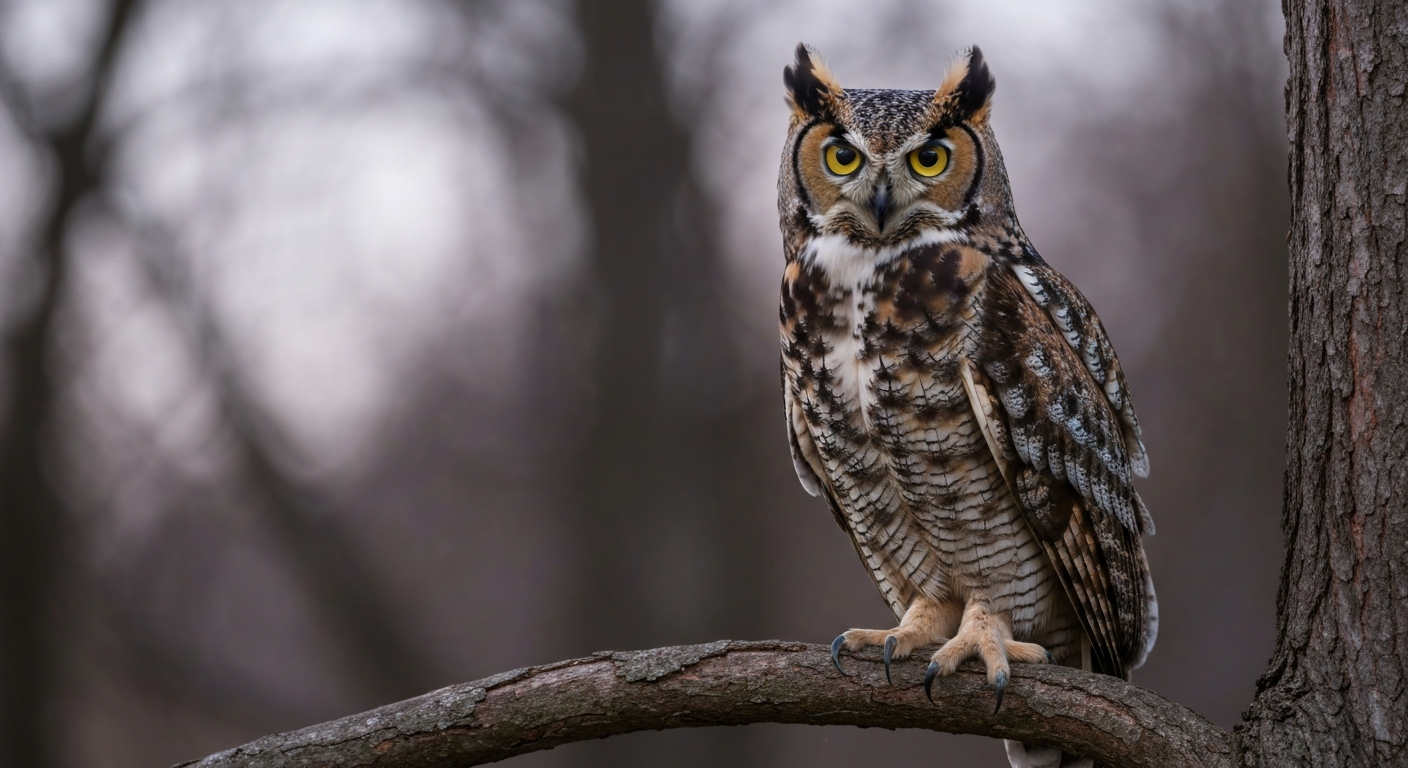
- Facial disc: the flat, rounded face with concentric feather rings is unique to owls. It acts as a sound-focusing dish, funneling noise toward the ear openings. Barn owls (Tytonidae) have a heart-shaped disc; typical owls (Strigidae) have a rounder disc.
- Large, forward-facing eyes: owls have enormous eyes set at the front of the face, giving binocular vision. Unlike most birds, they cannot move their eyeballs, which is why they rotate their entire head, up to around 270 degrees.
- Ear tufts (where present): species like the Great Horned Owl and Long-eared Owl have feather tufts on the head. These are not ears. The actual ear openings are asymmetrically positioned on the sides of the skull in many species, which improves sound localisation.
- Compact, upright posture: owls sit bolt-upright on a perch and look large for their body weight due to loose, fluffy feathering.
- Silent flight: owl wing feathers have comb-like leading edges and soft fringes that break up turbulence, making flight nearly silent. If a large bird flies past you at night and you heard nothing, it was almost certainly an owl.
- Pellets: look below regular roost sites for oval pellets of regurgitated bones, fur, and feathers. Owl pellets are firm and often intact, a reliable sign of a regular roost.
The easiest way to separate an owl from a diurnal raptor in poor light is the head shape: owls have large, rounded or box-shaped heads relative to body size, while hawks and falcons have smaller, sleeker heads. A barn owl in flight looks almost alien in comparison to a kestrel or sparrowhawk.
What owls can actually see (and the colour vision myth)
There is a persistent idea that owls cannot see colour at all, or alternatively that they are the only birds with blue-colour vision. Neither is quite right. Owls are optimised for low-light conditions: their eyes have a very high density of rod photoreceptors (which detect light intensity) relative to cones (which detect colour). This makes them exceptional in dim conditions but means colour discrimination is limited compared to many songbirds, which have four types of cone photoreceptors including ultraviolet-sensitive ones.
Owls do possess some cone photoreceptors and are not entirely colour-blind, but detailed colour vision is not their priority. Their visual system is built around motion detection and contrast in low light, not distinguishing the colours of berries or flowers. The idea that owls are unique in seeing blue is a misconception worth setting aside: blue-light sensitivity in the form of short-wave cones is found across many bird groups. See the related article 'Are owls the only bird that can see blue' for a focused discussion on blue-light sensitivity and how it compares across bird groups. Owl vision is extraordinary, but for different reasons than colour perception.
Are owls dangerous? What to do if one is on your property
Owls are not aggressive toward people under normal circumstances. They are predators that hunt small mammals, birds, and insects, and a human being is not on their menu. That said, owls will defend active nests and fledglings. Great Horned Owls in particular have a well-documented history of striking people who get too close to a nest site, using their talons. The strikes can draw blood and cause eye injuries, so keeping a respectful distance during breeding season is genuinely important, not just polite. If you're asking 'is owl a dangerous bird', the short answer is that they rarely pose a threat to people in normal situations, though nesting adults can strike and cause injury if provoked.
If you find an owl on the ground or on your property, the response depends on the situation. An adult owl sitting calmly on a low branch in daylight may simply be resting or may be unwell. A fledgling owl on the ground with fluffy juvenile feathers is often just a brancher: a young owl that has left the nest but cannot yet fly properly. In both cases, the standard advice from wildlife bodies is to leave it alone if it is not in immediate danger. Do not handle it unless necessary.
In the United States, nearly all native owl species are protected under the Migratory Bird Treaty Act (MBTA). Handling, possessing, or relocating them without appropriate federal and state permits is regulated, even with good intentions. If an owl appears genuinely injured, the correct action is to contact a licensed wildlife rehabilitator or your state wildlife agency. The National Wildlife Rehabilitators Association (NWRA) maintains a directory. In the UK, the Wildlife and Countryside Act provides similar statutory protection, and the Barn Owl Trust offers practical guidance on what to do if you find an injured or grounded owl.
The 'wise owl' and 'evil owl' myths, and the howl/owl mix-up
Owls have accumulated more cultural baggage than almost any other bird. The 'wise owl' stereotype traces back to ancient Greece, where the little owl (Athena noctua) was associated with Athena, goddess of wisdom. The reality is that owls are not especially intelligent compared to corvids or parrots. Their brains are heavily devoted to processing auditory and visual information for hunting, not to problem-solving or social cognition. The reputation for wisdom appears to stem from their solemn, forward-facing gaze, which looks distinctly contemplative to human observers.
The 'evil owl' association runs in parallel, particularly in some Indigenous North American traditions, parts of African folklore, and historical European superstition, where an owl calling near a house was taken as a death omen. This probably has more to do with owls being nocturnal and their calls being eerie than with any actual owl behaviour. Neither the wise nor the evil reputation is biologically grounded. Whether owls are 'good' or 'bad' birds is a matter of cultural interpretation rather than ornithology. A related question, Is an owl a good bird, explores the same cultural-versus-biological distinction.
One common confusion worth flagging: a surprising number of searches ask about 'howl' as a bird, treating it as an alternative spelling or word for 'owl.' Howling is a sound, not a bird. The mix-up seems to come from autocorrect, mishearing, or simple typos. If you have seen a reference to 'howl the bird' in a pop culture context, it is likely a fictional or stylised reference rather than a real species.
The full picture: owls in their correct classification context
Pulling everything together: owls are birds, clearly and unambiguously. They are warm-blooded vertebrates with feathers, beaks, and wings, and they reproduce by laying eggs. They are not mythical creatures, mascots, or mammals in disguise. Within the bird family tree, they occupy the order Strigiformes, divided into Tytonidae and Strigidae, and they sit somewhere within the Neoaves radiation, though their exact phylogenetic neighbourhood is still being resolved by genomic research.
They are not perching birds in the taxonomic sense, which belongs exclusively to Passeriformes. They are raptors in the functional sense, sharing ecological roles and some anatomical convergences with hawks and eagles despite being only distantly related. They perch constantly, but their feet are built for killing, not for gripping thin twigs. That distinction, between the passive elegance of a sparrow's automatic branch-grip and the vice-like power of an owl's talon, is what the whole perching-bird classification is really pointing at.
Quick-reference summary
| Question | Answer |
|---|---|
| Is an owl a perching bird (taxonomic)? | No. Owls are Strigiformes, not Passeriformes. |
| Is an owl a perching bird (behavioural)? | Yes. Owls perch, roost, and hunt from perches routinely. |
| What order are owls in? | Strigiformes, with two families: Tytonidae and Strigidae. |
| What makes passerines 'perching birds'? | Anisodactyl feet with an automatic tendon-locking perching mechanism. |
| Do owls have a tendon-locking mechanism? | Yes, but it is structured for prey-gripping, not passive branch-perching. |
| Are owls dangerous to people? | Rarely, except when defending nests; give nesting owls space. |
| Are owls legally protected in the US? | Yes, under the Migratory Bird Treaty Act. Contact a rehabilitator for injured birds. |
| Can owls see colour? | Limitedly. Their eyes are optimised for low-light motion detection, not colour. |
FAQ
One-sentence verdict: Is an owl a 'perching bird' (taxonomic vs functional)?
Taxonomically no—'perching birds' usually means the order Passeriformes (passerines) (IOC World Bird List: https://www.worldbirdnames.org/new/classification/orders-of-birds-draft/), but functionally yes—owls (order Strigiformes) routinely perch and possess anatomical gripping mechanisms that allow secure perching (Einoder & Richardson 2007; Galton & Shepherd 2012).
What do people mean by 'perching bird' in taxonomy and in everyday use?
Taxonomic meaning: 'perching birds' commonly refers to Passeriformes (the passerines), defined partly by a specialised anisodactyl foot suited to perching (Merriam‑Webster; IOC World Bird List). Functional/everyday meaning: any bird that regularly perches, roosts or hunts from a branch or pole—this includes many non‑passerines such as owls and raptors (Galton & Shepherd 2012).
How do passerine feet differ from owl feet anatomically?
Passerines are typically anisodactyl (three toes forward, one back) optimized for fine branch‑perching; owls show variation—many are anisodactyl but several species have a reversible toe and all have strong raptorial talons and a pronounced tendon locking/grip apparatus adapted for seizing prey (Merriam‑Webster; Einoder & Richardson 2007).
Do owls have the same automatic perching mechanism as passerines?
Owls possess digital tendon‑locking and flexor features that secure a grip (a form of tendon‑locking mechanism, TLM), but the anatomy and expression differ from passerine ADFM/DTLM implementations—both groups can perch with little active effort, though owls' systems are more raptor‑specialised (Galton & Shepherd 2012; Einoder & Richardson 2007).
What is the taxonomic placement of owls?
Owls belong to the order Strigiformes, typically divided into two families: Tytonidae (barn/bay‑owls) and Strigidae (typical owls); they are non‑passerine birds and are listed separately in major checklists such as the IOC World Bird List (https://www.worldbirdnames.org/new/bow/owls/).
Do owls behave like perching birds? When and why do they perch?
Yes—behaviorally owls commonly perch for roosting, territory displays and hunting (sitting on branches, posts or fence‑lines to watch for prey). Their perching supports ambush hunting strategies rather than the fine branch‑manoeuvring often used by passerines (Cornell Lab: All About Birds; Ward et al. 2002). (See species accounts: https://www.allaboutbirds.org/guide/Great_Horned_Owl/lifehistory).
Next Article
Are Owls the Only Bird That Can See Blue?
No. Many birds can perceive or discriminate blue wavelengths, not just owls; learn how bird vision and evidence work.