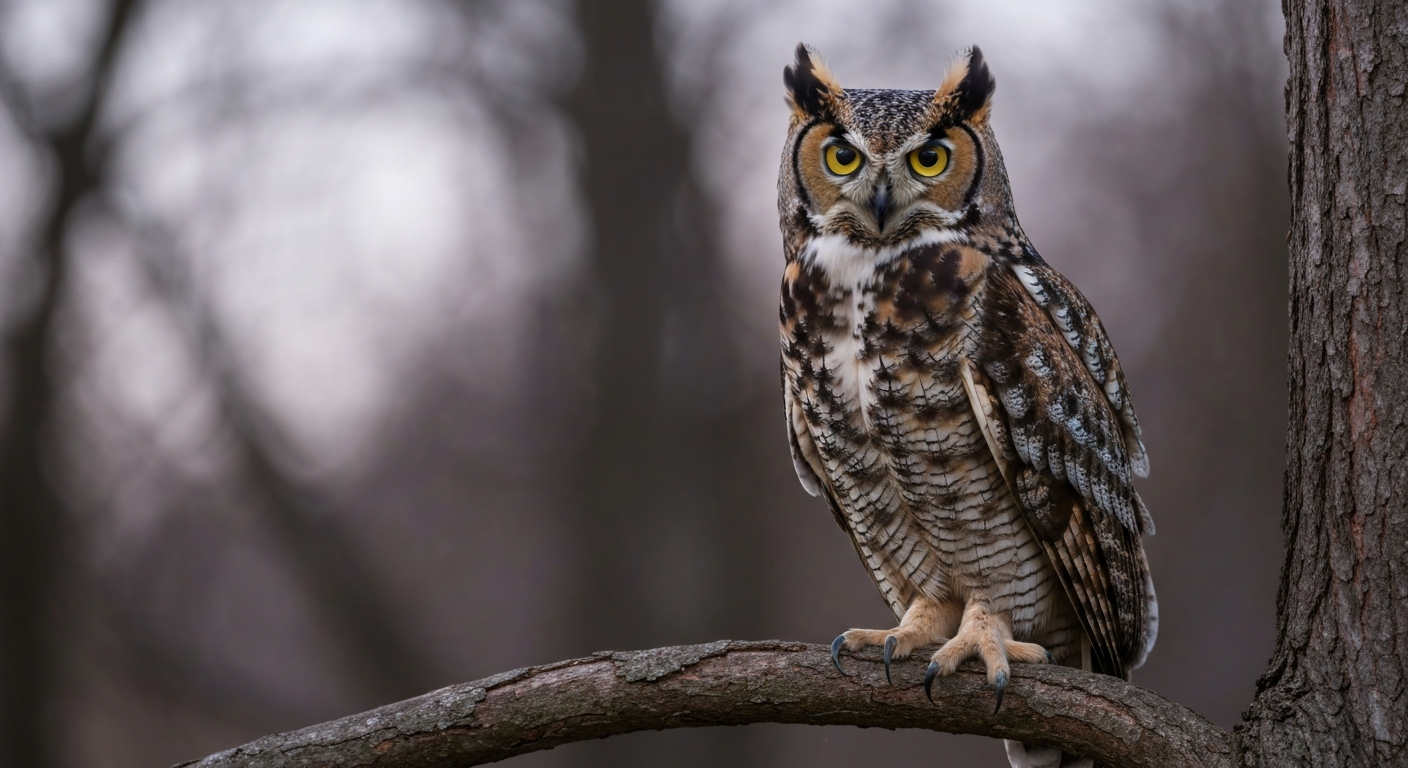
Owls can be dangerous, but the risk depends heavily on context, species, and what you mean by 'dangerous.' A healthy wild owl minding its own business poses virtually no threat to an adult human. But get too close to a nesting great horned owl, let a small cat roam at dusk near a territorial barred owl, or try to pick up an injured raptor without protection, and you will quickly discover that owls have talons capable of delivering deep puncture wounds with a grip force requiring around 28 pounds of pressure to break open. So: mildly to moderately dangerous under the right (or wrong) circumstances, and well worth understanding before you share outdoor space with one.
Is Owl a Dangerous Bird? Risks, Species, Safety Tips for Pets & People

Marcus Hendricks
17 Jul 2026
Who needs to read this and what you will find here
This article is for homeowners who have spotted an owl in the backyard, pet owners worried about a small dog or cat, birdwatchers planning a dusk survey, students writing a report on raptors, and anyone who typed a variation of 'is owl a dangerous bird' into a search engine and got a wall of contradictory results. You will find the biology behind owl weapons (talons, beak, grip strength), which species carry the most risk, when and why attacks happen, how likely attacks on humans and pets actually are, what owls can sense that makes them effective hunters, how the law protects them, and what to do practically if you encounter one, get injured by one, or find one injured on your property. There is also a section on cultural myths, because owls carry a lot of baggage as symbols of wisdom, death, and evil that has nothing to do with the real bird.
What kind of bird is an owl anyway?
Yes, owls are birds. They are feathered, warm-blooded, lay eggs, and evolved from the same reptilian ancestors as every other bird alive today. They belong to the order Strigiformes, which contains around 230 species split into two families: Tytonidae (barn owls and their relatives, with heart-shaped facial discs) and Strigidae (all other owls, sometimes called true owls). Strigiformes are most closely related to nightjars, swifts, and hummingbirds within the bird tree of life, though older textbooks sometimes placed them near hawks and falcons based on superficial ecological similarities. That classification was wrong, and molecular phylogenetics has settled it.
One thing owls are definitely not is passerines. Passerines, or perching birds, belong to the order Passeriformes, the largest bird order, covering sparrows, robins, crows, warblers, and about 60 percent of all bird species. Passerines have a specialized foot tendon arrangement (the anisodactyl foot with a locking tendon) that lets them grip branches passively while asleep. Owls do have an anisodactyl foot at rest, but their anatomy is built for gripping and crushing prey rather than for perching the way a songbird does. Owls are raptors, birds of prey, and that biological identity is what makes the 'dangerous' question worth taking seriously.
Species examples and how risk varies between them
Not all owls are built the same, and size matters enormously when assessing danger. Here is a quick look at several common species and the realistic risk each one carries.
| Species | Size (approx. weight) | Primary prey | Risk to humans | Risk to small pets |
|---|---|---|---|---|
| Great Horned Owl (Bubo virginianus) | 1–2.5 kg (2–5.5 lb) | Rabbits, skunks, rodents, birds | Moderate during nesting; talon grip ~28 lb force | Moderate to high — can take cats and small dogs |
| Barn Owl (Tyto alba) | 250–490 g (0.5–1 lb) | Small rodents, mainly voles and mice | Very low; small and non-aggressive toward humans | Very low — too small for pets |
| Barred Owl (Strix varia) | 470–1,050 g (1–2.3 lb) | Diverse — up to 95 prey items documented in one Oregon study | Low to moderate during nesting season | Low to moderate for small cats and rabbits |
| Eurasian Eagle-Owl (Bubo bubo) | 1.5–4.2 kg (3.3–9.3 lb) | Rabbits, hares, birds, young foxes | Moderate to high if provoked near nest | High — one of the largest owls on Earth |
| Eastern Screech-Owl (Megascops asio) | 120–240 g (4–8 oz) | Insects, small rodents, small birds | Very low; rarely approaches humans | Very low |
The great horned owl is the one that earns the most justified caution in North America. It is a large, powerful, highly territorial bird that will attack animals considerably larger than its typical prey if it feels its nest is threatened. At the other end of the scale, a barn owl hunting a meadow at night has no meaningful interest in a human adult and is not physically capable of causing serious injury to one. American Barn Owl, All About Birds (Cornell Lab of Ornithology) documents that barn owls hunt low over open country at night and primarily take small mammals, using sound to locate rodents American Barn Owl — All About Birds (Cornell Lab of Ornithology). Knowing the species you are dealing with changes the practical advice considerably.
The biological weapons: talons, beak, and grip
Owls hunt by silent flight and a sudden, decisive strike. Their primary weapons are their feet, not their beaks. The talons of Strigiformes evolved specifically for gripping and immobilizing prey: comparative functional morphology research shows owls have short toes with long, curved talons and exceptionally strong flexor tendons that maximize crushing grip force. The great horned owl's clenched talons require approximately 28 pounds of force to open, comparable to the grip of a much larger animal. Great Horned Owl, All About Birds (Cornell Lab of Ornithology) notes that a Great Horned Owl’s strong talons require 28 pounds of force to open Great Horned Owl — All About Birds (Cornell Lab of Ornithology) notes that a Great Horned Owl’s strong talons require 28 pounds of force to open.. Those talons can penetrate deeply and create serious puncture wounds in human skin, including on the scalp, face, and arms.
Peer-reviewed biomechanics research confirms that talon shape and stress-bearing properties across raptors, including owls, are tightly linked to how they handle prey rather than simply scaling with body size. This means even a medium-sized owl has talons disproportionately well-suited to restraint. The beak is secondary in most attacks: owls typically use it to administer a killing bite to captured prey after the talons have done the work. In a defensive strike against a human, a beak can still cause lacerations, but talon punctures are the main clinical concern. Puncture wounds from animal bites, including bird talons, carry a real risk of bacterial infection, and clinical infectious disease reviews recommend proper wound management and medical evaluation when wounds are deep.
Why owls attack: nesting, defense, and habituation
Unprovoked attacks on adult humans are rare. The vast majority of documented owl strikes on people fall into a handful of predictable scenarios.
- Nesting season defense: Great horned owls and barred owls are especially aggressive near active nests, typically from late winter through early summer. They will strike joggers, cyclists, and hikers who unknowingly pass under a nest tree.
- Territorial behavior: Some individual owls, particularly great horned owls, defend large territories and may attack people who enter them repeatedly.
- Mistaken identity: An owl hunting at dusk may occasionally swoop low toward a small moving target, including a reflective hair accessory or a small animal on a leash, and make contact before correcting course.
- Habituation: Owls that have become accustomed to humans (for example, near parks where people feed wildlife) lose some of their natural wariness and may act more boldly.
- Defense when injured or cornered: A grounded or injured owl will strike defensively at anyone who approaches. This is when most wildlife rescuers and curious members of the public get hurt.
The seasonal pattern is important to keep in mind. If you live in an area with nesting great horned owls, late winter to spring is your highest-risk window, and the risk is very site-specific: one tree with a nest, not the entire neighborhood.
How likely are attacks on humans and pets?
Attacks on adult humans are uncommon enough that they make local news when they happen, which tells you something about their frequency. Most documented cases involve nesting great horned or barred owls striking people who walked or ran beneath a nest. Scalp lacerations are the typical outcome: painful, occasionally requiring stitches, but not life-threatening. There are no well-documented cases of a wild owl killing an adult human.
Pets are a different story. Small cats, rabbits, and toy-breed dogs weighing under about 5 pounds (2.3 kg) are within the prey range of a great horned owl, and attacks on small pets are reported regularly, particularly at dawn and dusk. Barn owls are too small to threaten most pets. Eurasian eagle-owls in Europe and Asia are large enough to take larger prey, and pet attacks have been documented there too. Larger dogs and adult cats over about 4–5 kg are generally safe from owl attack, though they may be struck defensively near a nest.
One additional risk worth knowing about: raptors including owls can carry highly pathogenic avian influenza (HPAI), which they can acquire by preying on or scavenging infected birds. This does not make a perched owl in your yard a meaningful transmission risk to you, but it is a reason to avoid handling wild owls without proper protection, especially during active HPAI outbreak periods. Rabies, on the other hand, is not a realistic concern: documented natural rabies cases in birds are exceedingly rare, and birds are not considered a significant rabies reservoir.
What owls can sense: hearing, night vision, and the blue question
Owls are among the most sensorially sophisticated birds alive, and their hunting effectiveness stems from a combination of extraordinary hearing and excellent low-light vision. Classic neuroethology experiments on barn owls demonstrated they can locate prey using sound alone, relying on tiny differences in the timing and intensity of sounds reaching each ear (interaural time and intensity differences). The asymmetrical ear placement in some species enhances vertical sound localization. Neurophysiological research has mapped this precision down to the brain level, showing that the barn owl's midbrain contains a spatial map of the auditory world that supports sub-degree localization accuracy. In practice, this means a barn owl hunting a dark field can pinpoint a vole under snow based on the sound of its movements alone.
Their eyes are large, forward-facing, and packed with rod photoreceptors rather than cones, an adaptation for maximizing light sensitivity in dim conditions. Vertebrate retinal adaptation research confirms owls have very high rod densities and reduced cone systems, giving them outstanding night vision but limited color discrimination compared to diurnal birds. As for whether owls can see blue specifically: owls do possess some cone cells and can likely perceive some color, but their color vision is far less developed than that of a diurnal bird like a pigeon or a parrot. Blue is not a particularly meaningful target in their visual world. The question of whether owls are the only birds with specific color vision capabilities is one of those nuanced topics worth exploring in its own right.
Ecological role: are owls good for the environment?
Ecologically, owls are very much 'good' birds from a human-interest standpoint. As apex or near-apex nocturnal predators, they regulate populations of rodents, voles, mice, shrews, and rabbits that would otherwise cause significant agricultural and structural damage. Barn owls are particularly celebrated as natural rodent control: a single barn owl pair raising a brood can consume over 1,000 rodents in a year, making them genuinely valuable to farmers and grain storage operators. Barred owls' remarkably diverse diet (documented at up to 95 prey items in one western Oregon study) makes them highly flexible ecosystem regulators. The broader point is that owls occupy a critical trophic role, and their decline or removal from an ecosystem tends to produce measurable increases in rodent populations and the secondary problems that follow.
Legal protections: what the law says about owls
Before you consider any action involving an owl, whether moving one, trapping one that is bothering your pets, or picking up an injured bird, you need to know that owls are protected by law in most countries. In the United States, nearly all native owl species are covered by the Migratory Bird Treaty Act (MBTA), administered by the U.S. Fish and Wildlife Service. Under the MBTA it is illegal to take, possess, import, export, transport, sell, purchase, barter, or offer for sale any migratory bird or any part of one, including feathers, eggs, or nests, without a federal permit. In the UK, wild birds including owls are protected under the Wildlife and Countryside Act 1981, which covers nests and eggs as well as the birds themselves. Australia protects most owl species under the Environment Protection and Biodiversity Conservation (EPBC) Act and parallel state legislation.
What this means practically: you cannot legally relocate, keep, or kill an owl because it is nesting near your house or taking a liking to your backyard. Exceptions exist for licensed wildlife rehabilitators and permitted researchers. If you find an injured owl, the legal and correct course of action is to contact a licensed rehabilitator, not to try to treat or house the bird yourself.
What to do when you encounter an owl
The most important thing to remember is that owls generally want nothing to do with you, and almost every negative encounter is avoidable with a small amount of awareness.
- If you spot an owl perched nearby, observe from a respectful distance of at least 10 to 15 meters. Do not attempt to touch or feed it.
- In nesting season (roughly January to June in the Northern Hemisphere), be aware of any large stick nests in trees overhead, particularly in parks or wooded trails. If you hear an owl calling persistently as you approach an area, you may be near a nest. Give it a wide berth.
- If an owl swoops at you, raise your arms above your head, move away calmly, and do not run erratically. Protective headgear (a hat or helmet) is useful if you must walk repeatedly through a territory where a nesting owl has struck before.
- Children should be kept close to adults in areas with known nesting great horned owls, as their small size and quick movements can trigger a defensive strike more easily.
- Birdwatchers conducting nocturnal surveys should wear hats, avoid prolonged contact with known nest sites, and inform fellow observers of any established territory where strikes have been reported.
Protecting pets and property from owl encounters
If you have small pets and live in owl country, a few straightforward precautions reduce risk substantially.
- Supervise small pets (under about 5 lb / 2.3 kg) during dawn and dusk hours, which is peak hunting time for most owl species.
- Do not leave small pets, rabbits, or guinea pigs unattended in open enclosures with no overhead cover. A solid roof or hardware cloth overhead deters aerial predators.
- Motion-activated outdoor lighting can disrupt an owl's approach in open areas, though determined owls habituated to lights may ignore them.
- Avoid placing bird feeders in spots that also attract owls by concentrating small birds and rodents, which brings owls closer to areas where pets roam.
- Keep chickens and small livestock in predator-proof enclosures with covered runs, especially at night.
- Remove food sources that attract rodents (unsecured compost, grain spillage), which in turn attract owls.
First aid for owl injuries and when to get medical care
Talon puncture wounds are the most common injury from an owl strike on a human. These wounds can be deep and carry bacteria from the owl's prey into the puncture channel. If you are struck by an owl, clean the wound immediately with soap and running water for at least five minutes. Cover with a clean dressing. Because puncture wounds are difficult to clean thoroughly and carry elevated infection risk, medical evaluation is advisable for any wound that is deep, bleeding significantly, located on the face or scalp, or sustained by someone who is immunocompromised. A doctor will assess whether antibiotics are warranted and confirm tetanus vaccination status. Beak lacerations are treated the same way: clean, cover, and seek evaluation if the wound is more than superficial. As noted above, rabies from an owl bite is not a realistic clinical concern, but bacterial infection from deep punctures is.
When to contact wildlife rehabilitators or authorities
If you find an owl that is grounded, unable to fly, or visibly injured, resist the urge to pick it up barehanded. An injured owl will strike defensively with its talons. Use thick gloves, a heavy towel, or a blanket to gently cover the bird (covering the eyes reduces stress), then carefully place it into a ventilated cardboard box with air holes. Keep the box in a quiet, dark, warm location. Do not offer food or water: incorrect feeding can cause aspiration or metabolic harm in birds, and wildlife rehabilitators need to assess the bird before any feeding begins. Contact a licensed wildlife rehabilitator as soon as possible, your local animal control agency, or your state or national wildlife agency. In the U.S., the National Wildlife Rehabilitators Association (NWRA) and the International Wildlife Rehabilitation Council (IWRC) maintain directories of licensed rehabilitators. In the UK, the RSPCA and local wildlife hospitals handle raptor rescues. Do not attempt to treat, medicate, or keep the bird beyond temporary containment for transport.
Contact animal control or local authorities rather than a rehabilitator if an owl is actively and repeatedly attacking people in a public area, if a habituated owl is creating a sustained public safety issue, or if you suspect a bird has died from disease during an active HPAI outbreak, in which case your local wildlife or agriculture agency should be informed rather than you handling the carcass.
Are owls wise? Are they evil? What the myths actually say
Owls carry more symbolic weight per gram of bird than almost any other species. In Western European and Greek-derived traditions, the owl (particularly the little owl, Athene noctua) became associated with Athena, goddess of wisdom, and the image of the wise owl entered literature, heraldry, and children's books from there. The reality is that owls are no more cognitively sophisticated than other birds of similar brain size: crows and parrots dramatically outperform them on problem-solving tasks. If you specifically wondered 'is owl a wise bird', see the discussion here on cultural associations versus actual cognitive ability in owls. The 'wisdom' association has more to do with the owl's solemn appearance and large forward-facing eyes than with any measurable intelligence advantage.
In many other cultural traditions, including those of several Indigenous North American nations, parts of sub-Saharan Africa, and much of Latin America, owls are omens of death or bad fortune, associated with the spirit world and night. None of these associations reflect the bird's actual biology: owls are nocturnal predators that happen to produce unsettling sounds in the dark, which is plenty of raw material for superstition. Whether owls count as 'evil' is a cultural question with no biological answer. If you searched 'is owl an evil bird', see the cultural-myths section for why perceptions of owls as evil are symbolic and not based on the bird’s biology. Whether they are useful is a straightforward ecological yes.
Common confusions: 'howl' vs 'owl,' misidentified animals, and mascots
A notable number of searches about owls arrive through misspellings or phonetic confusion, with 'howl' being the most common. A howl is a sound, most closely associated with wolves and dogs, and has no biological connection to the bird order Strigiformes beyond sharing some letters. If you are researching the bird and landed here through a 'howl' query, you are in the right place now.
Animals that are sometimes confused with owls include the tawny frogmouth (an Australian bird that is often mistaken for an owl but belongs to a different order, Podargidae) and various nocturnal mammals with large eyes such as lorises and bush babies, which are primates, not birds. On the fictional side, owls appear as characters and mascots ranging from Hedwig in the Harry Potter series to the Duolingo owl (a cartoon based loosely on an eagle-owl), none of which affect the classification of the actual bird.
It is also worth noting that owls are genuine birds, not mythical creatures, despite sometimes being grouped in internet discussions with fictional winged animals. Questions about whether something qualifies as a bird, whether it is a real animal or a mascot, and how it fits into avian taxonomy are exactly the kind of classification puzzles this site addresses directly.
Practical takeaways by reader type
| Reader | Key takeaway |
|---|---|
| Homeowner | Owls near your house are protected by law; you cannot legally relocate or harm them. Manage attractants (rodents, small prey) and secure small livestock in covered enclosures. |
| Pet owner | Small pets under ~5 lb are at genuine risk from great horned owls at dawn and dusk. Supervise them outdoors and provide overhead cover for outdoor enclosures. |
| Parent / caregiver | Keep children close in areas with known nesting great horned or barred owls in spring. A simple hat provides meaningful scalp protection. |
| Birdwatcher | Wear a hat during nocturnal surveys, note known nesting sites on trail maps, and never approach a nest closer than you need to. Respect the bird's space and it will almost certainly respect yours. |
| Student | Owls are Strigiformes, not passerines. They are birds, yes, and their danger is real but contextual — size, species, and season determine risk more than any blanket label. |
| Injured-owl finder | Do not handle it barehanded. Use a towel, put it in a ventilated box, keep it dark and quiet, and contact a licensed wildlife rehabilitator immediately. Do not feed or water it. |
FAQ
Short direct answer — Is an owl a dangerous bird?
Short answer: Usually no for people, sometimes yes for small pets and prey animals. Most owls avoid people; their anatomy makes them effective predators of mammals, birds and large invertebrates, so they can seriously injure small pets and will defend themselves if handled or cornered.
Why could an owl pose a risk? (biological reasons)
Owls have strong, curved talons, a hooked beak for tearing, powerful grip muscles and forward-facing senses tuned for nocturnal hunting. Talon shape, tendon strength and bite/peck mechanics let some species restrain and kill prey much larger than a small pet. These adaptations make accidental or defensive wounds possible if a human or pet is grabbed or a person attempts to handle a wild owl.
Which owl species are most likely to cause harm?
Large, powerful species such as the Great Horned Owl (Bubo virginianus) and Eurasian Eagle-Owl have the strongest talons and can take sizeable prey, so they pose the greatest risk to medium-sized pets. Mid-sized owls like Barred Owls can also inflict serious wounds. Small species (e.g., many screech owls, small barn-owl species) are less dangerous to people and larger pets but can still injure small rodents, rabbits or very small domestic pets.
How likely is an owl to attack a human?
Attacks on humans are rare. Most wild owls are nocturnal or crepuscular and avoid people; reported human injuries tend to be from people attempting to pick up, restrain or otherwise handle an owl (e.g., nest/juvenile rescues, rehab attempts) rather than unprovoked attacks.
How likely are owls to attack or kill pets?
Owls regularly take small mammals and birds as natural prey. Outdoor cats, very small dogs, rabbits, guinea pigs and large birds are at higher risk—especially at night or in areas with dense owl populations. Risk varies by local owl species, habitat and pet husbandry (supervised/outdoor access at night increases risk).
What should I do if I encounter an owl nearby?
Do not approach or try to catch it. Give it space and observe from a distance. If a juvenile seems on the ground but uninjured, monitor from afar—parents often return. If the owl is obviously injured, grounded, trapped or in immediate danger (pets, traffic), cover it gently with a towel/blanket to reduce stress, place it in a ventilated box, keep it dark/warm and contact a licensed wildlife rehabilitator, local animal control or a wildlife agency for guidance.
Next Article
Is Owl a Perching Bird? Clear Verdict, Anatomy, Tips & Safety
Is an owl a perching bird? Clear verdict, anatomy, behavior, safety tips, ID help and myth-busting.