Wolf is to pack as bird is to flock. That's the answer you're looking for, and it's backed by every major dictionary from Cambridge to Merriam-Webster. A flock is the standard, widely understood collective noun for a group of birds, and it works across species the way 'pack' works for wolves. If you're answering a quiz, writing an analogy, or settling a debate, 'flock' is your word.
Wolf is to Pack as Bird is to: Answer, Collective Nouns

Marcus Hendricks
26 Jul 2026
How analogy statements like this actually work
The format 'X is to Y as A is to B' is a proportional analogy. It's asking you to identify the same type of relationship on both sides of the 'as.' In 'wolf is to pack as bird is to _,' the relationship is 'animal is to its collective group name.' Wolf belongs to a pack. Bird belongs to a flock. The blank has to complete the same category relationship on the right side that exists on the left side.
The most common mistake people make with these analogies is confusing the type of relationship. If the left side is animal-to-group, the right side has to be animal-to-group too, not animal-to-body-part, animal-to-habitat, or anything else. That's worth flagging because some test questions use similar-looking animal prompts to test exactly that kind of category slip. 'Bird is to feather as fish is to scale,' for example, is a completely different analogy type: it's about characteristic physical traits, not group names. Both are valid analogy forms, but they're measuring different things and should not be confused.
Why collective nouns exist and what they actually tell us
Collective nouns for animals aren't arbitrary. Many of them started as practical vocabulary for hunters, farmers, and naturalists who needed precise language for what they were observing. 'A gaggle of geese,' 'a murmuration of starlings,' 'a murder of crows': these all carry meaning, whether behavioral, ecological, or just poetic. The earliest printed source for most of these terms is the Book of Saint Albans, printed in 1486. This medieval text compiled what were called 'terms of venery,' essentially a vocabulary guide for describing groups of animals with appropriate status and style. Many of the more colorful collective nouns trace directly back to that manuscript.
In everyday modern writing, though, most of those terms stay in specialty contexts. Smithsonian and Audubon both note that the vast majority of English speakers and writers default to 'flock' for birds regardless of species, and corpus data from large English databases like COCA backs that up. 'Flock of birds' appears far more frequently in published writing than any species-specific term. The specialized terms are real and useful, but they're tools for precision and style, not requirements.
Common collective nouns for birds and when to use them
The most practical collective nouns for birds fall into a short working list. Here's what's used regularly in field guides, journalism, and ornithological writing, along with guidance on when each one fits.
- Flock: the default, species-neutral term for any group of birds; works in all registers and contexts
- Colony: used for birds that nest together in large groups, especially seabirds and penguins; also the correct term for bats and some insects
- Gaggle: specifically geese when they are on the ground or water, not in flight
- Skein: geese (or other waterfowl) in flight, typically in a V-formation; used in formal and field-guide writing
- Murmuration: a flock of starlings, especially when performing their synchronized aerial display; the word also describes the swirling flight behavior itself
- Congregation: used for some species including eagles; suggests a large, deliberate gathering
- Flight: a loose term for birds moving through the air together; Merriam-Webster lists it as a high-frequency collective
- Brood: a group of young birds hatched from the same clutch and raised together
- Clutch: the set of eggs laid in a single nesting cycle; sometimes used for the hatchlings from those eggs
A practical rule for writers: use 'flock' for general audiences and unspecified species. Switch to species-specific or behavior-specific terms (murmuration, skein, gaggle) when the species is named, the behavior is the point of the sentence, or the register calls for precision. Field guides and scientific writing lean toward the precise terms; news writing and casual prose lean toward 'flock.'
One grammar note worth knowing: collective nouns can take singular or plural verbs depending on context. Chicago Manual of Style guidance allows both, with the principle being notional agreement: if you're treating the flock as a single unit acting together, use singular ('the flock moves south'); if you're emphasizing the individuals within it, plural is acceptable ('the flock were flying in different directions'). Most US newsrooms and AP style lean toward singular in news writing. Pick one approach and stick with it throughout a document.
Notable and obscure collective nouns worth knowing
Beyond the working list, there are collective nouns that are well-documented, historically legitimate, and genuinely fun, even if you'd raise eyebrows using them in conversation. These come mainly from the Book of Saint Albans tradition and were preserved more as lexical curiosities than as living everyday vocabulary. See The Boke of Saint Albans (Project Gutenberg) for the 1486 terms of venery list See The Boke of Saint Albans (Project Gutenberg) for the 1486 terms of venery list..
- Murder of crows: one of the most widely known terms of venery; Merriam-Webster lists it; the origin is medieval but the word 'murder' here is thought to connect to the crow's historical association with death and battlefields
- Parliament of owls: recorded in the Book of Saint Albans tradition; owls' reputation for wisdom gave the group a suitably dignified legislative name
- Conspiracy of lemurs: not a bird example, but illustrates how inventive these medieval lists got, and how many of the non-flock terms share that same whimsical origin
- Rookery of penguins: 'rookery' is used for penguins as well as rooks (a corvid species); it refers specifically to a breeding colony
- Siege of herons: a recorded medieval term for herons gathering; 'siege' likely referenced the heron's patient, motionless hunting posture
- Exaltation of larks: another Book of Saint Albans term; still used occasionally in literary writing for its evocative sound
Most of these terms live in the territory between genuine vocabulary and historical trivia. They're accurate in the sense that authoritative sources record them, but they're not what ornithologists reach for in field reports. Use them when they add color or when the species and context make them precise; don't use them as a substitute for knowing the real biology.
Quick-reference collective nouns table
| Bird Species or Group | Collective Noun | Usage Note |
|---|---|---|
| Any bird (general) | Flock | Default term; works in all contexts and registers |
| Starlings (in aerial display) | Murmuration | Also describes the synchronized swirling behavior itself |
| Geese (on ground or water) | Gaggle | Do not use for geese in flight |
| Geese (in flight) | Skein | Used in field guides and formal writing; implies V-formation |
| Crows | Murder | Medieval origin; widely recognized; suitable for general and literary writing |
| Owls | Parliament | Historical term of venery; used in popular and literary contexts |
| Penguins | Colony or rookery | 'Colony' is more general; 'rookery' implies a breeding site |
| Eagles | Congregation | Used for gatherings of eagles; recorded in ornithological sources |
| Young birds (same hatch) | Brood | Refers to hatchlings raised together by the same parents |
| Eggs (single nest cycle) | Clutch | Technically refers to the eggs; sometimes extended to the hatchlings |
| Herons | Siege | Medieval term of venery; rarely used in modern field contexts |
| Larks | Exaltation | Literary and historical; from the Book of Saint Albans tradition |
Trait analogies: bird is to feather as fish is to scale
Once you move from group-name analogies to trait analogies, you're in different conceptual territory. 'Bird is to feather as fish is to scale' is asking about the signature physical characteristic that defines each animal class. Feathers are to birds what scales are to fish: the defining integumentary feature, the thing you'd look at to identify the animal type at a glance. This kind of analogy tests whether you understand what makes each animal group distinct, not just what you call a group of them.
It's worth being precise here, because feathers and scales are not equivalent in evolutionary origin even though they serve analogous functions (covering and protecting the body). Scales on fish are dermal structures made largely of bone or dentine. Feathers on birds are epidermal structures made of keratin. They're considered analogous structures, meaning they serve a similar surface-covering role, but they're not homologous, meaning they did not evolve from the same ancestral structure. Interestingly, bird scales (yes, birds do have scales on their legs and feet) and feathers are both keratin-based and share a deeper evolutionary relationship with each other than either does with fish scales. That's a nuance most analogy questions don't test, but it's real biology worth knowing.
Other trait analogies you might encounter in the same format include things like 'bird is to warm-blooded as fish is to cold-blooded' (thermoregulation), or 'bird is to egg as mammal is to live birth' (though this one has exceptions in both directions: platypuses lay eggs, and some fish bear live young). The analogy format is clean; the underlying biology is always messier, and that's part of what makes these questions useful for learning.
Analogous vs. homologous: why it matters
Analogous structures perform the same function in different lineages but evolved independently. Wings on birds and wings on insects are the classic example: both allow flight, but they evolved completely separately from different starting structures. Homologous structures share a common evolutionary origin regardless of current function. A bird's wing, a whale's flipper, and a human arm are all homologous: they all descend from the same ancestral tetrapod forelimb, even though they do very different things now. When you're working through trait analogies, it helps to know which type of similarity you're actually describing.
What actually makes a bird a bird (not a fish, mammal, or reptile)
This site exists in part to settle exactly this kind of classification question, so here's the concise diagnostic summary. Birds (class Aves) are defined by a specific cluster of traits that no other living animal class shares in combination. Knowing these traits also makes analogy questions much easier to answer, because you know what characteristics are genuinely bird-specific versus shared across vertebrates.
- Feathers: the single most diagnostic trait; no other living animal has feathers; all living birds have them
- Endothermy (warm-bloodedness): birds regulate their own body temperature internally, as mammals do; fish and most reptiles do not
- Hollow bones: pneumatized bones reduce weight for flight; not present in fish, mammals, or reptiles in the same way
- Beaks without teeth: modern birds have keratinous beaks, not teeth; ancestral birds had teeth, but no living species does
- Two-legged stance (bipedalism): birds are obligate bipeds; their forelimbs are modified into wings
- Egg-laying with amniotic eggs: birds lay hard-shelled or leathery amniotic eggs, a trait shared with reptiles and monotreme mammals but not most fish or placental mammals
- Four-chambered heart: birds and mammals both have fully separated four-chambered hearts; most fish have two-chambered hearts and most reptiles have three-chambered hearts (with exceptions)
- Scales on feet and legs: birds retain reptilian scales on their feet, a visible reminder of their evolutionary lineage from theropod dinosaurs
Fish, by contrast, are defined by gills for aquatic respiration, scales covering the body (typically), fins rather than limbs, and ectothermy in most species. For a focused explanation of whether a fish is classified as an animal or a bird, see fish is animal or bird. Mammals are defined by hair or fur, mammary glands for nursing young, and live birth in most species (with monotreme exceptions). Reptiles are ectothermic, scale-covered, and typically lay amniotic eggs. Birds sit closest to reptiles on the phylogenetic tree: they are technically avian dinosaurs, descending from theropod dinosaurs, which is why birds and reptiles share several traits including scales and egg-laying while still being clearly distinct classes.
If you want to go deeper on how birds are classified within vertebrate taxonomy or how specific species are placed in avian orders and families, authoritative sources to check include the Cornell Lab of Ornithology's Birds of the World database, the International Ornithological Committee's World Bird List, and the Integrated Taxonomic Information System (ITIS). These are the reference points that professional ornithologists and taxonomists use, and they're publicly accessible. The analogy 'bird is to feather as fish is to scale' is a clean teaching shorthand, but the full picture of what separates these classes is richer than any single trait comparison can capture.
The biotic and abiotic analogy connection
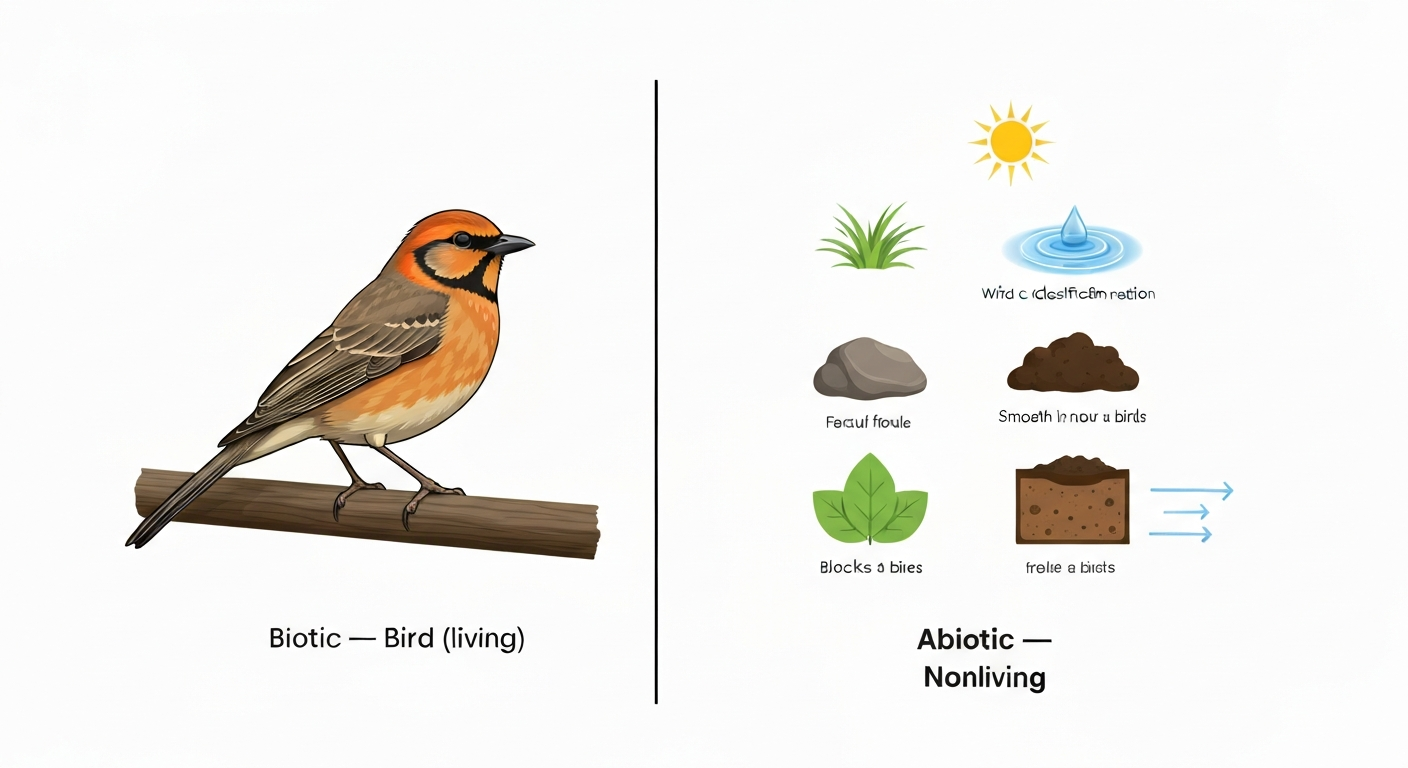
A related analogy you'll see in ecology and biology coursework is 'biotic is to bird as abiotic is to . A common classroom prompt is 'biotic is to bird as abiotic is to _', which expects a nonliving example such as temperature, water, or soil. ' This is a classification analogy of a different kind. Biotic means living or derived from living things. Birds are biotic organisms. Abiotic means non-living environmental factors: temperature, water, sunlight, soil minerals. The analogy is asking you to pair the category label with a representative example from that category, the same structural logic as 'wolf is to pack as bird is to flock,' but applied to ecological vocabulary rather than collective nouns.
Birds of a feather: the idiom and why it's phrased that way
The phrase 'birds of a feather flock together' is worth a note here because it combines two elements from this article: collective nouns (flock) and bird trait vocabulary (feather). The idiom means that people with similar characteristics, interests, or backgrounds tend to associate with each other. The 'birds of a feather' construction is a classical form using 'of a' to indicate shared type or kind, similar to 'men of a sort' or 'things of a kind.' It's not 'feathers of a bird' because the feather here is the identifying marker of similarity, not a possession. You're saying these birds share a feather (a common characteristic), not that a single bird owns feathers. The phrasing has been in documented use in English since at least the 16th century. For a concise explanation of why the idiom is phrased 'birds of a feather' rather than 'feathers of a bird,' see our short note on why 'birds of a feather' not 'feathers of a bird'.
That the phrase uses 'flock together' is fitting: flock is the natural verb and noun for bird groups, and the idiom reinforces exactly the collective behavior that makes 'flock' the right answer to the original analogy. Wolf is to pack as bird is to flock, and birds of a feather, naturally, flock together.
FAQ
What is the authoritative short answer to “wolf is to pack as bird is to”?
The standard single‑word answer is "flock." Major dictionaries and usage guides define "flock" as the general collective noun for a group of birds, and it is the default, high‑frequency term for unspecified birds.
Why is "flock" the best single‑word reply rather than a more ornate collective noun?
"Flock" is the default general term used in everyday English and in reference works; specialized or poetic terms (e.g., "murmuration," "murder," "gaggle") are species‑ or context‑specific or stylistic. For an analogy asking for a straightforward parallel to "pack," editors and lexicographers favor the common, unmarked collective noun: "flock."
Which common and notable collective nouns for birds should a publication list, and when to use each?
Concise practical list with guidance: - Flock — general, default for unspecified birds (use for most contexts) - Colony / rookery — breeding or nesting aggregations (gulls, penguins, seabirds) - Gaggle — geese on the ground (use when birds are stationary on land) - Skein — geese in flight (use for geese flying in formation) - Murmuration — large, tightly coordinated starlings in flight (behavioral and species‑specific) - Murder — crows (traditional/idiomatic; use when species is specified) - Congregation — seabirds or roosting groups (formal register) - Flight — birds in flight (general) - Brood / clutch — young or eggs (brood: young birds; clutch: eggs) Usage guidance: prefer "flock" for general audiences; use species‑specific or behavioral terms when the species, behavior, or register justifies the choice (e.g., "murmuration of starlings" for the swirling displays).
Where do many unusual collective nouns ("terms of venery") come from and are they authoritative?
Many fanciful collective nouns trace historically to medieval lists such as the Book of Saint Albans (1486). These "terms of venery" are documented primary sources and cultural curiosities, but most entries became lexical ornaments rather than common modern usage. Use them knowingly—appropriate for stylistic, historical, or playful contexts—not as default references.
What usage‑frequency evidence should editors consult to decide between "flock" and rarer terms?
Use corpora and frequency tools: Google Books Ngram for book‑language trends, the Corpus of Contemporary American English (COCA) for modern usage, and field guides or institutional publications (Audubon, Cornell Lab) for species‑specific conventions. These resources show "flock" far more frequent and broadly applicable than specialized terms like "murmuration."
How should collective nouns affect verb agreement and style in publication writing?
Follow your house style. Guidance: The Chicago Manual of Style allows singular or plural verb agreement depending on whether the group is treated as a unit or individuals (notional agreement). Many newsrooms following AP treat collective nouns as singular. For clarity and consistency, choose one approach per publication and apply it consistently.
Next Article
Biotic is to bird as abiotic is to: Answer & Explanation
Biotic:bird :: abiotic:sunlight, quick answer, clear explanation, examples, habitat effects and test tips.