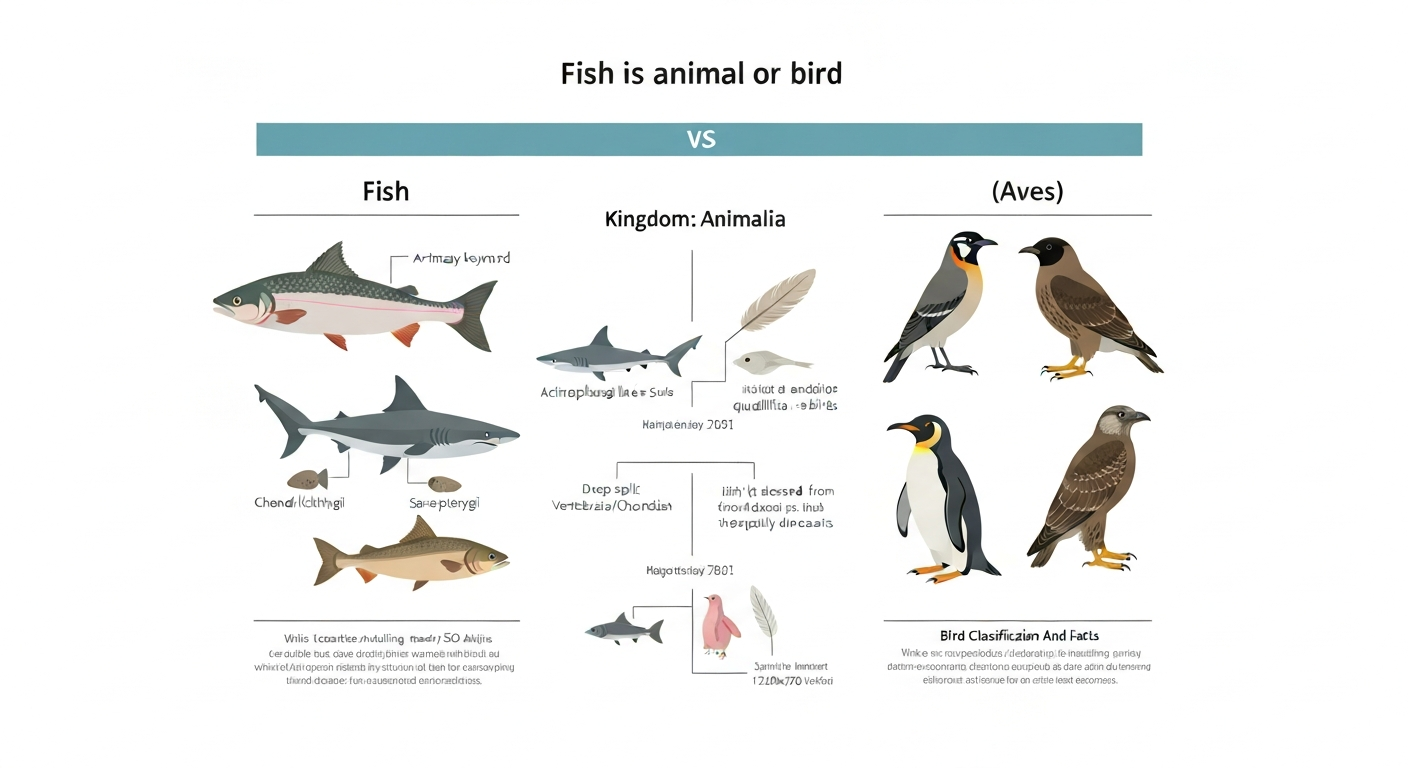
Fish are animals, not birds. Both belong to Kingdom Animalia, but they sit in completely separate branches of the vertebrate family tree. Birds are members of class Aves, defined by feathers, beaks, endothermy, and hard-shelled eggs. Fish are aquatic vertebrates spread across several distinct groups, none of which share those defining bird traits. If you've seen this question debated online or come across it in a school exercise, the answer is straightforward: a fish is an animal, full stop, and it is not a bird by any biological definition.
Fish Is Animal or Bird? Clear Science-Based Answer

Marcus Hendricks
12 Jul 2026
Why this question keeps coming up
The confusion is more understandable than it sounds. Search engines surface this query from students doing homework, people who've seen it framed as a trick question, and learners whose first language isn't English and who may be checking a fundamental classification fact. There's also a broader pattern of animal-versus-bird confusion that surfaces constantly online: penguins look odd for birds, ostriches can't fly, and some fish can glide through the air or breathe outside water. For a quick note on the wording and meaning differences, see why birds of a feather not feathers of a bird. When something aquatic seems to behave like something airborne, people genuinely want confirmation of where it fits.
Part of the problem is that everyday language doesn't map neatly onto biological taxonomy. We casually say a penguin 'swims like a fish' or call a flying fish by a name that implies it's airborne. Add in cultural examples, brand mascots, and mythological creatures that blend animal features, and it's easy to see why someone might pause and double-check. This site covers a lot of those edge cases, from aquatic birds to animals that are simply mistaken for birds, so this is exactly the kind of clarifying question worth answering properly.
What it actually means to be an animal
Kingdom Animalia is the broadest biological grouping that contains fish, birds, mammals, reptiles, insects, sponges, and every other creature most people would casually call an 'animal.' To qualify as an animal under standard taxonomy, an organism must be multicellular, eukaryotic (cells with a nucleus), and heterotrophic, meaning it gets energy by consuming other organisms rather than producing its own through photosynthesis. Animals also lack the rigid cell walls that plants and fungi have. Both fish and birds clear every one of those criteria, which is why both are unambiguously animals. The Integrated Taxonomic Information System (ITIS) and the Catalogue of Life, the two most widely used global species indexes, both place vertebrates, including fish and birds, firmly inside Kingdom Animalia. So the real question isn't whether fish are animals (they are), but whether fish are a type of bird (they are not).
What actually makes a bird a bird
Birds belong to class Aves, and the defining traits are specific enough that there's no serious debate about borderline cases. According to standard biology references including OpenStax Biology 2e, the core characteristics of birds are:
- Feathers: the single most diagnostic bird feature, found in no other living animal group
- A toothless beak or bill made of keratin
- Forelimbs modified into wings (even flightless birds like ostriches and penguins retain wing structures)
- Endothermy: birds generate and regulate their own body heat internally
- A high metabolic rate supported by a unique respiratory system using lungs plus air sacs
- Reproduction via hard-shelled, amniotic eggs
- A lightweight, partially hollow skeleton adapted for energy-efficient movement
- Four-chambered heart
Evolutionarily, birds descend from maniraptoran theropod dinosaurs. An integrative review published in Science in 2014 (Brusatte et al.) synthesized fossil, developmental, and molecular evidence confirming that many traits we consider uniquely 'bird' actually evolved stepwise across the theropod lineage long before modern birds appeared. Feathers, for instance, are documented in non-avian theropods in the fossil record. This dinosaur connection is one of the more satisfying facts in biology, and it's directly relevant here: birds' closest relatives are extinct reptiles, not fish. The relationship between birds and the features that define them, like feathers, is explored in more detail in related discussions on this site about what separates scales from feathers as integumentary structures.
Where fish actually sit in the tree of life
Fish are vertebrates, just like birds, but 'fish' is an informal umbrella term covering multiple distinct evolutionary lineages rather than a single, clean taxonomic group. Under the phylum Chordata and subphylum Vertebrata (both firmly within Kingdom Animalia), fish are split across several major clades. The Fish Tree of Life project, one of the most comprehensive phylogenetic resources for fish, provides dated phylogenies showing just how genetically and structurally diverse these groups are. The key point is that fish and birds share a common vertebrate ancestor deep in evolutionary history, but their lineages diverged hundreds of millions of years ago. Sharing an ancient ancestor doesn't make fish birds any more than it makes fish mammals.
The major groups of fish
When biologists talk about fish, they're referring to three broad groupings defined by skeletal structure and jaw morphology, as outlined in OpenStax Concepts of Biology:
- Jawless fishes (agnathans): the most ancient lineage, including lampreys and hagfish. They lack a hinged jaw and paired fins, and their skeleton is made of cartilage rather than bone.
- Cartilaginous fishes (Chondrichthyes): sharks, rays, and chimaeras. These have jaws but a skeleton made entirely of cartilage, along with paired fins and well-developed sensory systems. Sharks like the great white are classic members.
- Bony fishes (Osteichthyes): by far the largest group, split into ray-finned fishes (Actinopterygii, which includes the vast majority of familiar fish like salmon, tuna, goldfish, and cod) and lobe-finned fishes (Sarcopterygii, which includes lungfish and coelacanths — and, interestingly, the evolutionary group that gave rise to all land vertebrates including birds).
FishBase, the global online database for fish taxonomy and biology, catalogs all of these groups under Kingdom Animalia and lists tens of thousands of species across these clades. Not one of them is classified within Aves.
How fish and birds actually differ, biologically
Even a quick look at the biological basics confirms there's no overlap between fish and bird classification. Here's where the two groups genuinely diverge.
Feathers versus scales
Birds have feathers. Fish, in the overwhelming majority of cases, have scales. These are not variations of the same structure: feathers are complex, branched keratinous structures that evolved in the theropod dinosaur lineage, while fish scales are dermal plates of calcified tissue. Some fish lack scales entirely (catfish, many eels), but none have feathers. This is arguably the single clearest dividing line, and it's one that any person can verify just by looking. The relationship between feathers and fish scales is touched on in this site's related content comparing what feathers correspond to in fish anatomy. For a concise analogy, see "bird is to feather as fish is to".
Gills versus lungs
Most fish breathe through gills, extracting dissolved oxygen directly from water. Birds breathe using lungs augmented by a network of air sacs that create a continuous, highly efficient one-way airflow. It's worth noting some interesting exceptions: lungfish (genera Neoceratodus, Lepidosiren, and Protopterus) possess actual pulmonary structures and can breathe air, and mudskippers (genus Periophthalmus) spend extended time on land using enlarged gill chambers and skin-based respiration. These are fascinating evolutionary quirks, but they don't make lungfish or mudskippers birds. They're still firmly classified as fish within their respective clades in FishBase.
Ectothermy versus endothermy
Fish are generally ectothermic (cold-blooded), meaning their body temperature tracks the surrounding water temperature. Birds are fully endothermic, generating and maintaining a stable internal body temperature regardless of the environment. That said, some fish lineages have evolved regional endothermy, where specific tissues like the muscles or brain are kept warmer than ambient water using counter-current heat exchangers called retia. Grady et al. / review on enhanced thermoregulation and regional endothermy in fishes (PubMed Central) documents the independent evolution of regional endothermy in multiple fish lineages and describes counter‑current heat exchangers (retia) in tunas, lamnid sharks, and some billfishes supporting localized warming of muscles and other tissues. Tunas, lamnid sharks (including great whites), and some billfishes fall into this category. This is a genuinely cool evolutionary development, documented in peer-reviewed literature, but it's a partial, localized adaptation, not the whole-body endothermy that characterizes birds.
Skeleton, limbs, and reproduction
Birds have forelimbs modified into wings, a keeled sternum for flight muscle attachment (in most species), and a lightweight skeleton with partially hollow, air-filled bones. Fish have fins rather than limbs, no sternum in the avian sense, and many bony fish have a swim bladder, a gas-filled internal organ used for buoyancy control. Reproductively, birds lay hard-shelled amniotic eggs on land. Most fish reproduce by releasing eggs into water (external fertilization), though some sharks and fish species bear live young. None of these fish reproductive strategies involve hard-shelled, calcified eggs of the kind birds produce.
Fish vs birds: at-a-glance comparison
| Trait | Fish | Birds (Aves) |
|---|---|---|
| Kingdom | Animalia | Animalia |
| Phylum | Chordata | Chordata |
| Subphylum | Vertebrata | Vertebrata |
| Class | Multiple (e.g., Actinopterygii, Chondrichthyes) | Aves |
| Body covering | Scales (or scaleless skin) | Feathers |
| Gas exchange | Gills (most); some have lungs (lungfish) | Lungs + air sacs |
| Temperature regulation | Ectothermic (most); regional endothermy in some | Fully endothermic |
| Limbs | Fins | Wings (modified forelimbs) + legs |
| Skeleton | Bone or cartilage; often includes swim bladder | Lightweight bone, hollow in many species, keeled sternum |
| Reproduction | Eggs in water (most); some live-bearing | Hard-shelled amniotic eggs on land |
| Heart chambers | 2-chambered (most) | 4-chambered |
| Evolutionary origin | Ancient aquatic vertebrates | Maniraptoran theropod dinosaurs |
What about aquatic birds and 'flying' fish?
This is where the reasonable confusion lives. Penguins dive and swim so efficiently they've been described as 'flying through water,' and a person unfamiliar with biology might wonder whether a swimming bird and a fish are really that different. They are. Penguins still have feathers, still breathe air with lungs, still lay hard-shelled eggs on land, and are still fully endothermic. They're birds that swim, not fish that evolved feathers. Similarly, cormorants, gannets, and kingfishers all spend significant time in or near water, but their classification as birds is never in doubt.
On the other side, flying fish (family Exocoetidae) don't actually fly: they glide on enlarged pectoral fins after launching from the water surface, sometimes covering distances of over 200 meters. It's impressive, but gliding on fins is not the same as powered flight with wings and feathers. Flying fish are ray-finned fish in class Actinopterygii. The name is more poetic than taxonomic.
Spotting the difference yourself
You don't need a biology degree to tell a fish from a bird. The Cornell Lab of Ornithology's All About Birds is a great practical resource for identifying birds by their visible traits. The Cornell Lab of Ornithology, All About Birds (identification guides and resources) provides practical field identification guidance for bird species aimed at non‑specialists blank" rel="noopener noreferrer">The Cornell Lab of Ornithology — All About Birds (identification guides and resources) provides practical field identification guidance for bird species aimed at non‑specialists.. For fish, FishBase provides identification keys and species summaries accessible to non-specialists. In practice, three quick checks settle it every time: For a brief related note on collective nouns (for example, wolf is to pack as bird is to flock) see the linked discussion on collective animal nouns.
- Look for feathers. If the animal has feathers anywhere on its body, it's a bird. No fish has feathers.
- Check the breathing apparatus. If it's using gills in water, it's a fish. If it's breathing air through a beak or nostrils, it's likely a bird or other air-breathing vertebrate.
- Count the limbs and their shape. Birds have two wings and two legs. Fish have fins, not jointed limbs.
These three checks will resolve the question in virtually every real-world scenario, including the edge cases like penguins, ostriches, or mudskippers that trip people up online.
The evolutionary connection worth knowing
Here's a fact that genuinely surprises people: if you look at the fish group called lobe-finned fishes (Sarcopterygii), you'll find that lungfish are more closely related to birds than they are to ray-finned fish like salmon or trout. That's because the lobe-finned lineage gave rise to tetrapods (four-limbed vertebrates), and tetrapods eventually gave rise to reptiles, then to the maniraptoran theropod dinosaurs that became birds. So in a deep evolutionary sense, birds are modified dinosaurs that are themselves modified tetrapods that descended from ancient lobe-finned fish. That's a remarkable lineage, and it's exactly why shared ancestry doesn't automatically mean shared classification. A lungfish and a pigeon share a distant ancestor, but one is a fish and one is most definitely a bird.
Understanding where birds fit in the broader animal kingdom, and how their traits like feathers map to structures in other animals, connects naturally to questions this site covers in depth: what it means for something to be biotic in contrast to abiotic, how collective nouns like 'flock' apply to birds versus how group terms work for fish schools, and why specific bird features like feathers evolved the distinctive branched structure they have rather than simpler coverings like scales. Classification isn't just labeling: it reflects real biological history, and fish and birds tell very different chapters of that story.
FAQ
Is a fish an animal or a bird?
A fish is an animal. All fishes belong to Kingdom Animalia and are vertebrates, but they are not birds (class Aves). Fish are grouped into distinct clades such as jawless fishes, cartilaginous fishes (sharks and rays), and bony fishes (including ray‑finned and lobe‑finned fishes).
Why aren't fish considered birds?
Birds have a specific set of traits—feathers, beaks without teeth, a high metabolic rate (endothermy), wings (forelimbs modified for flight in many species), lungs with air‑sacs, and hard‑shelled eggs—that fishes do not have. Fish typically have gills, fins, scales, and a different respiratory and skeletal anatomy. These consistent anatomical and physiological differences place them in separate groups within Vertebrata.
What defines an animal versus a bird in taxonomy?
Animal (Kingdom Animalia) is a broad category that includes all multicellular animals (vertebrates and invertebrates). Bird (class Aves) is a narrower taxonomic class within vertebrates defined by characters such as feathers and other avian specializations. Thus birds are animals, but animals include many other groups like fishes, mammals, reptiles and amphibians.
How are fishes classified within the tree of life?
Living fishes are distributed among several major clades within Vertebrata: jawless fishes (Agnatha), cartilaginous fishes (Chondrichthyes: sharks, rays), and bony fishes (Osteichthyes), the latter including ray‑finned fishes (Actinopterygii) and lobe‑finned fishes (Sarcopterygii). Taxonomic databases and phylogenies place all these groups under Kingdom Animalia.
What are the key biological differences between fish and birds?
Key differences include: - Skin/covering: scales (fish) vs feathers (birds). - Respiration: gills (fish) vs lungs + air‑sacs (birds). - Thermoregulation: most fish are ectothermic; birds are endothermic. - Limbs: fins (fish) vs wings/legs (birds). - Reproduction: many fish release eggs externally; birds lay hard‑shelled eggs and have different parental care patterns. - Skeletal/air systems: fishes lack avian adaptations like pneumatic bones and a specialized avian respiratory system.
Are there any fish that breathe air or birds that dive like fish?
Yes, exceptions exist but they don't turn fishes into birds or vice versa. Lungfishes and some other fishes (e.g., mudskippers) can breathe air using lungs or modified structures. Conversely, many birds (penguins, diving ducks, gannets) are highly adapted to aquatic life and dive for food, but they retain avian traits (feathers, beaks, lungs) that make them birds, not fish.