
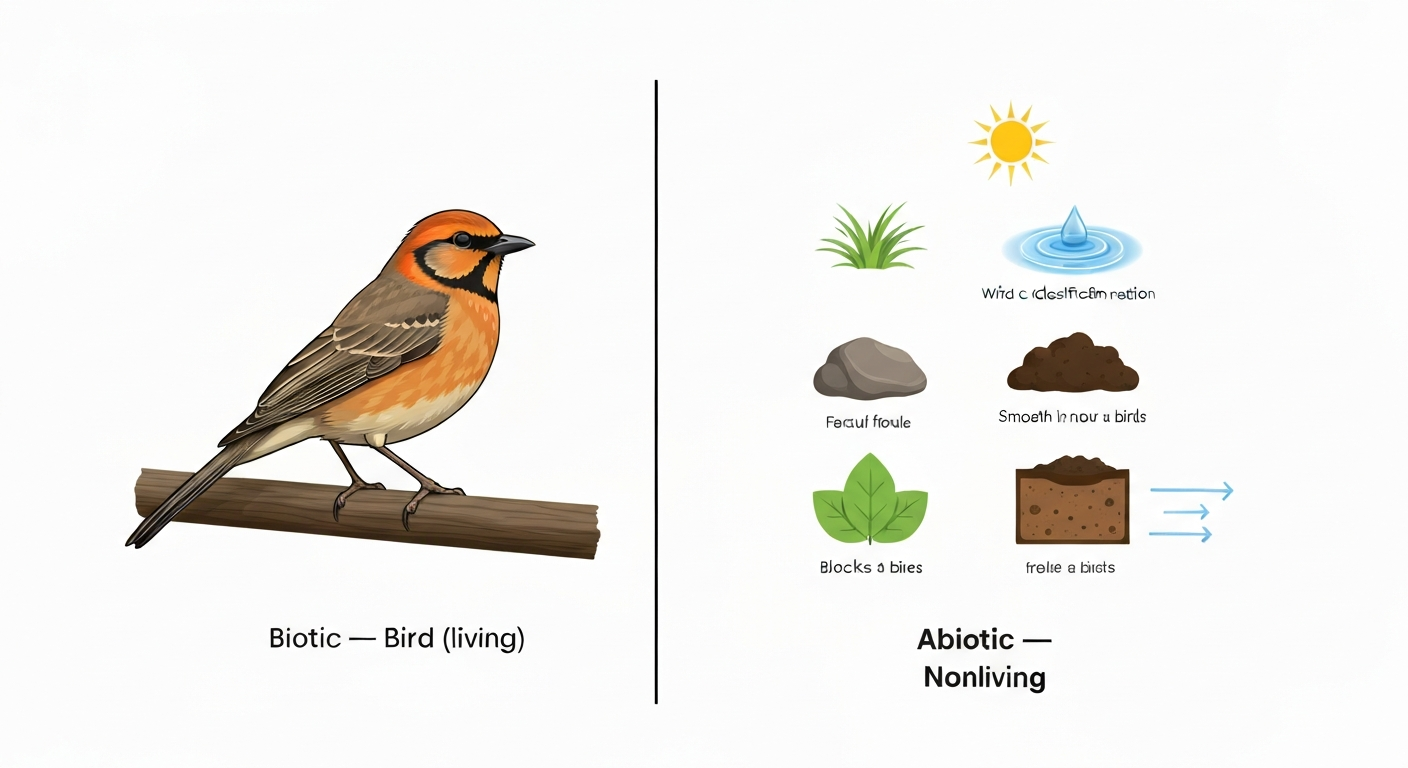
The best answer is sunlight, water, temperature, soil, rocks, or air. Any of these works because they are all abiotic (nonliving) factors, just as a bird is a biotic (living) thing. The analogy is asking you to mirror the relationship: biotic describes living organisms, and a bird is a living organism. Abiotic describes nonliving things, so you need a nonliving thing to complete the pair. Sunlight is the most commonly expected answer on biology tests because it is the clearest, most unambiguous example of a nonliving physical factor in an ecosystem.
Biotic is to bird as abiotic is to: Answer & Explanation

Marcus Hendricks
16 Jul 2026
The full answer and why it works
The analogy follows a simple category-to-example structure: biotic (the category) is to bird (an example of that category) as abiotic (the second category) is to _ (an example of that second category). You are not looking for a definition of abiotic. You are looking for a real-world thing that belongs to the abiotic category the same way a bird belongs to the biotic category. Sunlight, water, temperature, rocks, soil, and air all qualify. On a standardized test, sunlight or water are the safest picks because they are the most commonly cited abiotic examples in introductory ecology, and neither one has any biological component that could cause confusion.
Biotic vs abiotic: clear definitions you can actually use
Biotic means relating to or resulting from living organisms. Merriam-Webster is blunt about it: biotic = of life. If something is alive, was once alive, or was made by something alive, it falls under the biotic umbrella. A bird, a feather, a nest built from plant material, bacteria in a pond, a dead leaf decomposing on the ground: all biotic, because life is involved.
Abiotic means nonliving, not produced by living organisms. Authoritative ecology education resources list common abiotic factors as sunlight (day length/photoperiod), water, temperature, soil, air, and rocks, the nonliving physical and chemical components that shape ecosystems (Abiotic Factors, National Geographic Education) Abiotic Factors — National Geographic Education. Merriam-Webster again: abiotic covers the physical and chemical parts of an ecosystem that have no biological origin. A rock was never alive. Sunlight is a stream of photons from a nuclear reaction 93 million miles away. The wind does not breathe. These are abiotic. The distinction matters because ecology is fundamentally about how living things interact with both the other living things (biotic factors) and the physical world (abiotic factors) around them.
| Term | Meaning | Example relevant to birds |
|---|---|---|
| Biotic | Living or produced by living organisms | Bird, tree, insect prey, nest-building material |
| Abiotic | Nonliving, physical or chemical | Sunlight, water, temperature, rock, soil, air |
Six abiotic examples that complete the analogy
Each of the following is a legitimate, textbook-recognized abiotic factor. Any one of them is a correct answer to the analogy. Here is why each one qualifies.
Sunlight
Sunlight is a stream of radiant energy from the sun. It is not alive, it was never alive, and no organism made it. In ecology it is the foundational energy source for most food webs, and for birds specifically it is the primary abiotic cue that controls breeding, molt, and migration. Peer-reviewed avian physiology research (Dawson et al.) identifies photoperiod, the length of the day as driven by sunlight, as the principal signal birds use to time their entire annual cycle. Sunlight is the cleanest, most unambiguous answer on any test.
Water
Water is a chemical compound (H2O), not a living thing. It is absolutely central to bird ecology: wetland water levels are a primary abiotic control on the distribution and abundance of shorebirds and waterbirds worldwide. Wetlands International and Ramsar research show that inundation patterns directly determine where waterbirds nest, forage, and stop over during migration. The American Avocet, for example, forages in water typically no deeper than about 8 inches, a precise abiotic constraint on its behavior.
Temperature
Temperature is a measure of thermal energy. No organism creates temperature in any meaningful ecological sense; it is set by climate, season, and geography. IPCC climate research documents that changes in temperature drive range shifts and phenological changes in birds at a global scale. It is also a modulator of the breeding cycle: even when photoperiod is the trigger, temperature fine-tunes the exact timing of nesting and egg-laying in many species.
Soil
Soil is mostly abiotic, composed of minerals, water, and air, but it does contain a living fraction of microbes, fungi, and invertebrates. This makes it a slightly ambiguous choice compared to sunlight or rocks. That said, soil composition and substrate type are well-established abiotic factors in ecology. Research on ground-nesting shorebirds like the Kentish plover shows that soil and sand particle size directly influence nest-site selection and nest success. For test purposes, soil is acceptable, but if you have a cleaner option like sunlight or rocks on the answer list, use that instead.
Rocks
Rocks are purely nonliving mineral structures. They are also a strikingly direct abiotic factor for many bird species: gyrfalcons, peregrines, murres, cormorants, and dozens of seabird species depend on rocky cliffs, ledges, and outcrops as nesting substrate. The Audubon Field Guide notes Red‑faced Cormorant nests on rocky ledges and cliffs The Audubon Field Guide: Red‑faced Cormorant — Audubon Field Guide (nesting on ledges/cliffs). Without the right geology, these birds simply cannot breed. Rock is one of the most concrete, visually obvious abiotic examples you can give.
Air
Air is a mixture of gases: nitrogen, oxygen, carbon dioxide, and others. None of those gases are alive. For birds, air is not just the medium they breathe; aerodynamic research published in PNAS shows that wind and thermal air currents (abiotic atmospheric forces) directly affect flight mode, energy expenditure, and migratory route choice. Soaring birds like albatrosses and condors exploit these abiotic forces to cover thousands of miles at minimal metabolic cost.
How to read and solve biological analogies step by step
Analogy questions look intimidating but they follow a fixed logic. Once you see the pattern, you can solve them in seconds. Here is the process.
- Read the first pair and identify the relationship. In 'biotic is to bird,' the relationship is: biotic is the category, and bird is a specific example of that category. Category → Example.
- State the relationship in a plain sentence: 'A bird is a living (biotic) organism.' Now your template is: 'A _ is a nonliving (abiotic) thing.'
- Look at the second term in the second pair. You are given 'abiotic' and need to find its example, just as 'bird' was the example for 'biotic.'
- Fill in any nonliving physical thing: sunlight, water, temperature, a rock, air. Each one satisfies the pattern.
- Check your answer by swapping it back into the original sentence structure: 'Abiotic is to sunlight as biotic is to bird.' Does that hold? Yes, because sunlight is a nonliving factor and a bird is a living organism. The parallel holds.
Test-taking tips for analogy questions
Analogy questions are one of those question types where knowing the trap is half the battle. Here are the strategies I find most useful.
- Always identify the relationship first, before looking at answer choices. If you jump to the answers immediately, distractors will pull you toward wrong answers that sound vaguely related.
- Watch for category confusion. The most common trap in 'biotic is to bird' is choosing another biotic thing (like 'fish' or 'tree') instead of an abiotic thing. The analogy is asking you to cross the biotic/abiotic boundary, not stay inside it.
- Prefer the clearest, least ambiguous option. Sunlight and rocks are purer abiotic examples than soil, which has a living component. If multiple abiotic answers are offered, pick the one that is most unambiguously nonliving.
- Beware of 'sounds related' answers. Air and birds are related in everyday thought (birds fly through air), but that surface connection is not what the analogy is testing. The test is purely about category membership: living vs. nonliving.
- Rephrase the analogy as a sentence to verify. 'A bird is an example of something biotic; a _ is an example of something abiotic.' If your answer fits that sentence cleanly, it is correct.
- On multiple-choice tests, eliminate answers that are living organisms first. Any answer that is alive (bacteria, grass, insects) is wrong because it belongs to the biotic side.
How abiotic factors shape where birds actually live
It is one thing to define abiotic factors in the abstract; it is more useful to see how they physically constrain and direct bird life across real habitats. Here are five habitat types where the abiotic connections are obvious.
Wetlands
Water depth and seasonal flooding patterns (both abiotic) determine which waterbirds can use a wetland and when. Ramsar-designated wetlands along flyways like the East Asian-Australasian Flyway function as critical stopover sites for millions of shorebirds precisely because their water levels create the right mudflat exposure at the right time of year. Change the abiotic hydrology and the birds disappear. This is why wetland conservation is fundamentally about managing abiotic conditions.
Deserts
Temperature and water scarcity are the dominant abiotic forces in desert ecosystems. Desert birds like the Cactus Wren and Roadrunner have behavioral and physiological adaptations that allow them to cope with extreme heat and minimal liquid water. The abiotic temperature ceiling effectively filters which species can persist, and the timing of rare rainfall events triggers breeding in many desert species far more than photoperiod does.
Forests
In forest habitats, light penetration (an abiotic factor set by canopy structure) shapes which birds can forage where. Understory species like the Ovenbird are adapted to low-light conditions, while canopy species like warblers exploit the sunlit upper layers. Soil composition also matters: it determines what plant community grows, which in turn sets the structural habitat, but the underlying abiotic driver is the mineral content of the substrate.
Coasts and cliffs
Rocky coastal geology is among the most direct abiotic controls on bird distribution. Seabird colonies of murres, puffins, kittiwakes, and cormorants are tied to specific cliff faces and rocky ledges that provide safe nesting sites above tide level. Remove the rock and you remove the colony. Wind patterns along coastlines (another abiotic factor) also influence where seabirds forage, with many species using predictable onshore and offshore wind systems to reduce flight costs.
Alpine and high-latitude zones
At high elevations and high latitudes, temperature and photoperiod interact as the two dominant abiotic drivers. Species like the White-tailed Ptarmigan live year-round at elevations where temperature alone would eliminate most birds. Their entire annual cycle, from breeding to molting to winter camouflage coloration, is timed by the interplay of changing day length (photoperiod, an abiotic light cue) and temperature. Climate research shows that warming temperatures are already pushing alpine bird ranges upslope, a direct abiotic effect on avian geography.
Related bird analogies that follow the same pattern
Once you understand how the biotic/abiotic analogy works, you can apply the same reasoning to other bird-centered analogies that show up frequently on biology and general knowledge tests. They all follow the same category-to-example or whole-to-part logic.
| Analogy | Relationship type | How to read it |
|---|---|---|
| Bird : feather :: fish : scale | Whole to defining external feature | A feather is the characteristic external structure of a bird; a scale is the characteristic external structure of a fish. Both pairs follow: animal → its defining surface covering. |
| Wolf : pack :: bird : flock | Individual to group name | A group of wolves is a pack; a group of birds is a flock. The analogy is simply individual animal → correct collective noun for that species. |
| Biotic : bird :: abiotic : sunlight | Category to example | Bird is an instance of the biotic category; sunlight is an instance of the abiotic category. The analogy tests whether you can supply the correct example from the correct category. |
| Bird : feathers :: fish : gills | Animal to its defining characteristic feature | Feathers define birds as a class; gills define fish. Useful for understanding what makes a bird a bird, not just what it looks like. |
The bird-to-feather analogy is especially worth knowing because feathers are the single most reliable defining feature of birds, the one characteristic that separates birds from every other living class of animal. Similarly, the wolf-to-pack pattern tests collective nouns, a completely different relationship type from the biotic/abiotic category question, even though both use birds as reference points. Recognizing which type of relationship is being tested is the first step to solving any analogy correctly.
Why birds make such good examples in ecology analogies
Birds are almost universally recognizable as living things, which is exactly what makes them useful anchors in biology analogies. Nobody is going to second-guess whether a bird is biotic. That clarity is pedagogically useful: it lets the question focus attention on the abiotic side, where the conceptual work actually happens. The fact that birds interact with virtually every major abiotic factor, sunlight for migration timing, water for habitat, temperature for range limits, rocks for nesting, air for flight, makes them an unusually rich case study for illustrating how living organisms depend on and respond to their nonliving environment. See the article 'why birds of a feather not feathers of a bird' for further discussion of using birds in ecology analogies. That is not a coincidence; ecology textbooks use birds constantly as examples precisely because the connections are so visible and concrete.
It is also worth noting that questions about what counts as biotic versus abiotic sit alongside other bird classification questions that come up frequently in science education, including whether fish and birds belong to different animal classes and what the defining biological features of birds actually are. If you need a quick clarification on whether a fish is an animal or a bird, see whether a fish is an animal or a bird. Understanding the biotic/abiotic distinction is a gateway concept: once you see that a bird is biotic and a rock is abiotic, you are already thinking in the ecosystem framework that connects all of avian ecology.
FAQ
What single word best completes the analogy “biotic is to bird as abiotic is to ___” for test‑takers and quick searchers?
rock (acceptable single‑word alternatives include sunlight, water, temperature, air). Rock is a clear, unambiguously nonliving example that parallels 'bird' as a clear living example of 'biotic'.
Why is “rock” the recommended short answer?
Analogy logic: 'biotic' means related to living things; 'bird' is a specific example of something biotic. To mirror that structure you want a concrete, unambiguously nonliving example of 'abiotic'. 'Rock' fits because it is a simple, single‑word, nonliving object commonly used in tests and textbooks to illustrate abiotic components of ecosystems.
Are other one‑word answers correct (like sunlight or water)?
Yes. Sunlight, water, temperature, and air are all legitimate abiotic examples. Many teachers/test writers accept any unambiguously nonliving example. If a single best pick is required for standardized test style questions, choose a concrete noun (rock, water, or sunlight) rather than an abstract phrase.
Short definitions: what do 'biotic' and 'abiotic' mean?
'Biotic' = relating to or produced by living organisms (of life). 'Abiotic' = nonliving physical and chemical parts of an environment (not produced by living organisms). These are standard definitions in ecology and dictionaries.
Step‑by‑step reasoning to solve this type of biological analogy
1) Identify relationship type: here 'biotic' describes a class (living) and 'bird' is an example. 2) Keep the same pattern: find the class ('abiotic') and supply a specific example of that class. 3) Choose a clear, single‑word, unambiguously nonliving object (rock, water, sunlight). 4) Answer with that example and confirm it preserves the parallel (biotic:bird :: abiotic:rock).
Why might a test prefer 'sunlight' over 'soil' or vice versa?
Tests prefer items that are unambiguous. 'Sunlight' is purely abiotic. 'Soil' can contain living components (roots, microbes, invertebrates), so it can be ambiguous if the test expects a strictly nonliving example. 'Rock' and 'sunlight' avoid that ambiguity.
Next Articles
Fish Is Animal or Bird? Clear Science-Based Answer
Clear, science-backed answer: fish are animals, not birds, why, key differences, ID tips & FAQ.
Bird Is to Feather as Fish Is to: Scales Explained
Solve the analogy by learning why birds have feathers and fish have scales as defining group traits.
Is a Dragonfly a Bird? How to Tell the Difference
Dragonflies are insects, not birds. Learn key bird traits vs dragonfly anatomy to tell them apart fast.