Yes, a loon is absolutely a bird. It has feathers, lays hard-shelled eggs, is warm-blooded, and is classified under class Aves, the scientific grouping that contains every bird on Earth. More specifically, loons belong to the order Gaviiformes and the family Gaviidae, with all five living species placed in the genus Gavia. So if you were wondering whether a loon might be a fish, a mammal, or something in between, you can put that question to rest.
Is a Loon a Bird? How Loons Differ From Ducks

Marcus Hendricks
15 May 2026
Loon vs. duck: they're not even close relatives
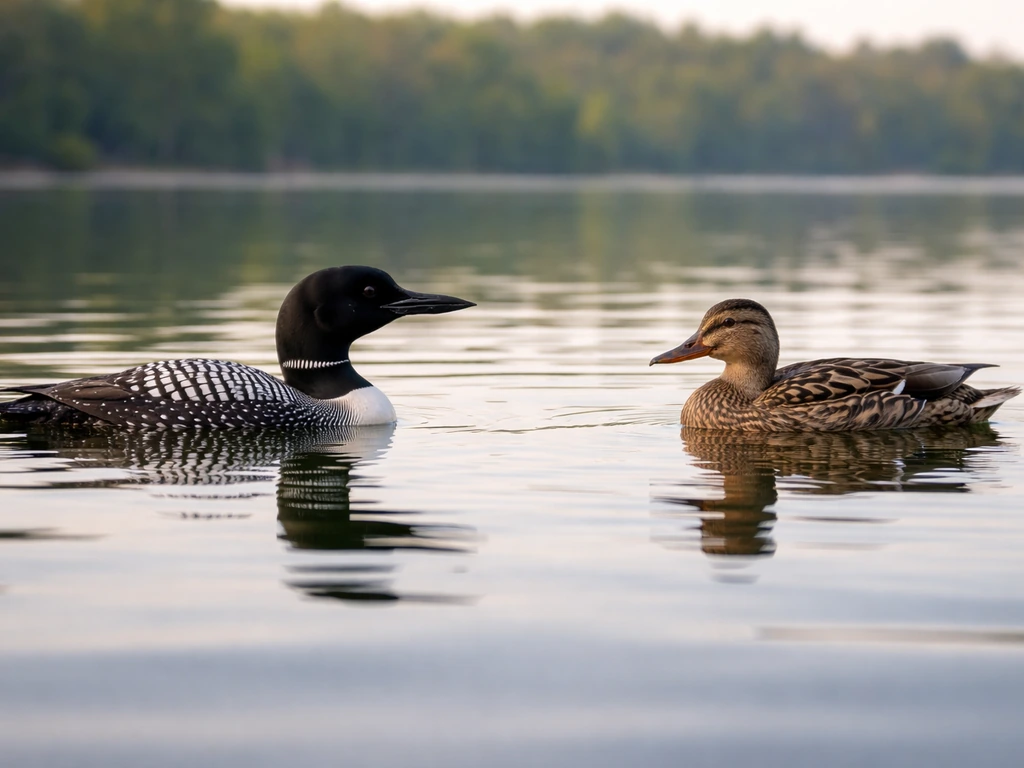
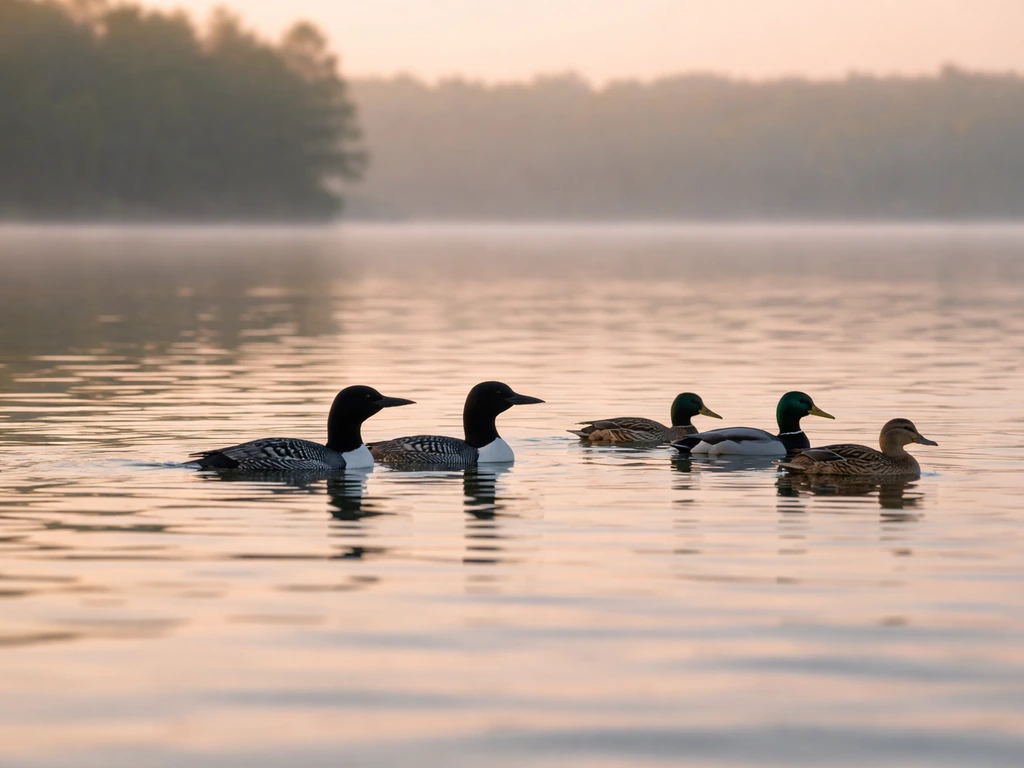
Loons are not ducks. I know they both swim, but taxonomically they are about as related as a hawk and a pigeon. Ducks belong to the order Anseriformes and the family Anatidae, which also includes geese and swans. Loons sit in their own entirely separate order, Gaviiformes. The two groups diverge at the order level, which is a pretty high branch on the bird family tree. Calling a loon a duck because both birds float on water is like calling a bat a bird because both fly.
There are also clear physical differences once you know what to look for. Loons are large, long-bodied birds that ride low in the water, almost like a submarine sitting just at the surface. They have a sharp, dagger-like bill built for spearing fish. Ducks, by contrast, tend to have flat, broad bills suited for filtering water and feeding near the surface. Loons also have their legs placed far back on their body, which makes them excellent underwater swimmers but genuinely awkward on land. Ducks have more centrally placed legs and can walk around comfortably.
| Feature | Loon | Duck |
|---|---|---|
| Order | Gaviiformes | Anseriformes |
| Family | Gaviidae | Anatidae |
| Bill shape | Dagger-like, pointed | Flat, broad |
| Leg position | Far back on body | More centrally placed |
| Feeding method | Deep diving (up to 60 m / 200 ft) | Surface feeding or shallow diving |
| Walking ability | Awkward on land | Walks normally |
| Body profile in water | Long, rides low | Rounder, sits higher |
What actually makes a bird a bird
If you want a reliable checklist for deciding whether any animal is a bird, the core traits are surprisingly consistent. Every bird, including loons, checks all of these boxes.
- Feathers: the single most defining feature of birds, shared by no other living animal group
- Hard-shelled eggs: birds reproduce by laying eggs with a hard, calcified shell
- Warm-blooded: birds regulate their own body temperature internally
- Beaked jaws: no teeth, just a beak or bill made of keratin
- Vertebrate skeleton: birds have a backbone, with bones often hollow for weight savings
- Unique respiratory system: birds have air sacs connected to the lungs that create one-way airflow, making their breathing unusually efficient
Loons demonstrate all of these traits in ways that are actually fascinating. That one-way respiratory system matters a lot when you are a loon, because loons can compress air from their lungs, feathers, and internal air sacs when diving to reduce buoyancy and sink faster. Birds have a unique respiratory system in which air sacs connect to the lungs and create unidirectional airflow through the lungs one-way respiratory system. They can reach depths of up to 60 meters (about 200 feet) when hunting fish. That is a bird doing something that looks more like a submarine maneuver, which is part of why people find them so confusing.
Loon taxonomy in plain English
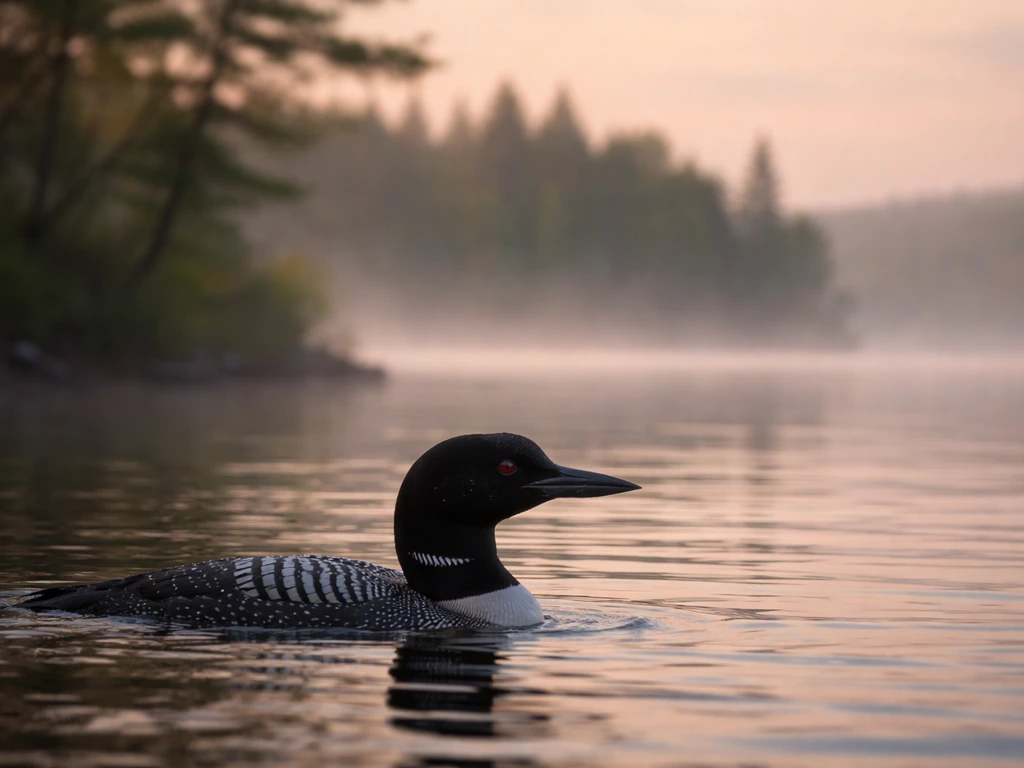
Taxonomy sounds intimidating, but think of it as a nesting set of categories going from broad to specific. Here is where loons sit, from the widest category down to the individual species level.
- Class: Aves (all birds — this is where loons officially become birds)
- Order: Gaviiformes (loons only — this is their own exclusive order)
- Family: Gaviidae (the loon family, containing all five living species)
- Genus: Gavia (all loons share this genus)
- Species: five total, including the Common Loon (Gavia immer), which is the most familiar species in North America
Cornell Lab of Ornithology's All About Birds and the U.S. Fish and Wildlife Service both list loons under Gaviiformes and Gaviidae. Audubon has a dedicated loon family page. Britannica confirms five living species. Every major bird reference agrees. There is no real debate here in the ornithology world.
Why people keep mixing loons up with ducks
The confusion is understandable. Both loons and ducks are waterbirds. You see them in the same lakes and ponds. They both swim, both have webbed feet, and at a glance, anything floating on a lake might just get called a duck by someone who is not a birder. That is a perfectly human response to an unfamiliar animal.
The confusion gets worse in winter. Loons in their non-breeding plumage lose the dramatic black-and-white checkerboard pattern that makes them iconic in summer. In winter, loons look much plainer and darker, and immature birds can look very similar to winter-plumaged adults. Even experienced birders find winter loon identification tricky. So if you spotted a grayish waterbird on a cold-weather lake and wondered if it was a duck or something else, you were actually asking a question that stumps experts too.
The most reliable field tells to separate loons from ducks are body shape and behavior. Loons sit very low and flat in the water, they have that long, stretched-out silhouette, and that pointed spear of a bill. In flight, they look stretched out with a long neck and bill extended, which is different from the more compact profile of most ducks. And if you see a waterbird diving and staying under for a genuinely long time, hunting fish at depth, that is a strong sign you are looking at a loon, not a duck.
How to verify whether anything else is a bird
The same process that confirms loons are birds works for any 'is X a bird?' question. Here is a practical toolkit.
- Check for the core bird traits first: feathers, beak, hard-shelled eggs, warm-blooded. If all four are present, you almost certainly have a bird.
- Look up the animal's scientific order and family on Cornell Lab's All About Birds, which lets you browse by family (like Gaviidae for loons or Anatidae for ducks). If the family is under class Aves, it is a bird.
- Use eBird's taxonomy tools. eBird maintains a standardized taxonomy updated annually. Searching a species on eBird and confirming its placement under Aves settles the question quickly.
- Check ITIS (the Integrated Taxonomic Information System), a standardized U.S. government database that provides a consistent scientific hierarchy for any species. It is free and authoritative.
- Use a field guide. Cornell Lab notes that field guides are organized by taxonomy, so related species appear together. If your mystery animal appears in the bird field guide under a recognized family, it is a bird.
This site covers a lot of these classification questions because the internet genuinely debates them. Similar confusion comes up around other birds with unusual names or habits. Larks, skylarks, and moonlarks have all generated real 'is it actually a bird? A moonlark is also a real bird, and the best way to confirm it is to use a taxonomy-based checklist like the one above. 'Is a lark a bird?' is another of those name-based questions, and the same taxonomy-first checklist will give you a clear answer. A lark definition not bird can help you see why name-based confusion happens and how to verify what you are looking at Larks, skylarks, and moonlarks. ' searches, and the same taxonomy-first approach solves those questions just as cleanly as it does for loons.
The bottom line: loons are birds. They are not ducks, not divers in some informal non-bird category, not aquatic mammals with a feather problem. They are fully certified members of class Aves with their own dedicated order and family, recognized by every major ornithological authority on the planet. If you hear that haunting wail echo across a lake, you are listening to a bird.
FAQ
If I see a loon underwater for a long time, does that automatically mean it is a loon and not another bird?
Not automatically. Long dives also happen with some other diving birds, like grebes. Use the full set of cues together, especially the low, flat sitting posture, the spear-like bill, and the stretched flight profile with a long neck.
Why do winter-plumaged loons look so different from summer loons?
They molt into non-breeding plumage that is more muted and can blur the classic high-contrast checkerboard pattern. Immature birds can be especially confusing because their markings and contrast are not as crisp until later in the season.
Can ducks hunt fish underwater the way loons do?
Some ducks dive, but their underwater style is usually different. Ducks are more often surface feeders or dabblers, and when they dive they typically do not match the loon’s extreme depth and long, deep hunting behavior combined with the loon’s body shape and bill.
How can I tell the difference in flight when I only get a quick glimpse?
Watch the overall silhouette. Loons tend to look long and stretched out, with the neck and bill extended, while many ducks appear more compact. If you see a bird repeatedly diving and reappearing very low on the water, that also supports loon over duck.
Are loons “related” to ducks in any way even if they are not the same order?
They are both birds, so they share ancient common ancestry at a very high level, but they are not closely related in the way that would show up at the order level. Their main practical takeaway is that similarity in swimming habits comes from adaptation to water, not from a close taxonomic relationship.
What is the fastest way to verify a claim like “is a loon a bird” without getting stuck on look-alikes?
Use a taxonomy-first approach and then confirm with one or two field traits. The first step is deciding whether it belongs to class Aves, and for field confirmation, match body shape plus behavior (low in water, spear-like bill, prolonged deep dives).
Do loons always “sound like” loons, and can that be used as proof?
Their vocalizations are distinctive, but sound alone is not reliable because other waterbirds can call in ways that resemble each other at a distance. Treat calls as a helpful clue, then confirm visually with posture, bill shape, and diving behavior.
Next Articles
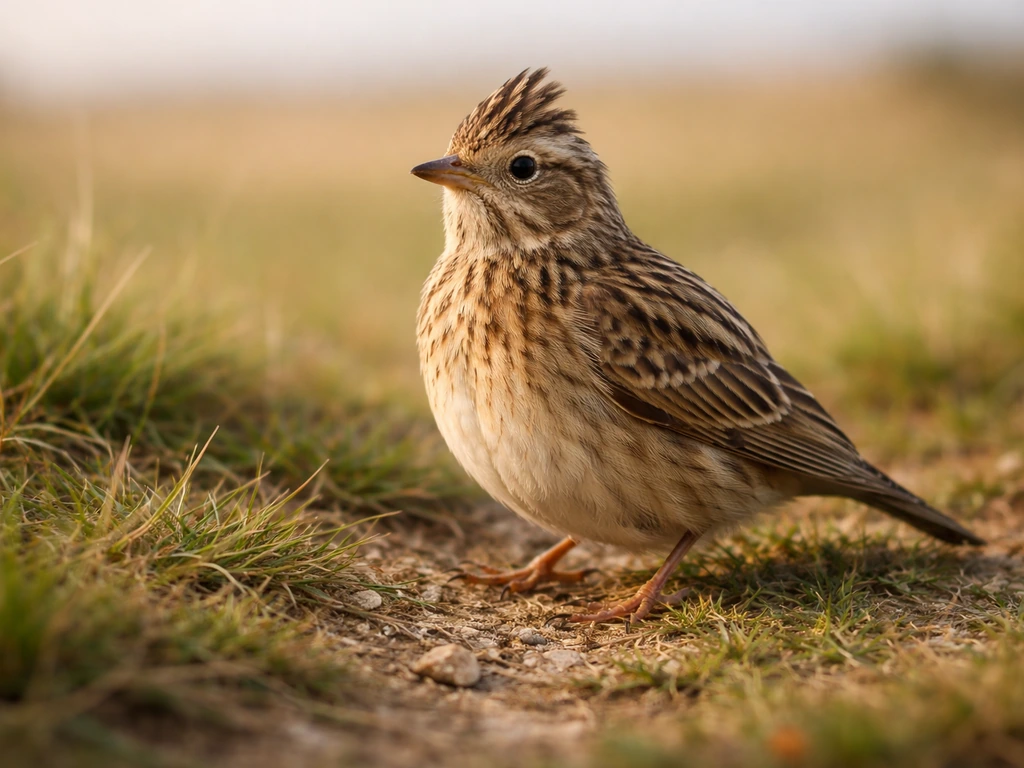
Is a Lark a Bird? What Larks Are and How to Tell
Yes, larks are birds in Aves, including the Alaudidae family, with key traits that confirm true bird status.
Lark Definition Not Bird: Meaning, Bird Type, Check
Clear meanings of lark in English and as a small songbird Alaudidae, plus a quick bird-checklist.
Is a Dragonfly a Bird? How to Tell the Difference
Dragonflies are insects, not birds. Learn key bird traits vs dragonfly anatomy to tell them apart fast.