A raptor is a bird that hunts and kills prey using its feet. That one detail does more to define the group than anything else. blank" rel="noopener noreferrer">Raptors have strongly hooked beaks, sharp curved talons, powerful feet, and exceptionally sharp vision. If a bird catches and kills animals using its talons rather than its beak, it almost certainly qualifies. The formal grouping covers birds in the orders Accipitriformes (hawks, eagles, harriers, ospreys), Falconiformes (falcons and caracaras), Strigiformes (owls), and sometimes Cathartiformes (New World vultures), depending on which definition you follow.
What Makes a Bird a Raptor: Traits and ID Checklist

Marcus Hendricks
5 May 2026
What 'Raptor' Actually Means (and Why It Gets Confusing)
The word 'raptor' comes from the Latin rapere, meaning to seize or carry off, which tells you a lot right away. In everyday use, people throw the word around loosely: hawks, eagles, owls, and falcons all get called raptors, and that usage is basically correct. Merriam-Webster defines a raptor as a carnivorous medium-to-large bird characterized by a hooked beak and large sharp talons, listing hawks, eagles, owls, and vultures as examples. Britannica is equally broad, defining the term as any bird of prey.
The scientific usage is a bit more precise, and that is where the confusion starts. Historically, 'raptor' was sometimes restricted to just the order Falconiformes (hawks, eagles, and falcons). Modern taxonomy now tends to split the diurnal birds of prey into separate orders: Accipitriformes for hawks, eagles, kites, harriers, and ospreys; Falconiformes for falcons and caracaras; and Cathartiformes for New World vultures like condors and turkey vultures. Owls sit in their own order, Strigiformes. Most ornithologists today include all four groups under the 'raptor' umbrella, but you will occasionally see sources that leave out owls or vultures depending on how strictly they are defining the term.
It is also worth addressing the dinosaur angle. When people hear 'raptor' in a movie context, they picture Velociraptor or similar theropod dinosaurs. Those animals are not raptors in the bird-of-prey sense, even though modern birds are technically descended from theropod dinosaurs. The word just got borrowed for two different purposes.
The Core Traits That Make a Raptor a Raptor
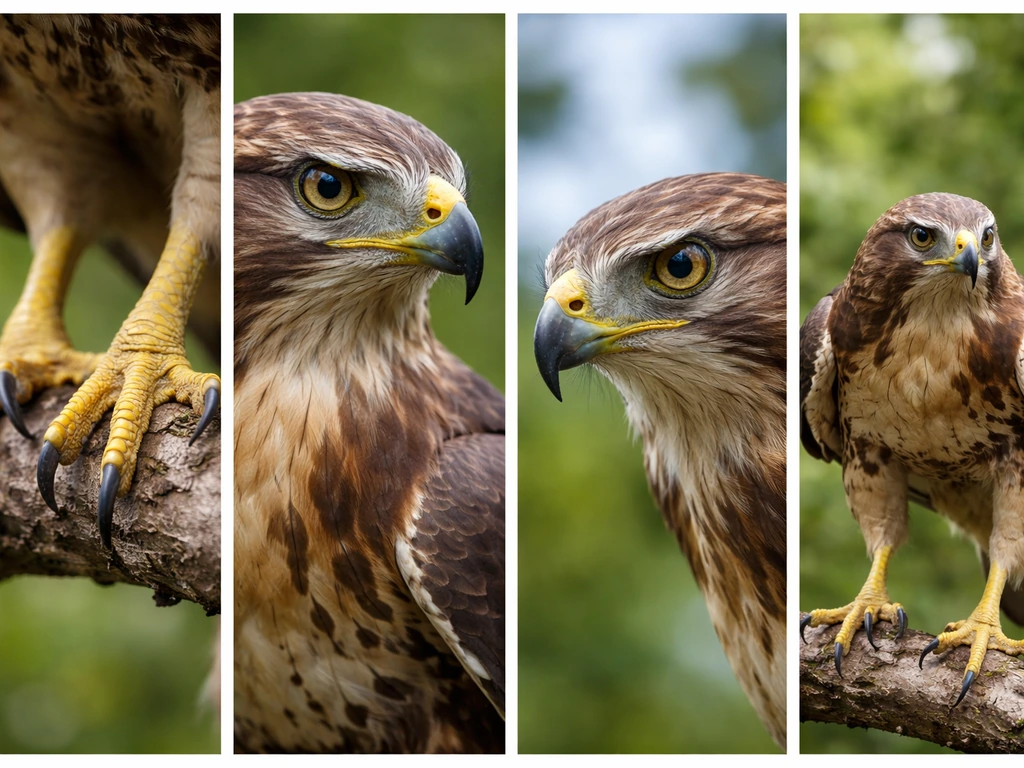
Four physical and behavioral traits appear consistently across every definition of 'raptor,' and every genuine raptor will show all four of them to some degree. Learn these and you can make a confident field call on most birds.
Talons Built for Killing
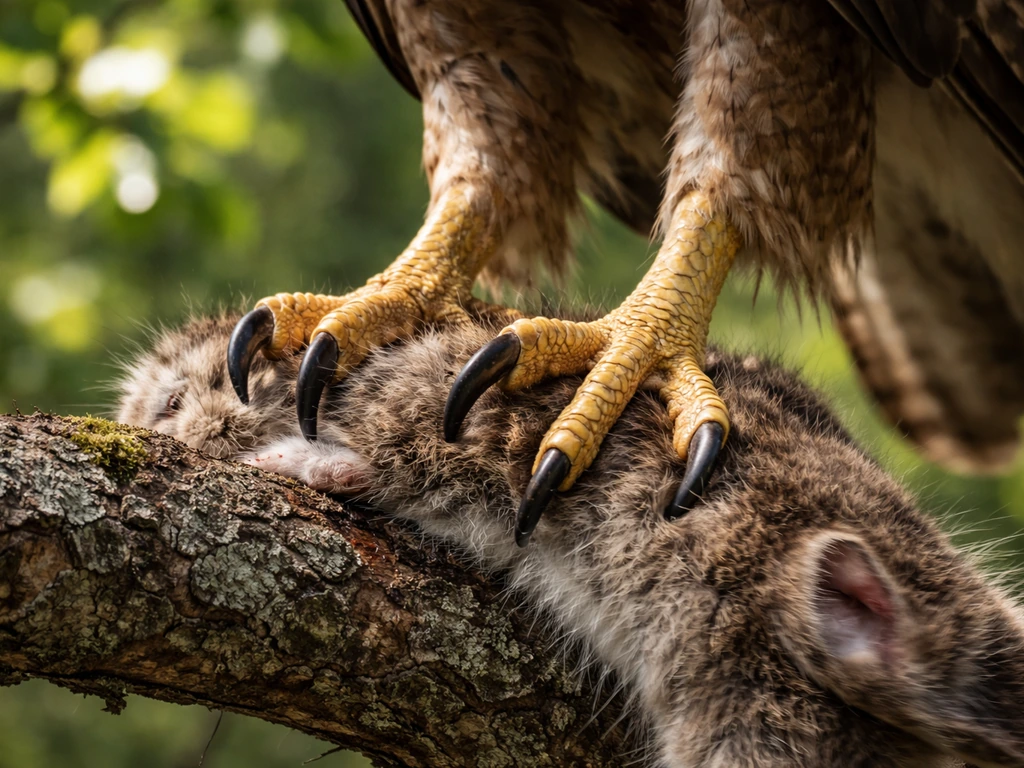
This is the defining feature. Raptors have large, curved, sharp talons that they use to seize, grip, and kill prey. This is different from other birds that might eat meat occasionally (like crows or gulls) but use their beaks to do the killing. An osprey hits a fish at full dive and grips it with feet designed to hold slippery prey. A red-tailed hawk pins a mouse to the ground using foot pressure alone. The talons are the weapon. The beak is mostly for tearing and eating after the fact.
A Strongly Hooked Beak
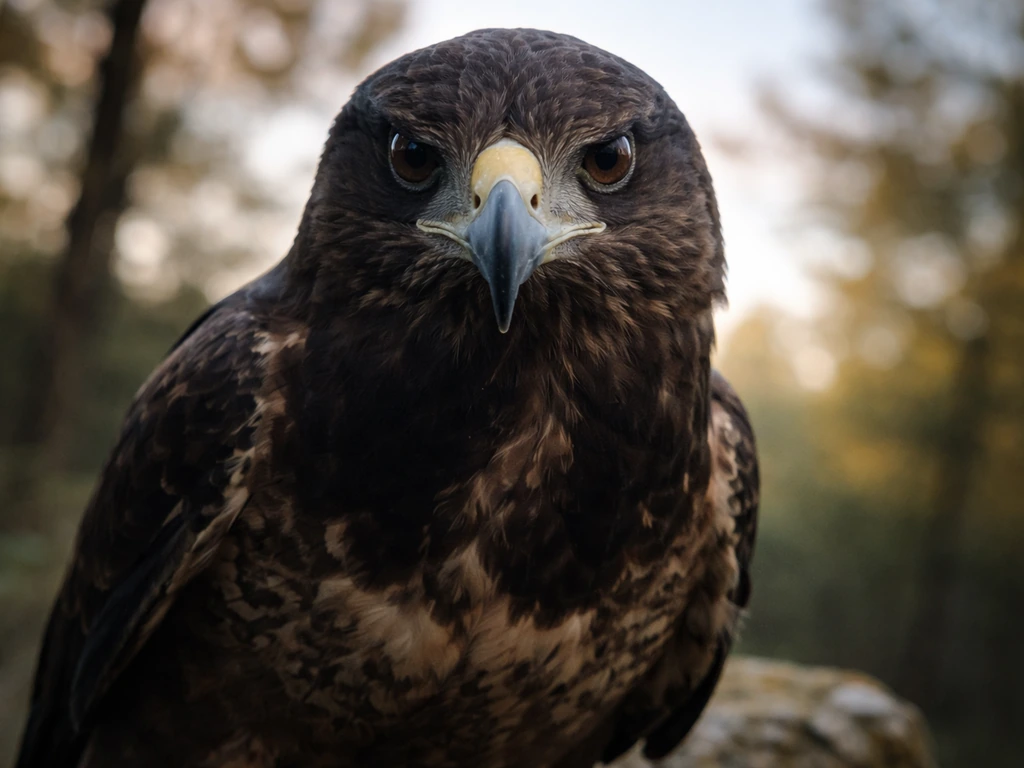
Raptors have a sharply hooked upper beak designed to tear flesh. The hook is more dramatic than what you see on a crow or a shorebird. The beak's main job is processing food that the talons have already secured, which is why it is built for ripping rather than catching. Falcons take this a step further: they have a notch (called a tomial tooth) on their beak's cutting edge that they use to sever the spinal cord of prey.
Exceptional Vision
Raptors have among the sharpest eyesight of any animals on earth. A red-tailed hawk can spot a mouse from 100 feet in the air. Their eyes are large relative to their skull, forward-facing enough to give them depth perception for targeting prey, and packed with photoreceptors. Owls add a twist: their eyes are tubular and fixed in their skulls, which is why they rotate their heads so dramatically. All raptors share this emphasis on high-acuity vision because finding prey from distance is central to how they hunt.
A Carnivorous Lifestyle
Raptors are obligate meat eaters. They eat vertebrates, insects, or carrion depending on the species, but they are not seed or fruit eaters. This diet requirement connects directly to the rest of their morphology: the talons, beak, and vision are all adaptations for finding and processing animal prey. Even vultures, which only eat carrion, fit this category because they are still meat eaters with the same hooked beak and strong feet, just without the active hunting component.
Quick Checklist: Is It a Raptor or Not?

Run through these in order when you spot an unfamiliar bird and want to know if it qualifies. You do not need all five boxes checked for absolute certainty, but true raptors will hit most of them.
- Does it have large, curved, sharp talons? Not just claws, but serious grip-and-kill tools.
- Is the beak strongly hooked at the tip, designed for tearing flesh rather than cracking seeds or probing mud?
- Is it eating or hunting vertebrates, large insects, or carrion? Not seeds, fruit, or filter-feeding.
- Are the eyes large, forward-angled, and clearly adapted for high-acuity vision?
- Does it fly in patterns consistent with hunting: soaring to scan, stooping on prey, or perching in open spots to watch for movement?
If the bird checks boxes one, two, and three, you almost certainly have a raptor. Box four is usually obvious. Box five is behavioral and helps eliminate confusion with look-alikes.
The Main Raptor Groups and How They Differ
Once you have confirmed you are looking at a raptor, the next step is figuring out which kind. The major groups are genuinely distinct in behavior and appearance, which makes identification more manageable once you know what to look for.
| Group | Order | Key Traits | Examples |
|---|---|---|---|
| Hawks and Eagles | Accipitriformes | Broad wings, soaring flight, highly variable size, diverse prey | Red-tailed hawk, bald eagle, Cooper's hawk, harrier |
| Falcons | Falconiformes | Pointed wings, fast direct flight, tomial tooth on beak, often take prey in the air | Peregrine falcon, American kestrel, merlin, caracara |
| Owls | Strigiformes | Nocturnal (mostly), facial disk to funnel sound, fixed tubular eyes, silent flight | Great horned owl, barn owl, snowy owl, screech owl |
| New World Vultures | Cathartiformes | Bald head, soaring on thermals, eats only carrion, keen sense of smell | Turkey vulture, black vulture, California condor |
| Osprey | Accipitriformes | Reversible outer toe, dives feet-first into water, specialized for fish | Osprey (only species in its family) |
| Secretary Bird | Accipitriformes | Long legs, walks to hunt on ground, stomps prey, highly unusual body plan | Secretary bird |
The secretary bird is a genuinely odd case worth highlighting: it looks almost nothing like a typical raptor because it hunts on foot across African grasslands, stomping snakes and rodents to death. It is also an example of why the question “is a secretary bird a raptor” can come down to definitions, not just appearance. But it clears every checklist item above, which is exactly why it still qualifies. The question of whether the secretary bird counts as a raptor comes up often enough that it is worth keeping the core definition in mind: hunting lifestyle, talons, beak, diet.
Common Look-Alikes and Internet Myths
A few birds and animals get mistakenly called raptors on a regular basis, and a few real birds get excluded when they should not be.
Corvids (Crows, Ravens, Jays)
Crows and ravens are smart, aggressive, and will absolutely eat small animals and even raid other birds' nests. But they are not raptors. Their feet lack killing talons, their beaks are not designed for tearing flesh, and their primary diet is omnivorous. They are corvids, a completely different lineage.
Herons and Storks
Great blue herons stab fish with a spear-like beak and swallow them whole. They are carnivores, they are large, and they can look intimidating. But they have no hooked beak, no killing talons, and they belong to an entirely different order. The same goes for storks. Diet alone does not make a raptor.
Shrikes
Shrikes are small songbirds with a hooked beak that impale their prey on thorns or barbed wire. They look and act surprisingly raptor-like, but they are passerines (perching birds) and their feet lack true raptor talons. They are a fascinating convergent evolution example, not actual raptors.
Dinosaurs and Fictional Creatures
Velociraptors, despite the name, are not birds of prey. Microraptor follows the same rule: despite its name, it is a small extinct dromaeosaur, not a bird Velociraptors. A common misconception is that a velociraptor is a bird, but it was actually an extinct theropod dinosaur. They are extinct theropod dinosaurs, and while birds are technically living dinosaurs, the overlap in terminology is a pop-culture collision, not a taxonomic one. Similarly, no fictional bird (the Mockingjay, for instance) qualifies as a real raptor no matter how predatory it sounds. These are fun questions for a trivia night but not serious classification debates.
Vultures: In or Out?
New World vultures (turkey vultures, condors) are sometimes left out of casual raptor lists because they do not hunt live prey. Old World vultures (found in Africa, Europe, and Asia) sit firmly in Accipitriformes alongside hawks and eagles. Both groups have the hooked beak and carnivorous diet, and most modern definitions include them. If a source excludes New World vultures, it is usually because of the separate Cathartiformes classification, not because they lack raptor characteristics.
How to Confirm an Unknown Bird Right Now
If you have spotted a bird and want a confident answer on whether it is a raptor, here is a practical workflow you can run today.
- Note the location, size, shape, and any field marks (wing pattern, tail color, facial features). A photo or video is worth a thousand words.
- Open Merlin Bird ID (Cornell Lab of Ornithology's free app) and use the photo ID or step-by-step filter. It covers raptors with strong accuracy and will tell you the species name immediately.
- Cross-check the species on AllAboutBirds.org (also Cornell Lab) or eBird. These give you confirmed range maps so you can verify whether that species is expected in your location at this time of year.
- Look up the species' taxonomic order in the species account. If it falls under Accipitriformes, Falconiformes, Strigiformes, or Cathartiformes, it is a raptor by any working definition.
- If you are still unsure, post the photo to a regional birding group on iNaturalist or Facebook. Birders are fast and enthusiastic about identifications.
Range matters more than people realize. A large bird of prey soaring over a coastal marsh in the eastern US in October is far more likely to be an osprey or a northern harrier than a golden eagle. Behavior helps too: if the bird is hovering in place over a field, it is almost certainly an American kestrel or a rough-legged hawk. If it is diving nearly vertically at 200 mph into a pigeon flock, it is a peregrine falcon. Context narrows the list fast.
For deeper identification, The Raptor Center at the University of Minnesota and the Hawk Mountain Sanctuary both publish accessible identification resources built specifically for raptors. Regional field guides (Sibley, Peterson, National Geographic) all have dedicated raptor sections with comparison plates showing the birds in flight, which is often the most realistic viewing angle you will get.
The bottom line: if the bird hunts with its feet, has serious talons, sports a hooked beak, eats meat, and has eyes built for precision targeting, it is a raptor. Everything else is a detail about which kind.
FAQ
Can a bird be a raptor if it only kills sometimes, like when it opportunistically catches prey?
Yes. Raptors are defined by their overall hunting and killing tool set, not by how often they hunt. If the bird has killing talons and a hooked tearing beak, it can still qualify even if it scavenges, steals, or hunts infrequently. The key check is whether the feet are built for gripping and dispatching prey, not just holding food.
What’s the difference between a raptor’s talons and “claws” on other meat-eating birds?
Raptor talons are strongly curved and shaped to seize and immobilize prey during active attacks. Many non-raptors have sharp feet, but their toe structure and shape usually do not support the same high-force grip and killing use. If you can see the bird striking or pinning prey with foot pressure, that’s a strong sign you are looking at raptor-style weaponry.
Does a bird still count as a raptor if it uses its beak to kill, then uses talons mainly for holding?
Usually no. The defining pattern is that the feet are the primary killing tool and the beak is mainly for tearing and processing afterward. There are exceptions in the sense that exact behavior can vary by species and prey, but if the beak is clearly doing the dispatching and the feet are not used as the killing instrument, it often points away from true raptors.
Are vultures considered raptors in the same way as hawks and falcons?
They can be, depending on the definition used. Many modern references include vultures because they share the hooked beak and strong grasping feet and are obligate meat eaters. The difference is behavioral, New World vultures may be excluded in stricter definitions because of their separate evolutionary order, even though they still show raptor-like morphology.
Why do some sources include owls as raptors and others don’t?
It comes down to whether the term is applied broadly (all birds of prey) or narrowly (typically diurnal hunting groups). Owls share the hooked beak, predatory diet, and talon-based capture and killing, but some authors restrict “raptor” to certain orders or lifestyles. If you’re doing field ID using traits, owls still fit the checklist logic.
How can I tell a raptor from a heron or stork when they both eat fish and look predatory?
Look at the “weapon role” in the capture. Herons and storks typically spear or stab with the beak and swallow prey largely intact, their feet are not built to immobilize prey with killing talons. Raptors may also eat fish, but the hallmark is seizing and holding with talons, then tearing with the hooked beak.
I saw a bird impale prey on thorns, does that make it a raptor?
Not usually. Shrikes are a common trap because they have a hooked beak and a “predator” posture. If the bird is a passerine and it impales prey but lacks true raptor killing talons, it’s a convergent look-alike rather than a raptor.
Can a bird be a raptor if it mainly hunts by scavenging rather than active hunting?
Yes, scavenging does not automatically remove it from raptor status. What matters is whether it has the raptor suite: hooked tearing beak, functional killing/gripping feet, meat-based diet, and predatory vision. Vultures are the classic example where the hunting style changes but the anatomy and diet still match the raptor pattern.
How reliable is “eyeshine” or eye size in identifying a raptor at a distance?
Useful but not definitive. Raptor vision adaptations help them target prey precisely, but from far away you often cannot confirm eye structure well. Treat vision as a supporting clue, and lean more on talon visibility, beak shape, and hunting behavior when possible.
What’s a quick checklist I can use if I only get a few seconds to look?
Use a “talons first” triage. Ask whether the feet are clearly built for gripping or killing (strong curvature, grasping during attacks). Then check beak shape (noticeable hook for tearing) and diet context (meat-focused behavior, not just opportunistic scavenging). If you can’t see feet, watch how it hunts (pins and grips prey versus spearing or swallowing intact).
Are birds-of-prey in flight always easy to spot by shape?
Not always. Some raptors can look sleek and “ordinary” from below or at high altitude, and some look-alikes mimic the silhouette. When the silhouette is unclear, rely on behavior cues like hovering, stooping, or vertical dives, plus any momentary view of the head shape and feet position during attacks.
Does the term “raptor” apply to extinct animals like Velociraptor?
In casual language it can, because people connect “raptor” to predation, but taxonomically it does not match the bird-of-prey meaning. Velociraptor and similar animals are non-bird theropod dinosaurs, so they are not raptors in the same way as hawks, falcons, owls, and vultures.
Next Articles
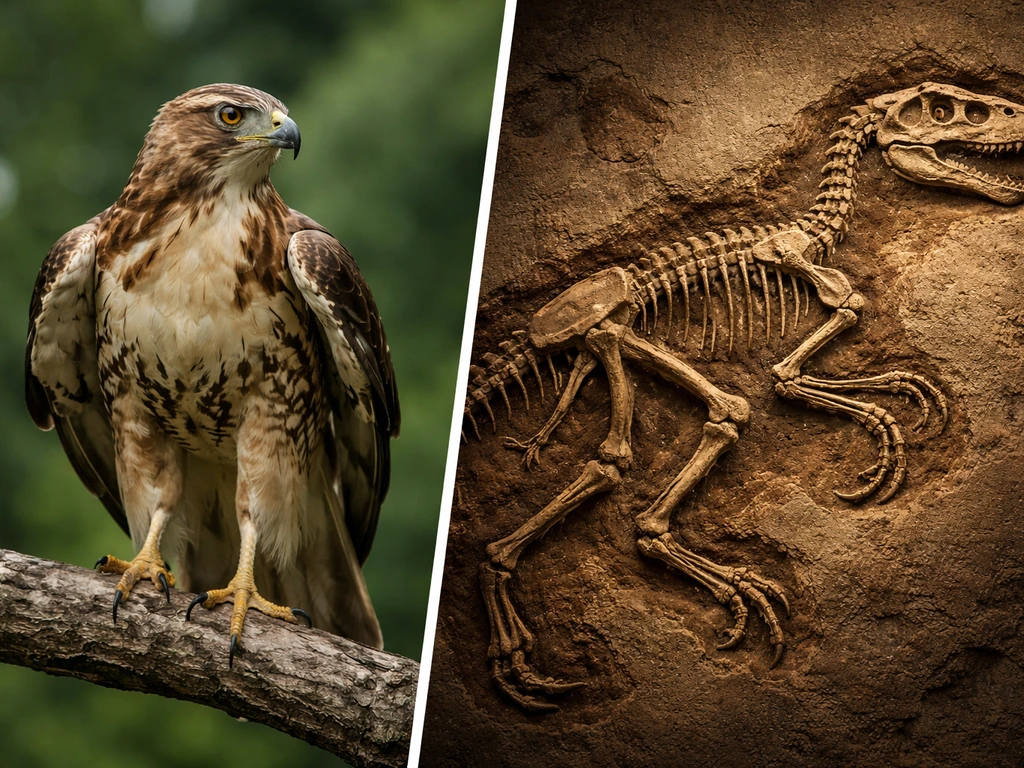
Is a Raptor a Bird? Birds of Prey vs Dinosaur Raptors
Clear verdict: raptors are birds of prey, not dinosaur names, and how real dinosaur raptor lineage connects to birds.
Is a Dragonfly a Bird? How to Tell the Difference
Dragonflies are insects, not birds. Learn key bird traits vs dragonfly anatomy to tell them apart fast.
Is a Flyer a Bird? How to Tell Flyers From Real Birds
No. Flyers aren’t automatically birds; true birds have feathers, beaks, bird anatomy, and breeding traits, not just flig