Yes, an osprey is absolutely a bird of prey. It sits in the order Accipitriformes, family Pandionidae, genus and species Pandion haliaetus, right alongside hawks and eagles. It hunts live animals using powerful talons, hovers and dives feet-first to snatch fish from the water, and carries every physical trait that defines a raptor: a strongly hooked beak, sharp curved talons, and exceptional eyesight. There is no ambiguity here from a taxonomy or biology standpoint.
Is an Osprey a Bird of Prey? Facts and Identification Tips

Marcus Hendricks
22 May 2026
What 'bird of prey' actually means
The phrase 'bird of prey' is used pretty interchangeably with 'raptor' in everyday birding language, and for most practical purposes they mean the same thing: a bird that actively hunts other animals, typically using strong feet and talons to seize prey. Hawks, eagles, kites, harriers, falcons, and vultures are the classic examples. Owls get included too, even though they mostly hunt at night.
It is worth knowing, though, that there is no single airtight scientific definition that everyone agrees on. The Journal of Raptor Research has noted that 'raptor' and 'bird of prey' lack one universal standard definition, and usage does vary across sources. In practice, the working definition used by ornithologists and serious birders focuses on a set of physical traits: a hooked beak for tearing flesh, strong feet with curved talons for gripping prey, and sharp vision for spotting targets from altitude. An osprey checks every single one of those boxes.
Where the osprey fits in the family tree
The osprey's full scientific placement is order Accipitriformes, family Pandionidae, genus Pandion, species Pandion haliaetus. Pandionidae is a small family with just one living species: the osprey. It used to be folded into the broader hawk-and-eagle family Accipitridae in older classifications, but modern taxonomy gives it its own family, recognizing how distinct it is. That said, it still belongs to the same order as hawks, kites, harriers, and eagles, which tells you everything about where it sits in the raptor world.
It is also sometimes called the 'fish hawk,' and that nickname reflects its specialization without changing its raptor credentials one bit. Being a specialist does not disqualify a bird from being a raptor, any more than a fishing eagle being specialized makes it less of an eagle.
Osprey raptor traits and how it hunts
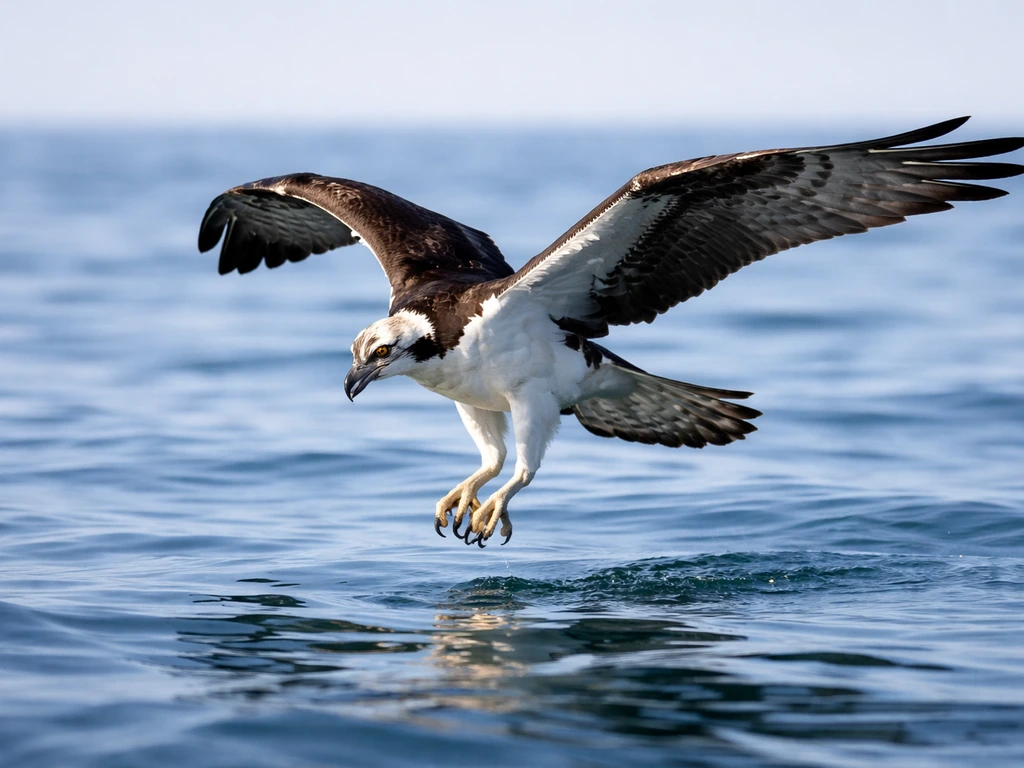
Everything about an osprey's body is built around catching fish. It hovers above the water surface, sometimes for several seconds, then folds and dives feet-first, plunging into the water to seize a fish with its talons. Ospreys are fish-eaters that hover above water and then plunge feet-first to seize fish using their talons hovers and then folds and dives feet-first, plunging into the water to seize a fish with its talons. This is not a passive feeding strategy like a heron standing in the shallows. This is active, high-speed predation.
The feet are especially impressive. Ospreys have a reversible fourth toe (they can rotate it forward or backward) and sharp spiny structures called spicules on the undersides of their toes. Both features exist for one reason: gripping slippery, struggling fish. Add in the strongly hooked, dark beak for tearing flesh and the large, forward-facing eyes for depth perception, and you have a textbook raptor adapted for a very specific niche. Cornell Lab’s All About Birds notes diagnostic identification traits such as the hooked, strongly dark beak and the head pattern with a broad dark eye line or mask plus a pale head.
- Strongly hooked, dark beak for tearing prey
- Large curved talons for seizing and holding live fish
- Reversible outer toe for gripping from multiple angles
- Spiny spicules on the toe pads for anti-slip grip on wet, slippery prey
- Exceptional binocular vision for spotting fish from height
- Active daytime hunting using hovering and feet-first diving
How to identify an osprey in the field
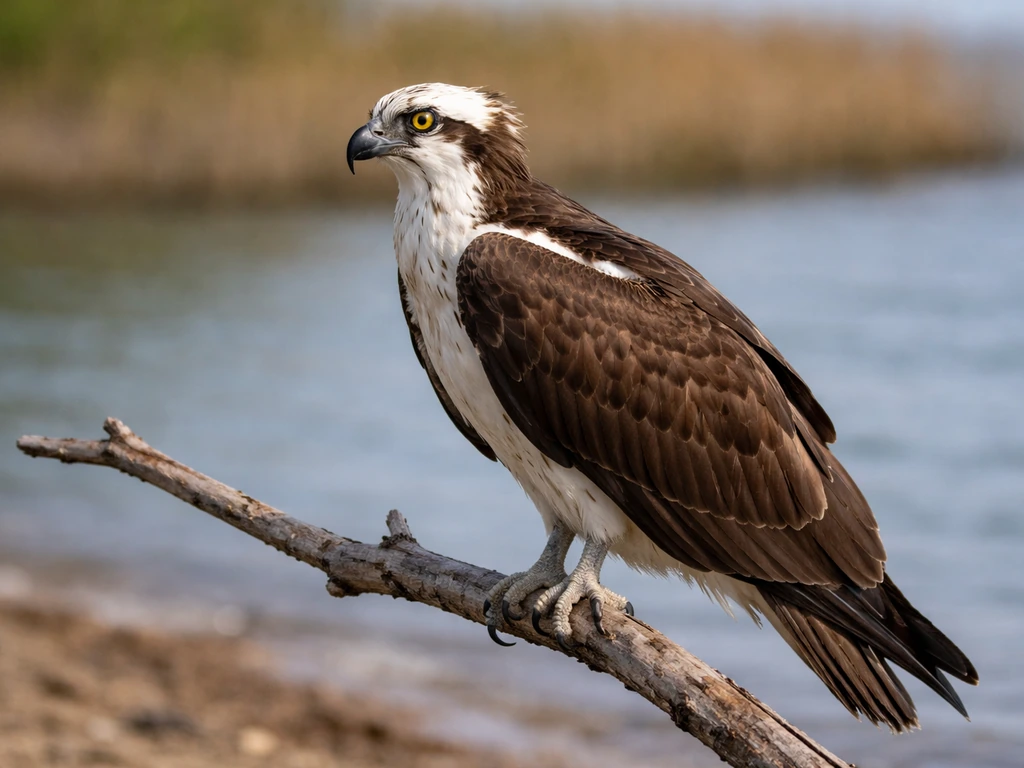
Once you know what to look for, ospreys are actually one of the easier large raptors to identify with confidence. There are a handful of field marks that are distinctive and consistent.
What to look for when perched
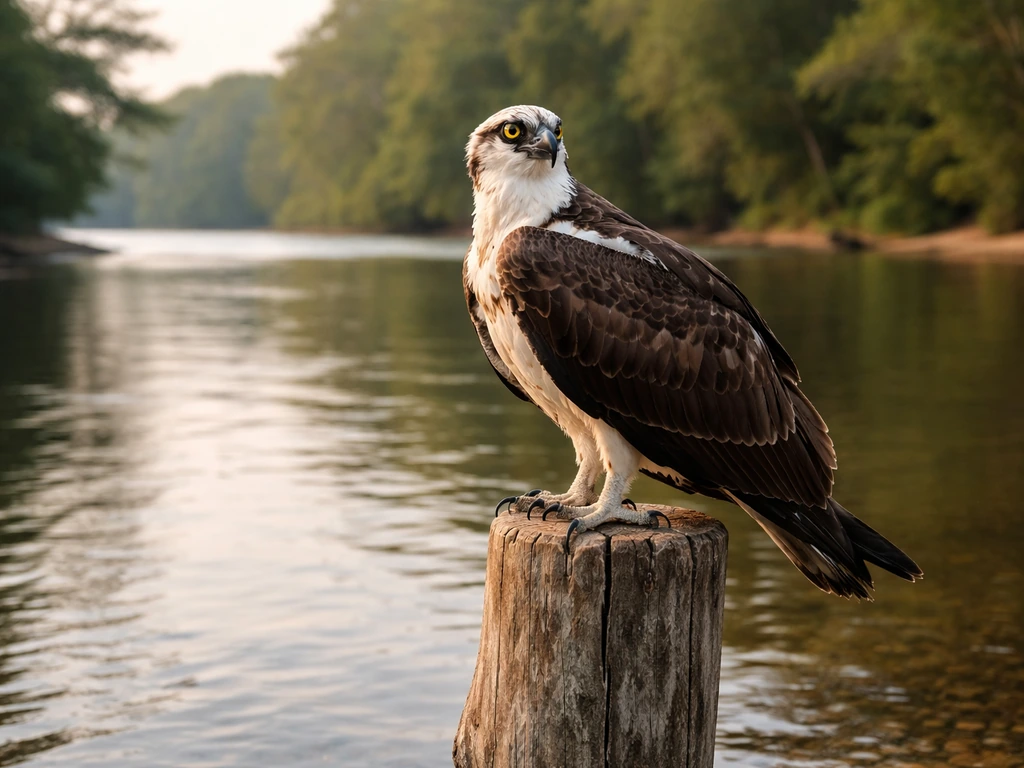
- White or pale head with a bold, broad dark stripe running through the eye (often called a 'mask' or 'eye stripe')
- Strongly hooked, dark beak
- White or pale underparts, often with a streaky brown 'breast band' across the chest
- Brown upperparts (back, wings)
What to look for in flight
The most useful in-flight cue is the wing shape. When an osprey glides or soars overhead, its long wings are slightly bowed or kinked at the wrist, creating a distinctive 'M' shape when seen from below. Almost no other large raptor you are likely to encounter in North America shows that same silhouette. Bald eagles, for comparison, hold their wings flat and straight. The M-shape alone, combined with the white underparts, is usually enough to confirm an osprey at distance.
Osprey vs. common look-alikes
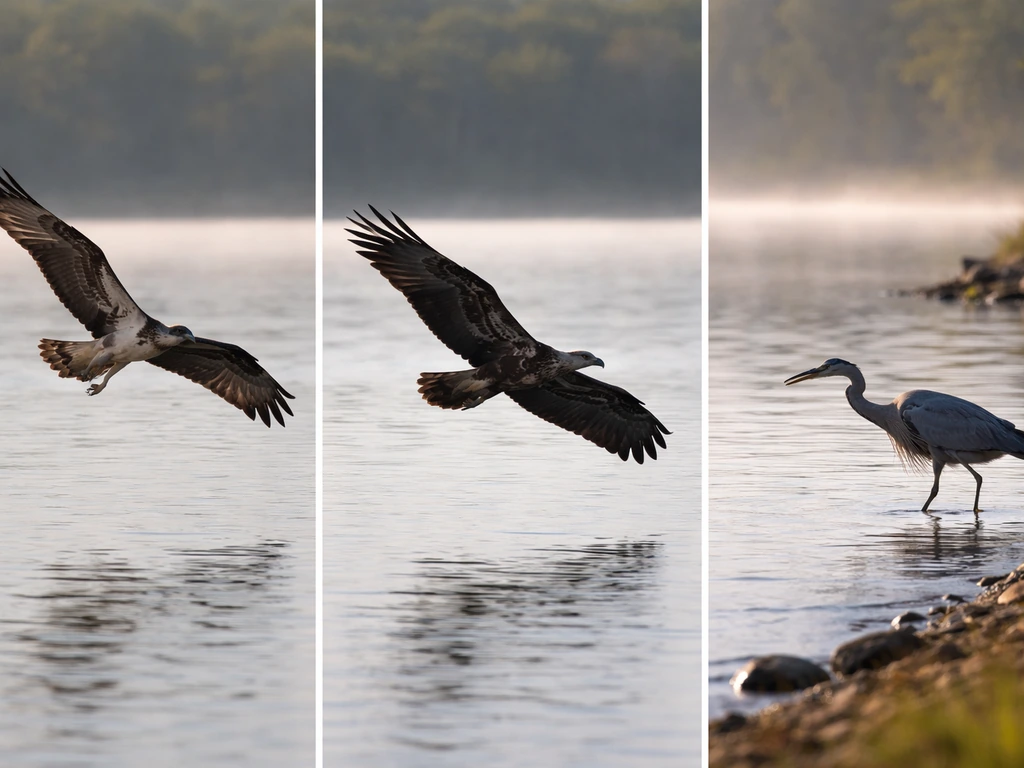
| Feature | Osprey | Bald Eagle (juvenile) | Great Blue Heron |
|---|---|---|---|
| Wing shape in flight | Kinked, forming an 'M' from below | Flat, plank-like | Folded neck, trailing legs |
| Head pattern | White with bold dark eye stripe | Mottled brown (no clear stripe) | Gray with dark plumes |
| Hunting method | Hovers, then dives feet-first into water | Snatches fish from surface or carrion | Stands still, stabs with beak |
| Beak | Strongly hooked, dark | Strongly hooked, yellow (adults) | Long, straight, dagger-like |
| Raptor classification | Yes | Yes | No |
The heron comparison is worth dwelling on. Herons are often seen near water hunting fish, so people occasionally lump them in with raptors mentally. But a heron is not a bird of prey. It stands in shallow water and strikes downward with a straight beak. It lacks talons, a hooked beak, and every other defining raptor trait. This is the same kind of confusion that comes up around birds like the great blue heron vs. the osprey, or around whether fishing-focused birds automatically earn raptor status. They do not. Behavior alone does not make a bird of prey. Taxonomy and physical traits do.
Common misconceptions about 'bird of prey' classification
The biggest misconception is that any bird eating fish or small animals qualifies as a bird of prey. That is not how it works. Kingfishers eat fish. Herons eat fish. Penguins eat fish. None of them are raptors. The 'bird of prey' label comes from a combination of physical equipment (hooked beak, talons, strong grip, acute vision) and evolutionary lineage, not just diet.
A related confusion is whether 'bird of prey' and 'raptor' are exact synonyms. Technically they are not always treated as identical, especially when you get into formal taxonomy debates about where owls fit, or whether New World vultures belong with raptors or not. But for the osprey, none of that ambiguity applies. It is squarely in the diurnal birds of prey group, placed in Accipitriformes by every major authority, and nobody seriously argues otherwise.
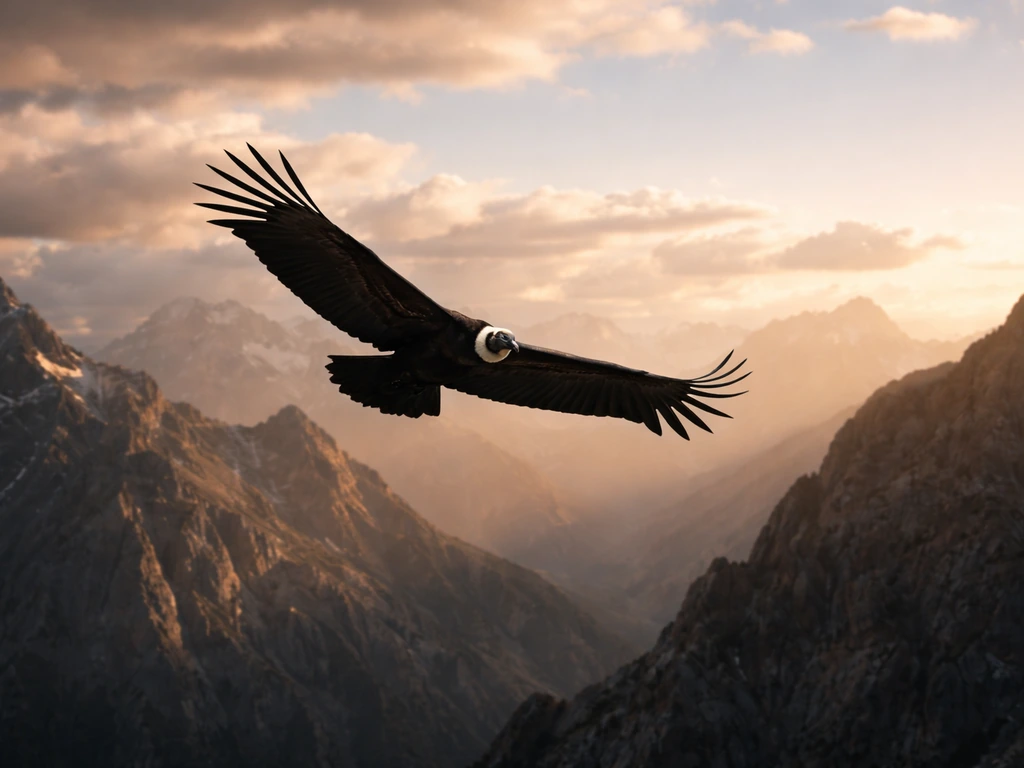
There is also occasional confusion between the osprey and similar-looking birds at a glance. Juvenile bald eagles can fool beginners because they are large, brown, and often found near water. But the M-wing shape, the dark eye stripe, and the hunting behavior (hovering and plunging vs. soaring and snatching) separate them cleanly once you know what to watch for. Similar classification questions come up with other large birds like condors and buzzards, where the 'bird of prey' label is also accurate but the specific taxonomy differs. Condors are also large birds that are sometimes discussed under the bird of prey label, but their specific classification differs from ospreys. For example, a buzzard is also considered a bird of prey because it is a raptor that hunts using hooked beaks and talons.
How to confirm this yourself and keep learning
If you want to verify the osprey's classification firsthand, the most satisfying way is to watch one hunt. Find a lake, river, estuary, or coastal area within osprey range, look for the bird hovering high above the water, and watch for the feet-first plunge. That behavior, combined with the M-wing silhouette and the white-and-brown plumage, is a high-confidence identification. No other common large bird does all of that.
For taxonomy verification, Cornell Lab's All About Birds and the U.S. Fish and Wildlife Service both list the osprey as Pandion haliaetus in family Pandionidae, order Accipitriformes. That order placement alongside hawks and eagles is the formal confirmation of its raptor status.
For field identification support, the Merlin Bird ID app (from Cornell Lab) is the most practical tool available right now. Set your location, enter the date, and describe what you saw. Merlin's 'probable birds' feature filters species by what is actually expected in your area and season, which significantly reduces misidentification. eBird's range maps for the osprey are also useful for checking whether you are in a location and time of year where ospreys are expected before committing to an ID.
The osprey is one of the most widely distributed raptors on the planet, found on every continent except Antarctica. If you are near water and you see a large bird with an M-wing silhouette hovering and diving feet-first, you are almost certainly looking at one. And yes, it is absolutely a bird of prey.
FAQ
If an osprey is a bird of prey, is it also a “raptor” in the same way as hawks and eagles?
Yes. In practical birding usage, osprey are treated as raptors because they hunt actively, use strong grasping feet with talons, and have raptor-style body equipment (hooked beak, sharp vision). The main difference is that ospreys sit in their own distinct family, Pandionidae, rather than in the same family as most hawks and eagles.
Can I count an osprey as a bird of prey if it’s just perched and not hunting?
Yes, you can still identify it as a bird of prey by physical traits and body design, not only behavior. Look for the hooked, dark beak, pale underparts, and especially the consistent wing pattern and silhouette. Perching alone does not prove “hunting status,” but it does not remove raptor identity either.
How can I tell an osprey from a heron when both are near water and eating fish?
Focus on equipment and movement. Ospreys have talons and a hooked beak, and they usually pause above the water before diving feet-first. Herons more often stand or wade, strike downward with a straight beak, and do not show the osprey’s distinctive M-shaped wing silhouette from below.
Do juvenile ospreys look different enough to confuse them with other birds of prey?
They can. Juvenile ospreys are often browner and less crisp-looking than adults, which can make them harder to separate at a glance. The most reliable approach is to confirm the wing silhouette (the kinked “M” look) and the hunting plunge, not just plumage color.
If a bird eats fish, does that automatically mean it is a bird of prey?
No. Fish-based diet is common across many bird types, like herons, kingfishers, and penguins, but most of them lack the raptor toolkit (notably grasping talons and a hooked beak used for tearing). For classification, use a combination of lineage and physical predation adaptations, not diet alone.
What’s the fastest field-check to confirm an osprey when it’s far away?
Use the “from-below” wing check. When soaring or gliding overhead, ospreys tend to show long wings with a slight bow or wrist kink that reads like an “M.” Then add a second confirmation with white underparts and the hovering to feet-first plunge pattern if you get the chance.
Are ospreys nocturnal like some other birds of prey?
Ospreys are primarily diurnal, they hunt during daylight. If you see a bird of prey hunting at night, it is more likely to be an owl or another night-active raptor, and that affects how you interpret “bird of prey” behavior.
How accurate are bird ID apps for ospreys, and what’s a common mistake when using them?
They’re usually reliable for ospreys because the species is expected near water in many regions, and the app filters by date and location. The most common mistake is relying on the first suggested option without checking the key field marks, especially the M-wing silhouette and fishing dive behavior.
Do ospreys ever hunt in ways that could make them seem less like a raptor?
Occasionally you might catch them carrying prey, eating on a perch, or hovering briefly without committing to a dive. That can make them seem “passive,” but the defining trait is still the raptor design and active capture method they use when hunting, particularly the feet-first plunge and talon grasp.
Next Article
Is a Condor a Bird of Prey? Answer and Key Differences
Yes, but only loosely: condors are New World vultures that mainly scavenge, not true predatory raptors.