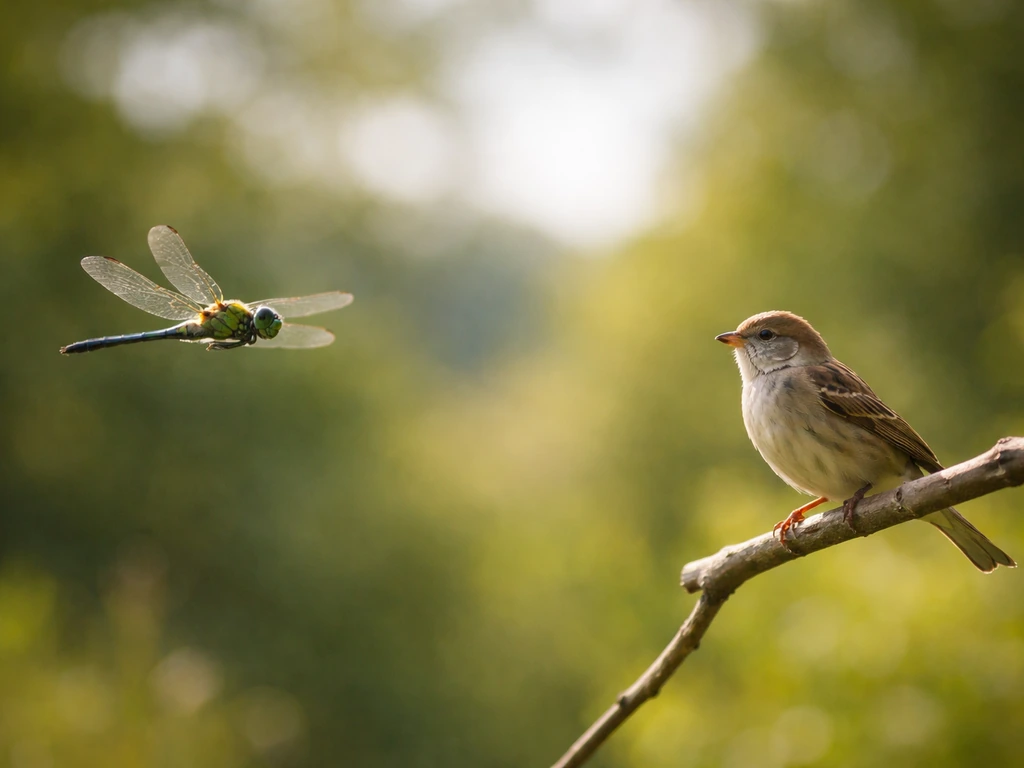
Yes, vultures are birds of prey. Under the broad definition used by most wildlife agencies, conservation organizations, and educational institutions, vultures sit firmly in the birds-of-prey category alongside hawks, eagles, falcons, and owls. The catch is that "bird of prey" is not a strict taxonomic rank the way "family" or "order" is. It is an ecological and functional label, and depending on how tightly you define it, vultures can look like borderline cases. But in practice, every major conservation body from the U.S. Fish and Wildlife Service to the IUCN includes vultures when they talk about raptors and birds of prey.
Is Vulture a Bird of Prey? Taxonomy and Key Traits Explained

Marcus Hendricks
23 Apr 2026
What "bird of prey" actually means
Here is the part that trips people up: "bird of prey" and "raptor" are popular and ecological terms, not formal taxonomic categories. There is no single scientific order called Raptors that neatly wraps up every hawk, eagle, falcon, owl, and vulture. Researchers have debated the definition for decades, and a peer-reviewed commentary in the Journal of Raptor Research pointed out explicitly that no single standard definition for "raptor" or "bird of prey" existed in the scientific literature.
In common usage, a bird of prey is a carnivorous bird that kills and eats other animals, using a hooked beak and sharp talons as its primary tools. The University of Minnesota Raptor Center defines raptors straightforwardly as carnivorous, meat-eating birds. Dictionary.com's popular definition frames it as a bird that "hunts and kills other creatures for food," which is exactly where vultures start to look like outsiders, since they mostly eat animals that are already dead. But a stricter evolutionary definition, discussed by ornithologists like Kenn Kaufman at Audubon, frames raptors as species within lineages that evolved from a raptorial landbird ancestor and largely retained that lifestyle. Under that framing, vultures belong.
Some researchers have proposed using "raptorial feet" as the single defining trait. Others draw the line at hunting behavior. The result is that groups like owls and vultures end up included or excluded depending on who you ask. The Peregrine Fund, one of the leading raptor conservation organizations in the world, acknowledged this directly: hawks, eagles, and falcons are universally agreed to be birds of prey, while owls and vultures are the contested cases. In practice, almost all wildlife curricula and conservation frameworks resolve that contest by including both.
So are vultures birds of prey? Yes, and here is why
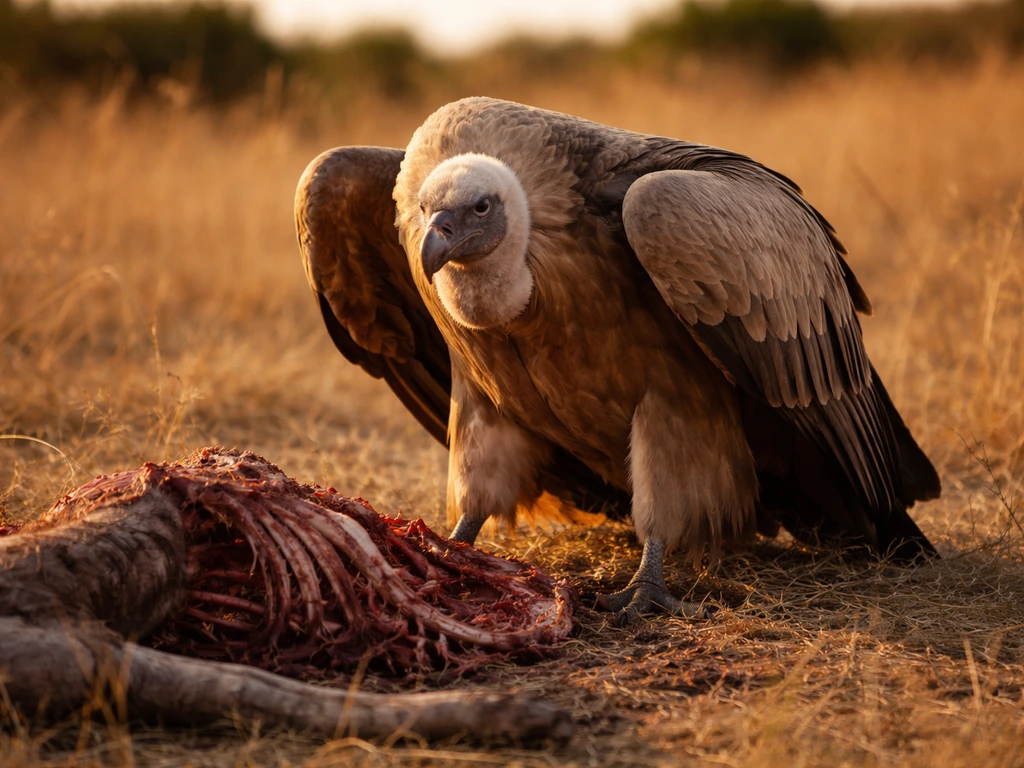
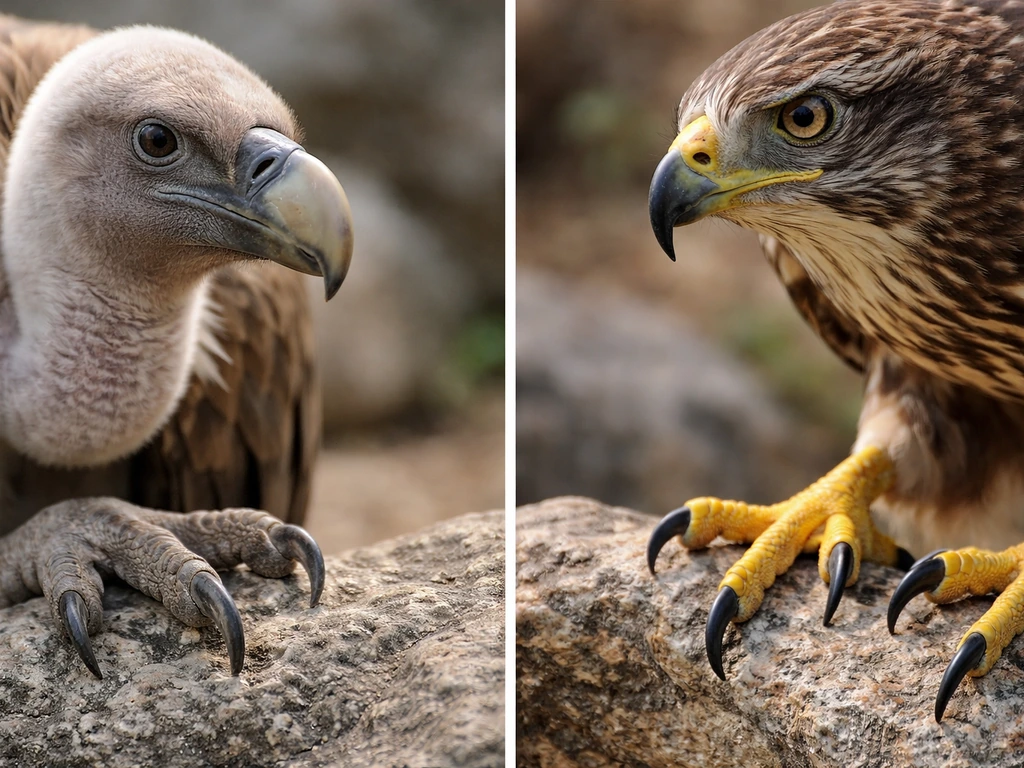
Vultures check enough of the right boxes to count. They have hooked beaks adapted for tearing meat, they are fully carnivorous, they share evolutionary ancestry with raptorial bird lineages, and every major practical reference from the U.S. FWS lesson plans to IUCN conservation documents explicitly lists them as "scavenging birds of prey." Britannica's entry on birds of prey includes vultures while noting one key difference: in non-predatory vultures, the talons are present but atrophied compared to hunters like eagles and hawks. That weakened talon is actually a useful clue to their lifestyle, not a reason to kick them out of the category entirely.
The honest answer is that vultures are birds of prey by the broad definition, and borderline by the strictest behavioral definition. If you are asking can you own a bird of prey, the same “raptor” rules and permits that apply to hawks and eagles may come up depending on your location and the specific species involved. For everyday purposes, treating them as birds of prey is correct, well-supported, and consistent with how conservation science talks about them.
How vultures are built for scavenging
Vultures are not just opportunistic scavengers who stumbled into eating carrion. They are highly specialized for it in ways that are genuinely remarkable. Understanding these adaptations helps explain both why they count as birds of prey and why they differ from hunting raptors.
Bare head and neck
Many vultures that feed on large carcasses have featherless or sparsely feathered heads and necks. The is a tawny frogmouth a bird of prey question does not fit the usual birds-of-prey definition, since frogmouths are not raptors and typically do not hunt and kill other animals like hawks or eagles. A 2025 Journal of Ornithology paper confirmed what biologists have long suspected: bare skin on the head and neck prevents feathers from becoming soiled and matted with blood and tissue when a vulture plunges its head deep into a carcass. It is a purely functional adaptation to their feeding method, and it is one of the easiest field identification traits to spot.
Extreme digestive chemistry
Vultures can eat meat that would kill most other animals. Their gizzard pH is reported to be just slightly above zero, roughly comparable to battery acid, according to the San Diego Zoo Wildlife Alliance. That extreme acidity destroys most of the dangerous bacteria and pathogens present in rotting flesh. Research published in Nature Communications also showed that the facial skin and hindgut of New World vultures like the turkey vulture (Cathartes aura) and black vulture (Coragyps atratus) host a specialized microbiome that further helps them tolerate the toxic microbial load of carrion.
Beak shape and weakened talons
Vultures have the short, strongly hooked beak that is characteristic of birds of prey, designed for tearing and pulling meat from bone. What they lack, compared to eagles or hawks, are powerful grasping talons. Since they do not need to seize and subdue live prey, the selective pressure that drives talon strength in hunting raptors simply was not there, and the talons in non-predatory vultures have become significantly reduced over evolutionary time.
Wing design for soaring
Vultures have broad, long wings built for sustained thermal soaring rather than the high-speed stoops or agile woodland pursuits of falcons and accipiters. Soaring efficiently over large areas is how they locate widely scattered carcasses. Turkey vultures in particular are also well-known for using their exceptional sense of smell to find carrion, which is unusual among birds.
Vultures vs true hunting raptors: the real difference
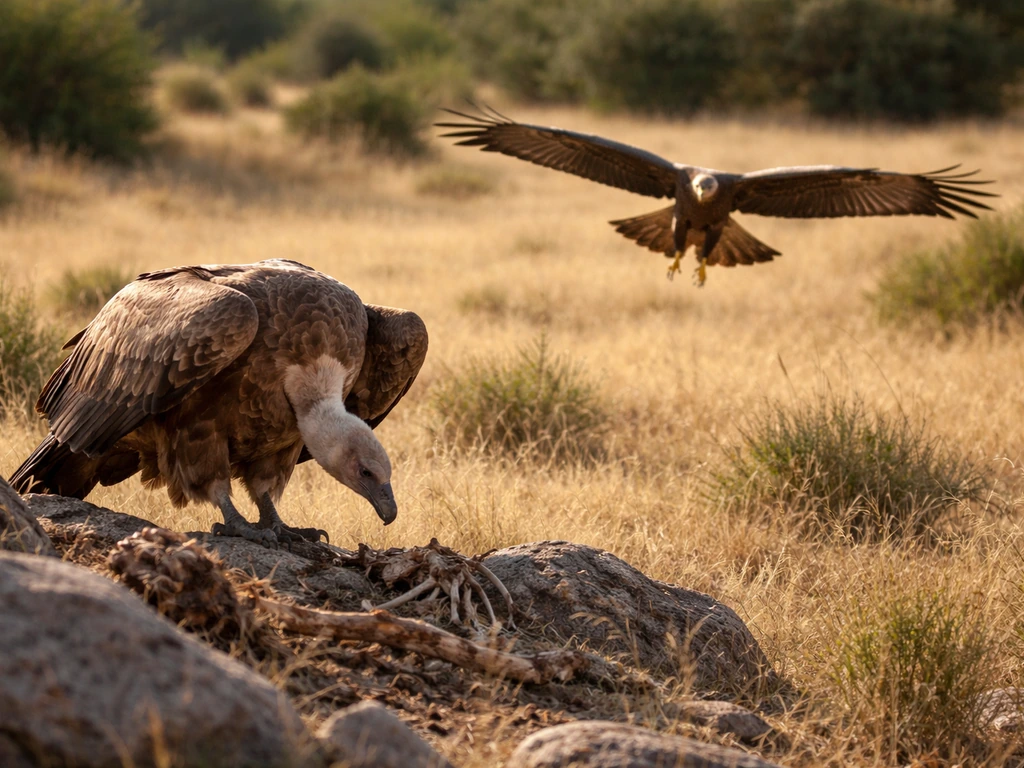
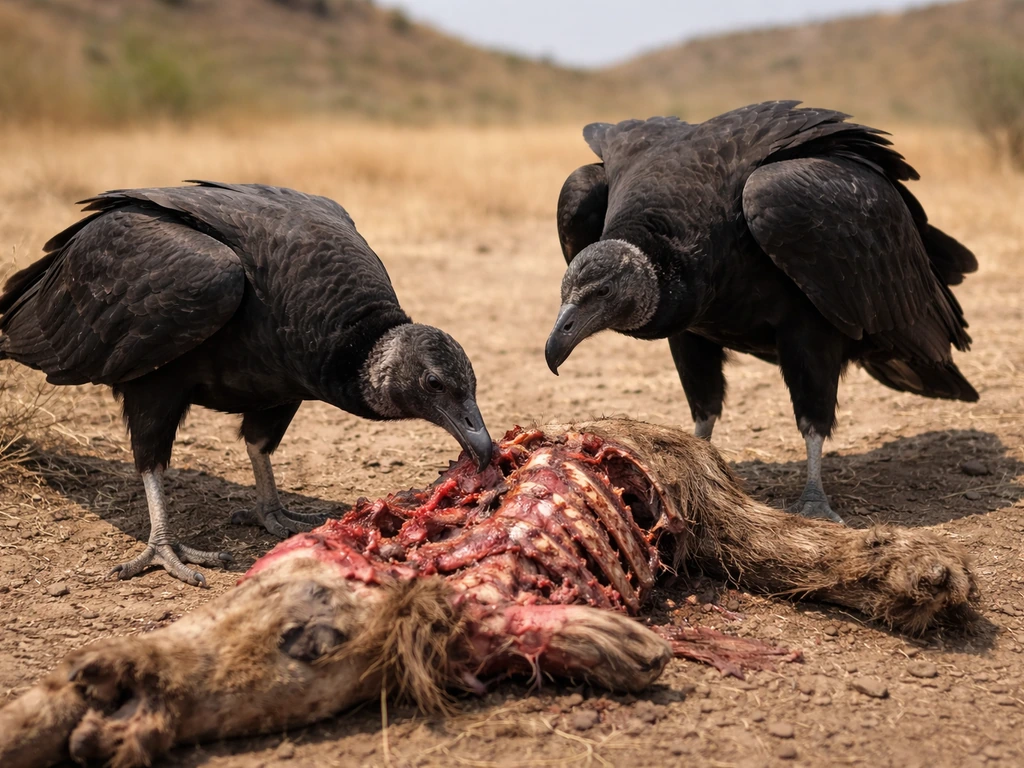
The practical distinction between vultures and hawks, eagles, or falcons comes down to how they acquire food. Hunting raptors actively locate, chase, capture, and kill live prey. Their powerful talons are their primary weapon, used to grip and kill. Their speed, eyesight, and agility are all tuned to predation. Vultures, by contrast, are scavengers first. The turkey vulture rarely if ever kills live prey. The lappet-faced vulture is an exception that occasionally attacks weak or young live animals, but even that species feeds primarily from carcasses.
It is worth noting that the line between hunter and scavenger is blurry even among "true raptors." Bald eagles and golden eagles regularly eat carrion. Many raptors are opportunists. The difference with vultures is that scavenging is not an occasional supplement to their diet but the entire strategy around which their anatomy and behavior evolved. The BC Ministry of Forests raptor conservation guidelines acknowledge this directly, noting that while raptors typically hunt and kill prey, some species regularly or mostly scavenge.
| Trait | Hunting Raptors (eagles, hawks, falcons) | Vultures |
|---|---|---|
| Primary food source | Live prey (actively hunted) | Carrion (dead animals) |
| Talons | Large, powerful, used to kill prey | Present but reduced/atrophied in non-predatory species |
| Beak | Hooked, for tearing | Hooked, for tearing (same basic shape) |
| Head feathering | Fully feathered | Bare or sparsely feathered (many species) |
| Digestive adaptations | Standard carnivore digestion | Extremely acidic stomach, specialized microbiome |
| Wing shape | Variable: broad to narrow/pointed | Broad, built for thermal soaring over large areas |
| Hunting behavior | Active pursuit, ambush, stooping | Passive: soar and locate, then feed |
| "Bird of prey" status | Universally agreed | Included by most definitions; contested by strictest behavioral criteria |
Where vultures sit in bird classification
This is where things get a little technical but genuinely interesting. Vultures are not a single unified group in the evolutionary tree. There are two distinct lineages that independently evolved the scavenging lifestyle, and they are not closely related to each other.
Old World vultures (found in Europe, Africa, and Asia) belong to the order Accipitriformes and the family Accipitridae. That puts them in the same family as eagles, hawks, and kites. They are true raptors by lineage, and their scavenging is a specialization within a predatory family. New World vultures (found in the Americas, including the turkey vulture, black vulture, and California condor) are classified in their own order, Cathartiformes, and family Cathartidae. Cornell Lab's taxonomy treats them as a separate family entirely, distinct from Accipitridae.
The two groups look similar because they evolved similar solutions to the same ecological problem, a phenomenon called convergent evolution. The same pressures that favor a hooked beak, broad wings, and a bald head for carrion-feeding produced those traits twice, in two unrelated bird lineages. Modern phylogenetic analyses place Cathartidae alongside other raptorial families as part of a broader assemblage, even though their order-level placement separates them from Old World vultures. This is part of why the question of whether vultures are "raptors" resists a simple yes or no: it depends on whether you are grouping by behavior, by anatomy, or by evolutionary lineage.
How to identify a vulture and tell it apart from other large raptors
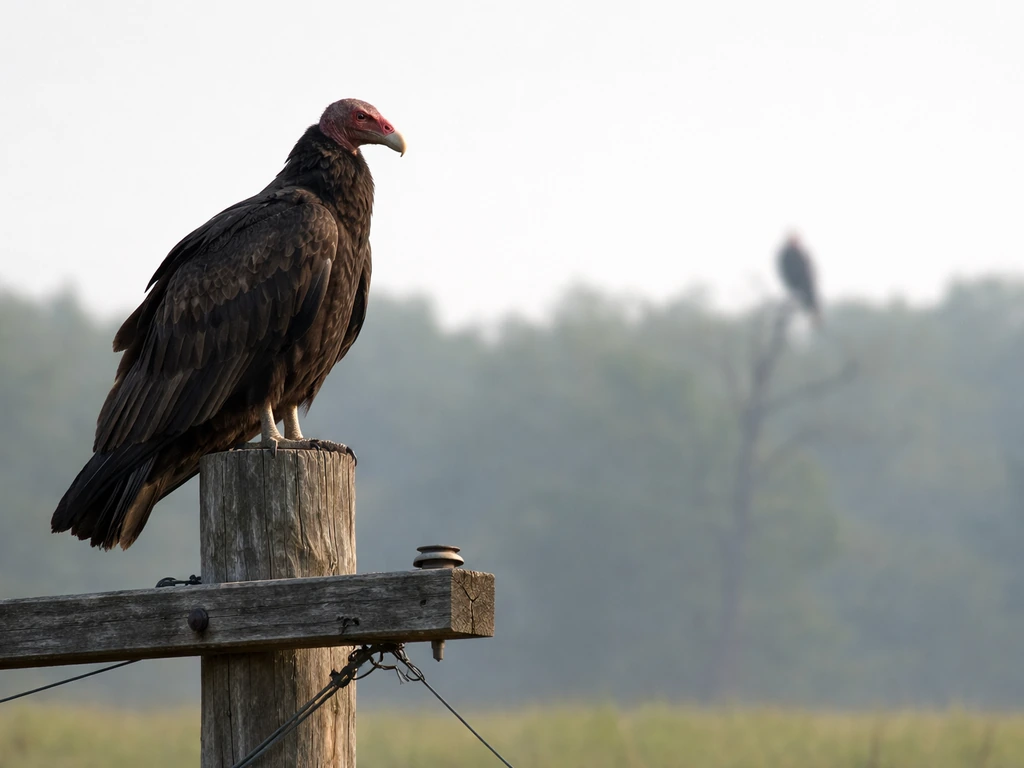
If you are trying to figure out whether the large dark bird overhead is a vulture or something else, here is a practical checklist. Vultures have a distinctive look in both perched and in-flight views, and once you know what to check, the confusion goes away quickly.
- Bare or very sparsely feathered head and neck: this is the single most distinctive vulture trait and almost always visible at reasonable range
- Short, strongly hooked beak: visible at close range; similar in shape to eagles and hawks but combined with the bald head is a reliable combo
- In flight: wings held in a shallow V shape (dihedral), rocking or tilting side to side while soaring, not the flat-winged glide of most eagles
- Large size with long, broad wings and a relatively small, naked-looking head
- Reduced or weak-looking feet: unlike eagles, whose feet look powerful, vulture feet are smaller and less imposing
- Behavior: circles high on thermals for extended periods, rarely flaps, descends when it locates food
Common lookalikes
The zone-tailed hawk is a fascinating case worth knowing. It mimics the appearance and flight style of the turkey vulture so closely that prey animals, which have learned to ignore vultures as harmless, do not react to the approaching hawk. This convergence means zone-tailed hawks can genuinely fool experienced birders in the field. The key difference is that zone-tailed hawks have a feathered head and a distinctly banded tail, and they occasionally flap with more purpose than a drifting vulture.
Eagles and ospreys are also sometimes confused with vultures at a distance, but their fully feathered heads, powerful feet, and more direct flight style usually separate them once you get a clear look. Ravens and large corvids can superficially resemble small vultures overhead, but the flight style, beak shape, and head profile are completely different.
If you are curious about related classification debates, the question of whether ravens count as birds of prey follows similar logic to the vulture discussion, and the secretary bird raises its own interesting questions as a raptor that hunts entirely on foot. You may also be wondering whether the secretary bird is an eagle, but it is really a distinct type of raptor with its own hunting style.
If you are also wondering is a vulture a bird, it helps to start from the same broad definition used in these classification debates ravens count as birds of prey. Swifts, by contrast, are an easy case too, because they are not birds of prey, so if you are wondering is a swift a bird of prey, they do not fit the raptor label ravens count as birds of prey.
Swifts, by contrast, are an easy case in the opposite direction: despite their aerial agility, they are not birds of prey at all.
The bottom line
Vultures are birds of prey. They are carnivorous, they have the hooked beak and general anatomy of raptors, and they are classified alongside raptors in virtually every conservation and educational framework that matters. The thing that separates them from hawks and eagles is not that they fail to qualify as birds of prey, but that they specialized in scavenging rather than active hunting, and their anatomy evolved to match that lifestyle.
Weakened talons, a bare head, and an almost indestructible digestive system are the signatures of that specialization. Understanding that distinction makes it much easier to navigate the online debates about what counts as a raptor: the label is broad enough to include vultures, and the science supports putting them in it.
FAQ
If vultures are birds of prey, do they still hunt like hawks and eagles?
In most real-world bird lists and raptor education materials, yes. The practical reason is that “bird of prey” is used as a functional umbrella for carnivorous or meat-eating raptors, so scavenging vultures are included even if they rarely, or never, kill live prey.
Do any vultures actually kill live prey, or are they always scavengers?
Mostly no. Turkey vultures and black vultures are typically non-predatory scavengers, meaning they obtain food from carcasses rather than pursuing and killing prey. A few exceptions exist among certain species, but predation is not their main feeding strategy.
If vultures have weaker talons, why are they still considered raptors?
They can, but “atrophied” does not mean “gone.” Vultures have reduced grasping ability compared with hunting raptors, and their feet are better suited for standing, walking, and holding pieces while feeding. That reduced talon strength is a clue to their scavenging lifestyle.
What are the fastest ways to tell a vulture from an eagle, hawk, or raven?
In field identification, look at behavior and head shape, not just body size. Vultures often show a bare or lightly feathered head while feeding, and they commonly use soaring over large areas to find carcasses. Hawks and eagles usually have fully feathered heads and show more direct, purposeful flight when hunting.
Is “raptor” the same as “bird of prey,” or is the wording flexible?
Yes. Even though many people say “raptor” and “bird of prey” as if they mean the same thing, they are not always identical labels. “Raptor” is often used for carnivorous birds with raptorial traits, while some stricter discussions reserve “raptor” for specific evolutionary lineages or hunting behavior.
Why do some sources disagree about whether vultures are “true raptors”?
It depends on what framework you are using. If you are matching the way wildlife agencies and conservation groups talk, vultures fit. If you are applying a strict evolutionary or behavioral definition, vultures can be considered borderline cases, especially when contrasting owls versus vulture feeding modes.
Are vultures only scavengers, or are they adapted to handle disease better than other birds?
Generally, no, not as a medical or moral question, but as an identification one. The digestive system is specialized for carrion pathogens, so vultures are not “just” dirty eaters, and they are adapted to avoid most issues that would harm other birds. This specialization is part of why their anatomy supports the bird-of-prey label.
If someone wants to own a vulture, do the same “bird of prey” rules always apply?
For ownership, the relevant question is usually species-level and jurisdiction-level, not just the label “bird of prey.” Some places regulate raptor species under wildlife or falconry rules, while others treat vultures differently, so you would need to check local permits, enclosure rules, and legality for the exact species.
Are all vultures closely related, or are there different “types” of vultures?
Yes, and it is because taxonomy and behavior do not always align neatly with the common label. Old World and New World vultures evolved similar scavenging adaptations independently (convergent evolution), so the answer can shift depending on whether you are grouping by lineage or by feeding niche.
Next Article
Is a Dragonfly a Bird? How to Tell the Difference
Dragonflies are insects, not birds. Learn key bird traits vs dragonfly anatomy to tell them apart fast.