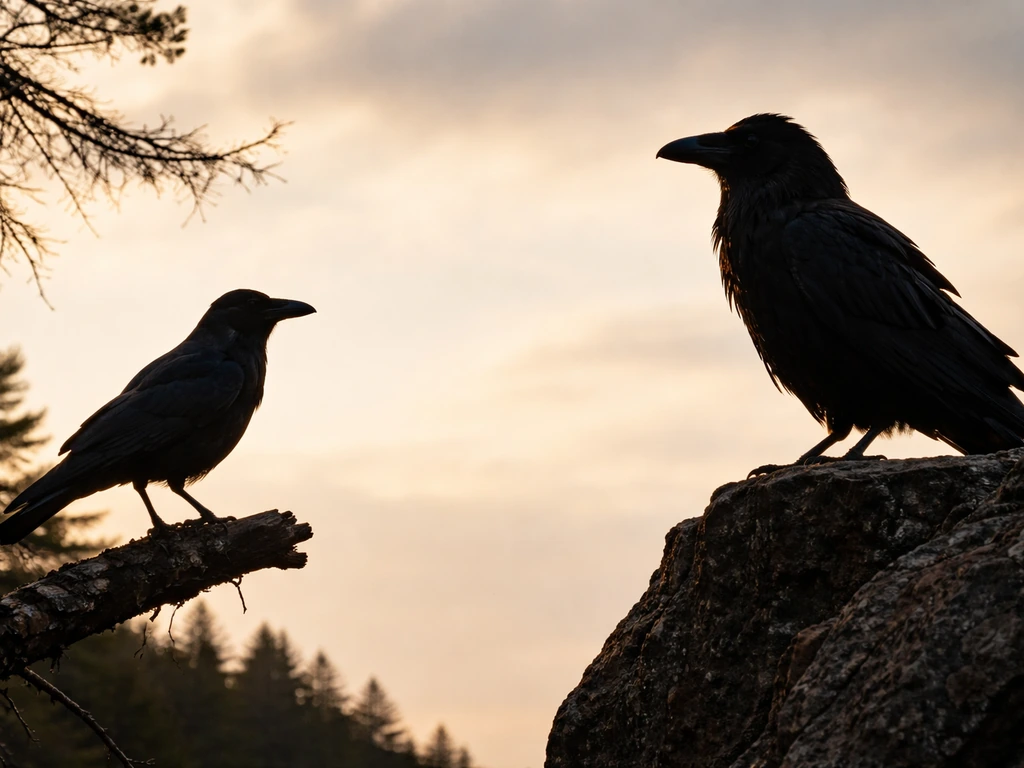
If you are still asking yourself whether a crow even qualifies as a bird in the first place, the short answer is yes, absolutely. Both crows and ravens are birds in every biological sense. The question here is just whether they are the same bird, and they are not.
Why people think they're the same bird
The confusion makes sense when you list what crows and ravens have in common. Both are entirely black, glossy birds with stout bills. Both are famously intelligent, highly adaptable, and often live near humans. Both eat a wide range of food including carrion, and both have a reputation in folklore for being dark, mysterious, and clever. If you have only ever glimpsed a big black bird at the side of the road, you could reasonably wonder if there is really any difference at all.
The overlap in behavior adds to the confusion. Both are scavenging birds that exploit human food waste, roadkill, and agricultural scraps. Both cache food, mob predators, and use tools in experimental conditions. Ravens eat carrion along with a wide range of animal and plant foods, just like crows. So to a casual observer, their habits look nearly identical too.
The real culprit is that most people encounter one or the other but rarely both in the same place at the same time. Without a side-by-side comparison, the size difference is hard to register. Once you see them together, or once you know the specific things to look for, the confusion fades quickly.
How to tell a crow from a raven: size, tail, bill, and flight
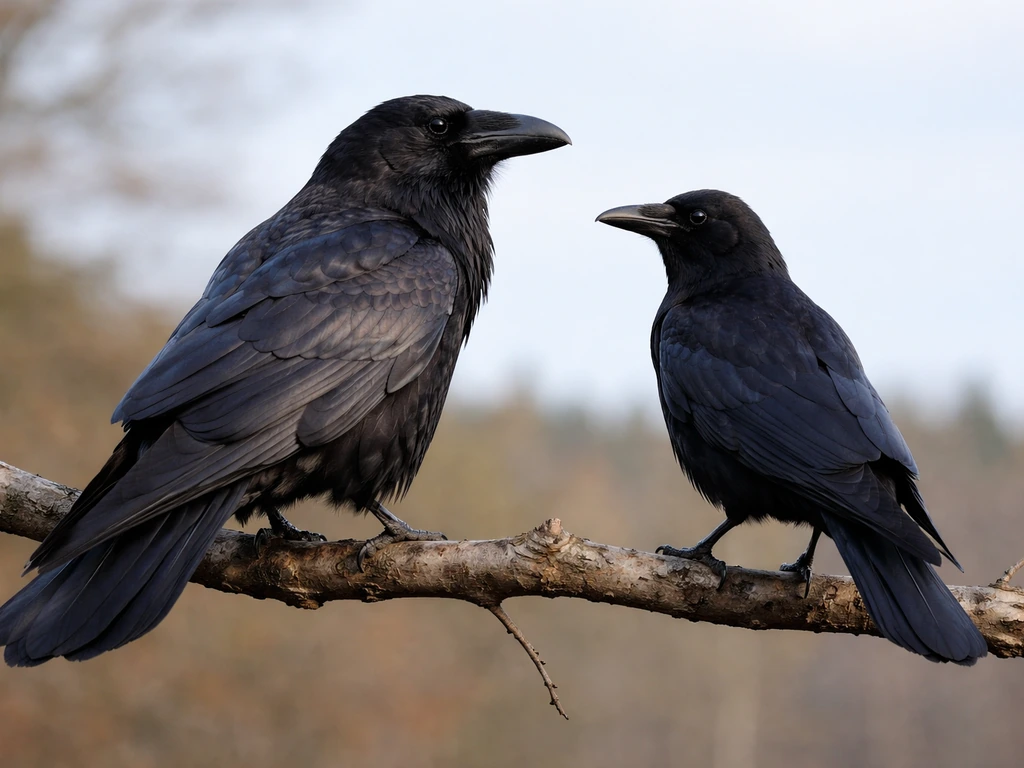
Size is your first and most reliable clue. An American Crow is typically around 17 to 21 inches long. A Common Raven runs 22 to 27 inches, and Cornell Lab describes the crow as roughly two-thirds the size of a raven. That is a meaningful difference. A raven looks chunky and almost hawk-sized next to a crow. If you see a big black bird and your first thought is "that thing is huge," you are probably looking at a raven.
The tail is the next best clue, and it works especially well when the bird is in flight or spreading its tail. A crow's tail feathers are roughly the same length, so the tail fans out in a rounded shape, like a hand of playing cards spread evenly. A raven's tail is wedge-shaped or diamond-shaped because the central feathers are longer than the outer ones. When a raven fans its tail, you see a clear point at the bottom rather than a flat edge. This is one of the most reliable field marks you can use at a distance.
The bill is another strong indicator. A crow's bill is proportional to its head, moderate in size, and often looks slightly smaller than the head itself. A raven's bill is large, thick, and frequently looks longer than the head when seen in profile. Ravens also have a distinctive curve to the upper mandible. If the bill looks almost comically large and heavy for the bird's face, that is a raven.
Flight style rounds out the picture. Ravens have longer, narrower wings with longer, more pronounced "fingers" at the wingtips. More importantly, ravens glide and soar regularly, sometimes for extended periods. Crows flap more steadily and spend less time gliding. If you see a big black bird riding thermals or soaring effortlessly on an updraft, it is almost certainly a raven.
| Feature | American Crow | Common Raven |
|---|
| Length | ~17–21 inches | ~22–27 inches |
| Relative size | About two-thirds the size of a raven | About half again larger than a crow |
| Tail shape | Rounded, fan-like when spread | Wedge or diamond shape in flight |
| Bill | Moderate, often smaller than head | Large, thick, often longer than head |
| Wings | Rounded, shorter fingers at tips | Longer, narrower with pronounced wingtip fingers |
| Flight style | Steady flapping, less soaring | Frequent gliding and soaring |
Sound and behavior differences
The "caw vs croak" shorthand is a useful starting point, but it is incomplete. Crows give the familiar sharp, repetitive "caw" call that most people recognize. Ravens produce a much deeper, gurgling croak that rises in pitch, and scientists have categorized raven vocalizations into as many as 33 distinct call types. So while a crow sounds like it is barking at you, a raven sounds more like it is rolling something around in its throat. The NPS describes the most familiar raven call as a deep, resonant croak, and notes that raven calls are frequently misidentified precisely because they vary so much.
Behaviorally, ravens tend to be less urbanized than crows. Common Ravens nest on cliff ledges, high in tall trees (especially conifers), and occasionally on human structures like power-line towers and bridges. Crows are far more likely to nest in suburban neighborhoods, parks, and city trees. If you are hearing a big black bird calling from your backyard in a mid-sized American city, it is almost certainly a crow. Ravens are more common in wild, rugged, or forested landscapes, though their range does overlap with crows in many areas.
Ravens also tend to travel in mated pairs or small family groups rather than the large communal flocks that crows form. If you see fifty black birds mobbing a hawk or roosting in a parking lot together, those are crows. If you see two large black birds cruising a canyon rim, those are almost certainly ravens.
What "same bird" actually means taxonomically
When people ask if crows and ravens are "the same bird," they usually mean one of two things: are they the same species, or are they at least the same kind of thing? The answer to the first question is no. The American Ornithological Society's checklist treats Corvus brachyrhynchos and Corvus corax as distinct species, and the U.S. Fish and Wildlife Service lists them separately as well. Different species means they do not interbreed under normal conditions and follow separate evolutionary paths.
The answer to the second question is closer to yes. Both belong to the family Corvidae and the genus Corvus, which means they share a common ancestor and are more closely related to each other than either is to, say, a blue jay or a magpie (which are also corvids). Think of it like asking if a wolf and a coyote are "the same animal." They are not the same species, but they are clearly closely related and share a lot of traits. Whether a raven is just a type of crow is a question worth exploring in full, but the quick version is: no, they are separate species within the same genus, not one species with two names.
This distinction matters practically because crows are protected under specific federal regulations and ravens carry their own protected status as well. They are legally and biologically separate birds, not interchangeable names for the same animal.
Look-alikes, juveniles, and regional complications
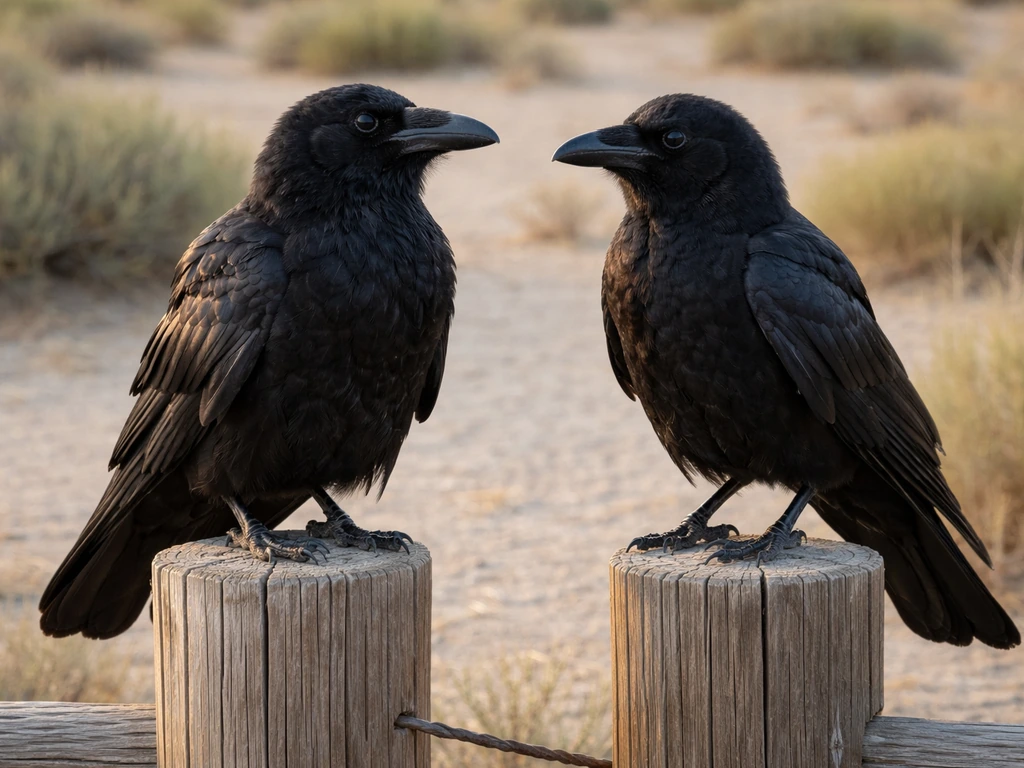
A few situations make identification genuinely harder. Juvenile ravens are smaller than adults and can overlap in size with large crows, which trips up a lot of birders. The tail shape and bill proportions still apply, but you have to look more carefully because the size difference is less dramatic. If you are not sure, lean on the tail shape and bill as your primary checks.
In the southwestern United States, the Chihuahuan Raven (Corvus cryptoleucus) is a smaller raven species that overlaps in size with large crows, and it muddies the waters further. It is still a raven, not a crow, but it is noticeably smaller than the Common Raven. That is not the only bird in the corvid family that can cause confusion either. If you have ever encountered a bird you could not immediately place, you might also have wondered about other less-familiar corvid relatives, the way some people ask whether a scraper qualifies as a bird when they run into an unfamiliar term.
Regional range also matters. In much of the eastern United States, if you see a large black bird, it is almost certainly an American Crow, because Common Ravens are much less common there outside of mountainous areas. In Alaska, western Canada, and the Rocky Mountain West, ravens are abundant and crows may be the less common sighting. Knowing your geographic location narrows the field significantly before you even check the tail shape.
One more thing worth knowing: crows themselves come in several species in North America, including the Fish Crow (Corvus ossifragus) and the Northwestern Crow (Corvus caurinus, though now often lumped with the American Crow). Fish Crows are slightly smaller than American Crows and have a distinctly nasal call that sounds more like a high "uh-uh" than a clean caw. Understanding that a crow is a bird with real taxonomic complexity helps explain why identification is not always as simple as "big black bird equals raven, smaller black bird equals crow."
How to confirm your ID right now
If you are standing outside with a bird in front of you, or reviewing a photo or recording, here is the order of checks to run through:
- Size: Does the bird look noticeably large, almost hawk-sized? Lean toward raven. Pigeon-sized or a bit bigger? Lean toward crow.
- Tail shape: Watch when it spreads its tail or fans it in flight. Flat, rounded fan equals crow. Wedge or diamond shape equals raven.
- Bill: Is the bill roughly proportional to the head, or does it look oversized and curved? Oversized points to raven.
- Flight: Is the bird gliding and soaring for extended periods, or flapping steadily? Soaring is a strong raven indicator.
- Sound: Does the call sound like a sharp repetitive caw, or a deep, rolling croak? Croak means raven.
- Location and habitat: Are you in a city park, suburb, or farmland? Crow is far more likely. Remote mountains, cliffs, or wild forest? Raven moves up in probability.
For audio confirmation, the Merlin Bird ID app from the Cornell Lab of Ornithology is a solid tool. It can identify birds from a live recording or a photo. That said, Merlin itself recommends comparing your recording against its reference recordings to confirm what you heard, rather than accepting the app's label without a second look. It is a starting point, not the final word.
If you want to go further, eBird is worth checking. It uses automated data filters and human expert reviewers to flag unusual sightings, so you can look at recent local reports and see what species have actually been confirmed near you. If Common Ravens have not been reported within 100 miles of your location in the past month, the big black bird in your yard is almost certainly a crow. Local field guides keyed to your region are also invaluable for sorting out which corvids actually occur where you live.
The bottom line: crows and ravens are closely related, superficially similar, and genuinely easy to confuse at a glance. But they are not the same bird. They are separate species with different sizes, different tail and bill shapes, different flight styles, different calls, and different habitat preferences. With a little practice, you will find that telling them apart in the field becomes second nature within a season.